
small patio
By Anna Grace | 19 June 2026
The Small Patio Glow-Up Guide: Furniture, Lighting, and Layout Tricks That Fit
You measured your patio twice because you couldn’t believe the number the first time. Ten feet by eight feet doesn’t sound like much when you’re picturing dinner parties and lounge chairs and maybe a little herb garden in the corner. But here’s the thing nobody tells you: small patios often end up more charming than sprawling ones, because every inch has to earn its place. There’s no room for that awkward unused corner or the patio furniture set that’s technically there but nobody ever sits in.
I turned a patio barely bigger than a parking space into the spot where my neighbors “just happen” to stop by every evening. It wasn’t magic. It was a handful of smart choices about furniture, plants, lighting, and layout that I’m about to hand you on a silver platter (or a small side table, given the theme).
Whether you’re working with a condo balcony, a townhouse slab, or a tiny backyard patch, this guide covers the practical stuff that actually moves the needle. No fluff, no Pinterest fantasy shots that require a budget the size of a small country’s GDP.
Measure First, Dream Second
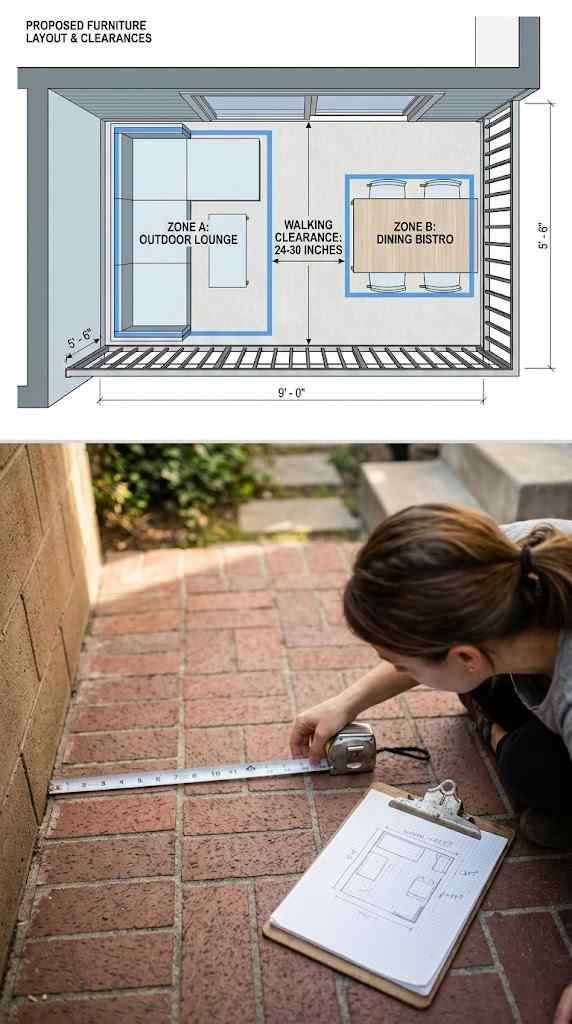
Before you buy a single chair, grab a tape measure and get real numbers. Small patio design fails most often because people buy furniture that looks perfect online and then physically doesn’t fit through the door, let alone the space itself.
Here’s a simple rule: leave at least 24 to 30 inches of walking clearance around any furniture piece. That’s enough room to walk without doing an awkward side-shuffle every time you want a refill. Sketch your patio dimensions on paper (yes, actual paper works fine) and mark where the door swings open, where downspouts sit, and where the sun hits hardest in the afternoon.
Knowing your exact square footage and traffic flow before shopping saves you from returns, regret, and a lot of Tetris-style furniture rearranging.
A few things worth noting during this step:
- Check if your patio has any structural quirks, like an uneven surface or a slight slope for drainage
- Note where electrical outlets are, since string lights and small appliances need power
- Look at sun exposure at different times of day, especially if you want shade later
It also helps to test your layout with painter’s tape before you commit to anything. Mark out where a table or lounge chair would sit directly on the patio floor, then live with it for a day or two. Walk through your usual routine, morning coffee, evening wind-down, and see if the taped-off zones actually make sense once you’re moving through them in real life. This sounds excessive until you realize how many “perfect” furniture arrangements fall apart the moment someone tries to open a cooler or reach past a plant. Cheap masking tape saves you from expensive furniture mistakes, and that trade-off is always worth it.
I skipped this step my first year and bought a bistro table that was technically two inches too wide for the space between my railing and my sliding door. Two inches. It lived in my garage for six months before I sold it. Lesson learned, tape measure purchased.
Choose Furniture That Multitasks
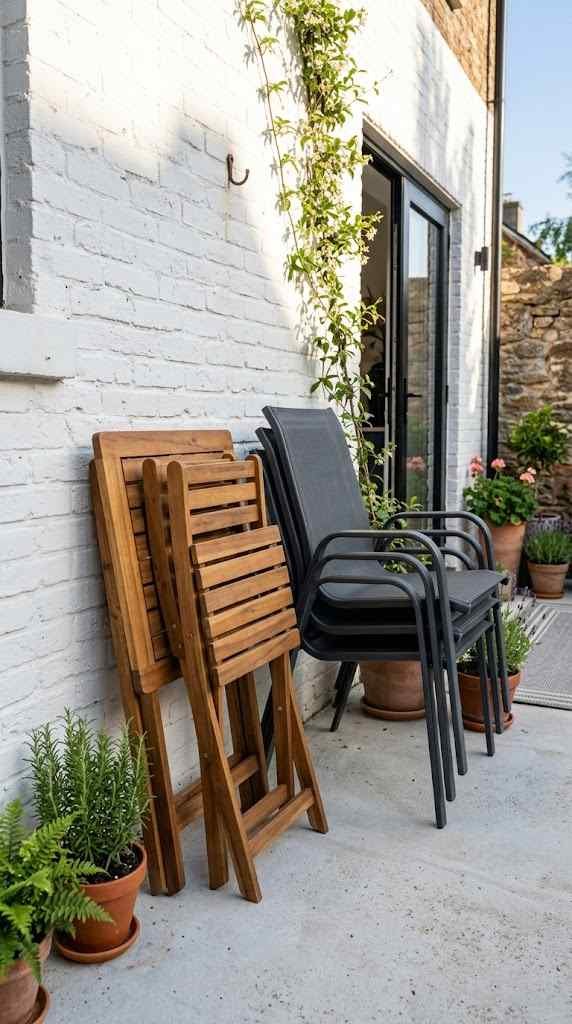
Small patio furniture needs to work harder than furniture in a big backyard. Every piece should either fold, stack, nest, or serve more than one purpose. Otherwise you’re just cluttering a space that was already tight to begin with.
Foldable bistro sets are the classic choice for a reason. They give you a table and two chairs that disappear against a wall when you’re not using them. If you host more than two people occasionally, look at stacking chairs instead of a fixed set, since you can pull extras out only when needed and tuck them away the rest of the time.
Ottomans with hidden storage are another sneaky-good option. They double as extra seating, footrests, or a spot to set drinks, and the storage compartment hides cushions, gardening tools, or that one string of lights you can never find. IMO, this is one of the most underrated furniture upgrades for tight outdoor spaces.
Consider these space-saving furniture categories:
- Foldable or stackable chairs – easy to store, easy to pull out for guests
- Drop-leaf or extendable tables – small footprint daily, bigger when company comes
- Wall-mounted or railing-hung furniture – shelves and planters that don’t touch the floor
- Multi-use ottomans or benches – seating plus storage in one piece
- Vertical bar carts – narrow footprint, lots of storage, easy to roll aside
Material choice matters just as much as size when space is tight. Lightweight materials like aluminum or resin wicker let you rearrange furniture on a whim, which matters more on a small patio where the “layout” might change depending on whether you’re hosting two people or six. Heavy wrought iron looks gorgeous, sure, but good luck dragging it around every time you need a different configuration. I eventually swapped my heavy metal chairs for lightweight resin ones, and it completely changed how often I actually rearranged the space for different occasions. Ask yourself before buying: will I actually move this piece, or will it become a permanent fixture I regret?
Skip anything oversized just because it looked cozy in a photo. A sectional sofa on an eight-by-ten patio isn’t cozy, it’s a hostage situation for anyone trying to reach the grill.
Go Vertical When Horizontal Runs Out
Once the floor space is spoken for, the walls and railings become your best real estate. Vertical gardening and vertical storage are the two moves that make a small patio feel like it has more square footage than it actually does.
Hanging planters, tiered plant stands, and railing boxes let you grow herbs, flowers, or small vegetables without eating into your walking space. A simple trellis against a wall can support climbing plants like jasmine or clematis, adding privacy and greenery at eye level instead of ground level. Command hooks and adhesive rails also work great for hanging string lights, small mirrors, or lanterns without drilling into rented property.
Why does vertical space matter so much? Because your eye naturally travels upward in a small area, and a patio that has visual interest at multiple heights reads as fuller and more intentional, not cramped. A flat, empty wall next to a cluttered floor makes a small space feel smaller, not bigger.
Mirrors deserve a special mention here. Hanging an outdoor-rated mirror on a patio wall bounces light around and creates the illusion of depth. It sounds like a decorating trick from a home makeover show, but it genuinely works, especially on patios that get shaded for most of the day.
A few vertical additions worth trying:
- Wall-mounted planter boxes for herbs like basil, mint, or rosemary
- A pegboard or slatted panel for hanging small tools, lights, or decor
- Tiered stands so you can group multiple small plants in one footprint
- Climbing vines on a trellis for a living privacy screen
Don’t overlook your ceiling either, if your patio has any kind of overhang, awning, or pergola. Hanging planters from an overhead structure adds greenery at a height nothing else on your patio occupies, which means zero competition with your floor space or wall space. A single hanging fern or trailing pothos can soften an otherwise boxy, hard-surfaced patio without taking up a single inch of usable footing. Just make sure whatever structure you’re hanging from can actually hold the weight, since a soaked hanging planter gets surprisingly heavy after a rainstorm.
Layer Your Lighting Like You Mean It
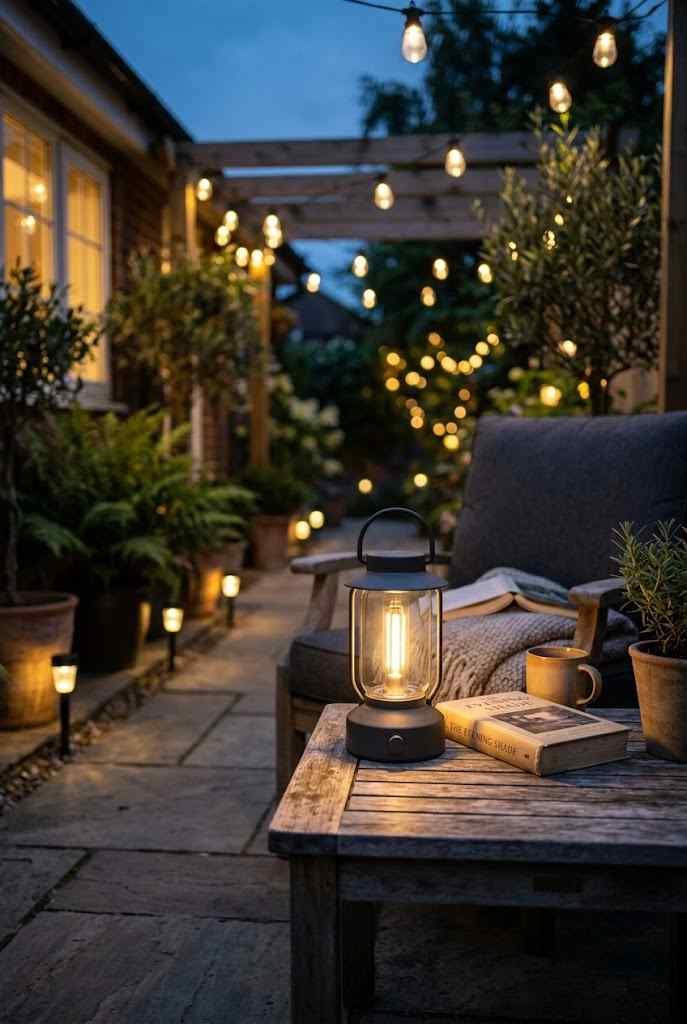
One overhead light or a single lamp isn’t going to cut it if you actually want to use your patio after sunset. Layered lighting, meaning a mix of ambient, task, and accent light sources, transforms a small patio from “fine during the day” to “where do I sign up to move in.”
String lights are the obvious starting point, and for good reason. They’re affordable, they wrap around railings or pergolas easily, and they instantly make a space feel warmer. Solar-powered options mean you don’t need an outdoor outlet, which is a lifesaver for renters or anyone without existing patio wiring.
Beyond string lights, add a few lower-level sources. Lanterns on the table, small solar stake lights along a planter edge, or a battery-powered puck light tucked under a bench all add depth without competing with each other. Task lighting matters too, especially if you’re cooking or reading out there. A clip-on lamp on the grill area or a small reading lamp near your favorite chair makes evenings genuinely usable instead of just atmospheric.
Rhetorical question time: how many patios have you seen that look gorgeous in daylight photos but turn into a black hole the second the sun sets? Too many. Don’t let yours be one of them.
Layered lighting with at least two or three different light sources at different heights is the single fastest upgrade for making a small patio feel finished.
Dimmable or warm-toned LED bulbs also help set the mood without blasting your neighbors with stadium-level brightness. Warm white (around 2700K to 3000K) tends to look more inviting outdoors than cool white, which can feel a bit clinical for a relaxing evening hangout.
Timing matters too, and this is where a lot of people overcomplicate things unnecessarily. A basic outdoor timer or smart plug lets your string lights turn on automatically at dusk, so you’re not fumbling for a switch every evening or, worse, forgetting to turn them on until you’re already annoyed about sitting in the dark. Motion-sensor lights near the entrance add a practical safety layer too, especially if your patio doubles as a walkway to a shed, gate, or trash bins. Small functional touches like these don’t scream for attention, but you’ll notice the difference the first time you don’t trip over a planter at night.
Use Color, Texture, and Rugs to Define Zones

Small patios often lack clear “zones,” which makes them feel like one undefined blob of outdoor space rather than a place with purpose. An outdoor rug is one of the cheapest, fastest ways to fix that. It visually separates a dining area from a lounge corner, even if both are only a few feet apart.
Stick to weather-resistant materials like polypropylene for rugs, since natural fiber rugs mildew fast outdoors, especially in humid climates. A rug in a bold pattern or a punchy color also adds personality without requiring a full furniture overhaul. Think of it as the accessory that pulls a small space together the way a good scarf pulls together an outfit.
Color choices for cushions, planters, and accessories matter more on a small patio than a big one, simply because there’s less visual real estate to distribute the impact. A cohesive color palette, maybe two or three main colors plus a neutral base, keeps things looking curated instead of like a clearance-rack grab bag. Mixing textures, like a woven planter next to a smooth ceramic pot next to a metal side table, adds interest without adding clutter.
If you want a patio that photographs well and feels good to sit in, texture is doing more work than most people realize. A cushion with a nubby weave, a rattan chair, and a sleek glass-top table together create contrast that makes a tiny space feel curated rather than sparse.
Small additions that create zones without eating up space:
- An outdoor rug under the seating area to anchor the layout
- A different cushion color or pattern for dining chairs versus lounge chairs
- A small planter cluster marking the “entrance” to your patio setup
- A shade sail or umbrella that visually caps one section of the space
Seasonal swaps also keep a small patio feeling fresh without requiring a full redesign every few months. Rotating a couple of cushion covers or swapping a summer-bright rug for something in deeper autumn tones costs very little but resets the whole mood of the space. It’s the outdoor equivalent of changing a throw blanket indoors, small, cheap, and disproportionately effective at making a space feel intentional year-round. Storage bins for off-season textiles keep this manageable too, so last year’s faded cushions don’t end up as this year’s eyesore.
FAQ’s
How much walking space should I leave on a small patio?
Leave 24 to 30 inches of clearance around furniture so movement stays comfortable and doesn’t feel cramped.
What furniture works best for a tiny patio space?
Choose foldable, stackable, or multi-use pieces like drop-leaf tables and storage ottomans to maximize function.
Can I still garden on a small patio?
Yes, use vertical options like railing planters, trellises, and tiered stands to grow herbs and flowers upward.
What lighting makes a small patio feel bigger at night?
Layer ambient, task, and accent lighting at different heights using string lights, lanterns, and warm-toned LED bulbs.
How do I make a small patio look less cluttered?
Use an outdoor rug and a cohesive color palette to define zones without adding extra furniture or decor.
CONCLUSION
A small patio isn’t a limitation, it’s a design challenge with a satisfying solution, and honestly, some of the coziest outdoor spaces I’ve ever sat in were smaller than a parking spot. Measure your space accurately, choose furniture that pulls double duty, take advantage of vertical real estate, layer your lighting instead of relying on one bulb, and use rugs and color to carve out distinct zones. None of these steps require a huge budget or a weekend demolition project.
Start with one or two changes if the whole list feels like a lot at once. Swap in a foldable table, add a string of solar lights, or throw down a rug, and see how much the space transforms before tackling the rest. Small patios reward small, thoughtful updates far more than big, expensive ones.