
Small Living Room Ideas
Small Living Room Ideas: How to Make Every Square Foot Count
By Anna Grace | 7 jan 2026
Your living room can feel cramped, or it can feel intentional. The difference isn’t square footage it’s strategy.
I lived in a 200-square-foot apartment once, and my living room barely fit a couch and a coffee table. But I learned something that changed everything: small spaces don’t need apologies; they need smart choices. This article breaks down exactly how to transform a tight living area into something that actually works and honestly, looks better than many bigger rooms I’ve seen.
Rethink What “Living Room” Actually Means
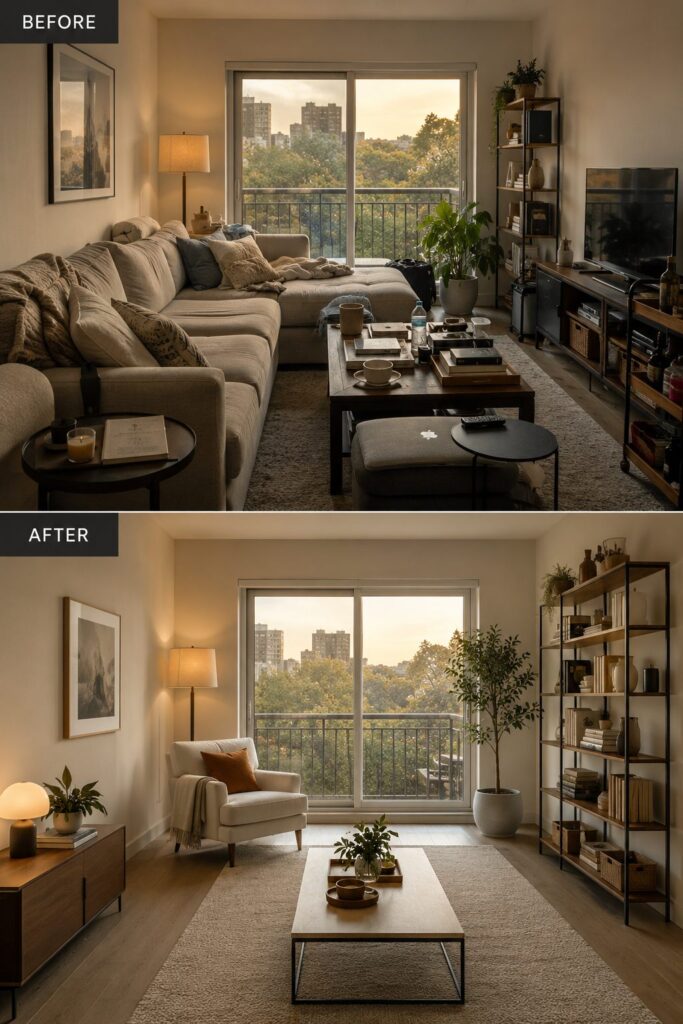
Here’s the thing nobody tells you about small living rooms: they’re only cramped if you try to make them do everything a normal living room does. Most people cram furniture into a tiny space and hope it works. It doesn’t.
Instead, get specific about what you actually use your living room for. Netflix binges? Video calls? Reading? Hosting people? Your answers change everything about how you’ll arrange it. I used to think I needed a traditional sectional taking up half the room because that’s what people did. When I ditched that expectation and added a single comfortable chair instead, suddenly the room breathed.
Figure out your actual priorities before buying anything. If you never have friends over, stop designing for entertaining. If you work from home and need a desk, integrate that from the start instead of squeezing it in later. The best small living room is one that serves your life, not an imaginary magazine version of your life
Define Your Living Room’s Purpose
Think about how you spend time in this space. Are you watching TV for three hours every evening? Do you host board game nights? Is it a transition space between your bedroom and kitchen, barely used? Is it where you do work calls?
Once you identify your primary activity, build around that. Someone who works from home needs a proper desk area even if it’s a narrow console table against one wall. Someone who mainly entertains needs comfortable seating that encourages conversation. Someone who reads needs good lighting and a quiet corner with a chair.
This purposeful approach eliminates the guilt of “not using your space properly.” Small living rooms excel when they’re designed specifically, not generically.
Skip the Sectional (Seriously)
Sectionals are designed for large rooms where you can sink into multiple sections and still feel cozy. In a small living room, a sectional is just a giant furniture anchor that eats your entire space and makes movement awkward. A single quality sofa, a loveseat, or even just two armchairs with a small table between them creates better flow and actually gives you room to move.
If you love the idea of lounging, a small sofa with one accent chair and an ottoman works beautifully. You get multiple seating without the visual heaviness of a sectional. The ottoman can even serve as a footrest, extra seating for guests, or a small table when you add a tray on top.
Go Vertical, Your Walls Are Free Real Estate
This is where most people fumble. They arrange furniture like they’re laying out a living room in a mansion, pushing everything against the walls and calling it a day. Small spaces demand that you think up.
Wall-mounted shelves, tall bookcases, and floating desks turn vertical walls into functional living space without eating floor area. A floor lamp in the corner takes up maybe 1 square foot; a table lamp on a side table takes just as much but feels bulkier. Vertical storage isn’t a workaround it’s the actual solution. Install shelves above your couch, use wall hooks for hanging storage, and choose taller, slimmer furniture over wide, squat pieces.
The psychological effect matters too. When your eye travels upward instead of getting stuck at eye level, rooms feel larger. 🙂 I’ve seen 150-square-foot living rooms that felt huge because the designer used every inch of height.
Floating Shelves Strategy
Floating shelves are the MVP of small living room design. They give you storage without legs taking up floor space, and they’re visual lightweight especially in white or natural wood that matches your walls.
Install them at different heights for visual interest (not in a perfect line). This creates rhythm and makes the space feel intentional rather than practical. Start with one shelf per wall, then add more as needed. Avoid the temptation to fill every inch negative space between items is what makes this work.
Tall, Narrow Furniture
Floor space is your most valuable real estate in a small living room. Every square inch of floor visible makes the room feel larger. So swap wide, squat furniture for tall, narrow alternatives.
A slim bookcase instead of a wide cabinet. A tall plant stand instead of a side table. A narrow console desk instead of a bulky work table. Even your TV stand can be vertical a wall-mounted TV saves the entire footprint of a traditional entertainment console.
This isn’t about choosing cheap furniture; it’s about choosing furniture with the right proportions. A quality tall bookcase costs the same as a quality wide cabinet, but one makes your room feel open and the other makes it feel stuffed.
Corner Utilization
Corners are dead zones in most small living rooms. Use them strategically.
A tall fiddle leaf fig plant in a corner adds height, greenery, and personality without taking much floor space. A narrow corner shelf unit provides storage while drawing the eye upward. A reading chair with a floor lamp creates a cozy designated space. A corner desk works for small work-from-home setups. Even hanging a large mirror in a corner creates the illusion of another dimension.
Light and Color Transformations (No Renovation Required)
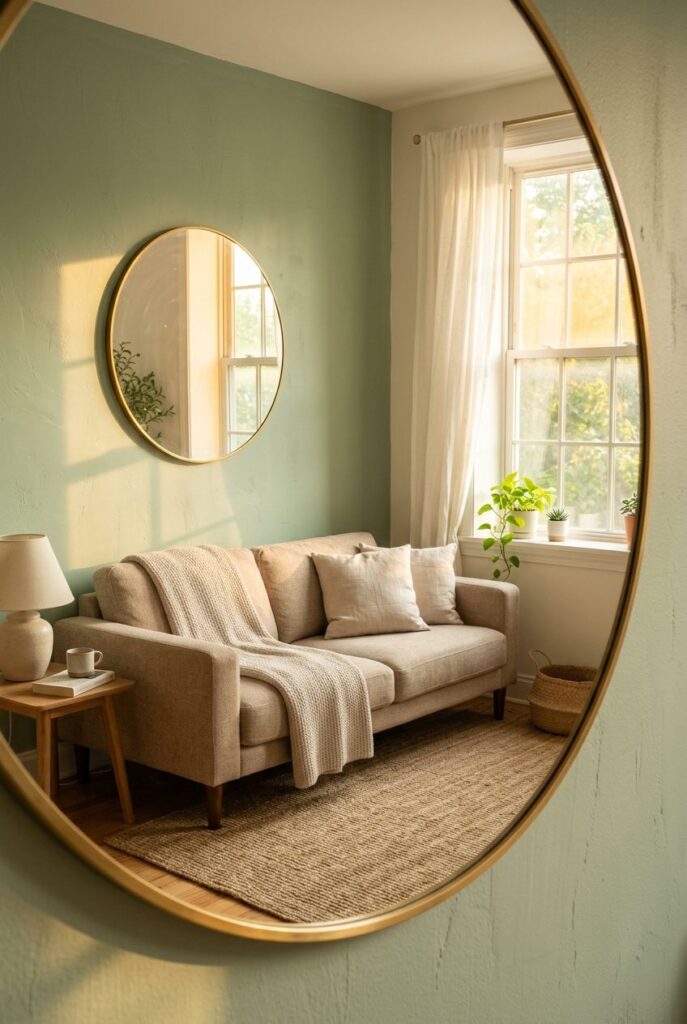
Paint is the cheapest renovation that actually works. Lighter walls make rooms feel bigger this isn’t a myth, it’s just how light behaves. But here’s what most people get wrong: you don’t need hospital white. Soft warm whites, pale greens, or barely-there grays work beautifully and feel less sterile.
Mirrors are the second-best trick. Position one across from a light source and watch your living room optically expand. Not for vanity for space. Strategic mirrors bounce light around and create the illusion of depth, which is basically magic in a small room.
Then there’s the less obvious move: use color intentionally on one wall or through textiles rather than painting everything neutral. A jewel-tone accent wall, a colorful rug, or textured throw pillows add personality without closing in the space if you choose colors that feel open rather than heavy.
What color actually feels spacious to you? It’s personal. Some people feel cramped in beige; others need neutrality to breathe. Experiment with paint swatches you can live with for a few days.
The Power of Natural Light
If your small living room has windows, maximize them obsessively. Skip heavy curtains; use sheer panels or light linen that let sunlight through while providing privacy. Natural light is free and makes every space feel bigger instantly.
Accent Walls Done Right
One accent wall works beautifully in small living rooms if you choose the right wall and color. Paint the wall behind your sofa, not the wall with windows (light colors reflect light better). Choose a color that feels rich but not heavy: sage green, dusty blue, warm terracotta, or deep charcoal.
Avoid bright neon or super saturated colors in small spaces; they overwhelm. Instead, choose colors with depth that feel sophisticated. A muted jewel tone adds personality without making the room feel like a box.
Rugs and Textiles
A well-chosen rug anchors a small living room and defines the space. A 5×7 rug is usually perfect for small rooms large enough to ground furniture but not so large that it dominates. Light-colored or neutral rugs visually expand space, while patterned rugs add interest without heaviness if the pattern is balanced.
Throw pillows and blankets add color, texture, and coziness without taking floor space. Stick to a consistent color palette (three colors max) so they feel curated rather than chaotic.
Furniture That Does Double Duty
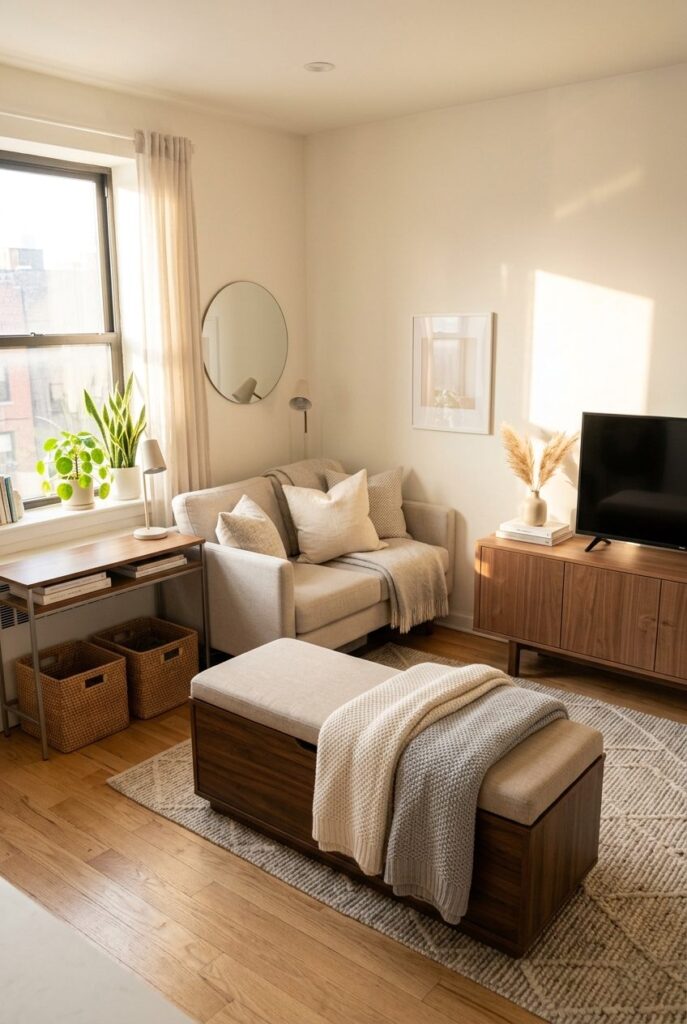
FYI a “living room” with six pieces of single-purpose furniture in a small space is already lost. You need furniture that works harder.
An ottoman that opens for storage and serves as both footrest and extra seating? That’s one piece doing three jobs. A console table behind your couch that also works as a desk or dining surface for two? Suddenly your room isn’t just a living room it’s flexible. A storage bench serves as seating, guest bed backup, and hidden storage all at once.
The trick is choosing multi-functional pieces that don’t look like they’re compensating for size. Avoid anything that screams “space-saving gimmick.” Instead, select furniture that’s genuinely well-designed and happens to solve multiple problems. A sleek credenza looks intentional whether it’s in a small space or a mansion.
One caveat, resist the urge to cram furniture just because it fits. A small living room crammed with five “clever” furniture pieces feels worse than a small living room with three great pieces and breathing room. Empty space is a design feature, not wasted space.
Smart Furniture Choices
Storage ottomans are legitimate game-changers. They provide a place to rest your feet, extra seating for guests, hidden storage, and can hold a tray to become a coffee table. Choose one in a neutral color that matches your aesthetic.
Console tables serve multiple purposes: behind a sofa as a display surface, as a narrow desk, as a side table for drinks and snacks, or even as a dining surface for two in a pinch. A good console table is only 12-14 inches deep, so it takes minimal space.
Wall-mounted desks are essential for small living rooms that need to double as work spaces. They fold away or sit against the wall, taking up negligible floor space while providing a proper work surface.
Nesting tables stack compactly but can be pulled apart when you need extra surface space. They’re especially useful for coffee tables in small rooms because you can adjust based on how many people you’re hosting.
Proportional Scale
Furniture scale matters more in small rooms. Oversized pieces that would look fine in a 300-square-foot room can overwhelm a 150-square-foot space. Choose furniture proportioned to the room not necessarily smaller, but more refined.
A sofa with clean lines and exposed legs feels less heavy than one with a skirt touching the floor. A glass coffee table is less visually heavy than a solid wood one. A chair with thin arms feels more open than one with thick, cushioned arms.
It’s not about buying miniature furniture; it’s about choosing pieces that don’t visually dominate the space.
Storage Doesn’t Have to Look Like Storage
This is where most small living rooms fail visually. People buy plastic bins, wire shelves, and obvious organizers that scream “we’re organizing our small space!” Instead, storage should disappear.
Baskets under a console table store blankets and pillows without looking like a storage solution. A credenza with closed doors hides the chaos while providing seating or surface space. Wall shelves with books, plants, and a few decor pieces look curated, not like you’re desperately trying to hide clutter.
The difference, open shelving with intention versus open shelving as default. If you display books, plants, and a few art pieces with negative space between them, it looks collected. If you cram every inch with stuff you’re hiding, it feels chaotic. Less is genuinely more here ruthlessly edit what you display and what you store behind closed doors.
Plants especially work in small spaces because they look intentional, they add color and texture, and they’re legitimately good for you. Hanging plants in corners, trailing vines on shelves, or a tall fiddle leaf fig in an unused corner transforms a room from cramped to curated.
The Basket Strategy
Woven baskets are the secret weapon of small space styling. They’re beautiful enough to display, functional enough to hide clutter, and they add warmth and texture to a room. Tuck them under console tables, on lower shelves, or in corners.
What to Display vs. Hide
Display: books you love, plants, one or two meaningful art pieces, perhaps a nice candle or object you actually use. Hide: electronics cords, charger cables, boxes, random items, cleaning supplies, seasonal decorations. This creates visual calm while keeping everything accessible.
The rule: if it doesn’t make you happy or serve a purpose, it shouldn’t be visible. This sounds harsh, but it’s the difference between a room that feels curated and one that feels like storage.
Storage Doesn’t Have to Look Like Storage
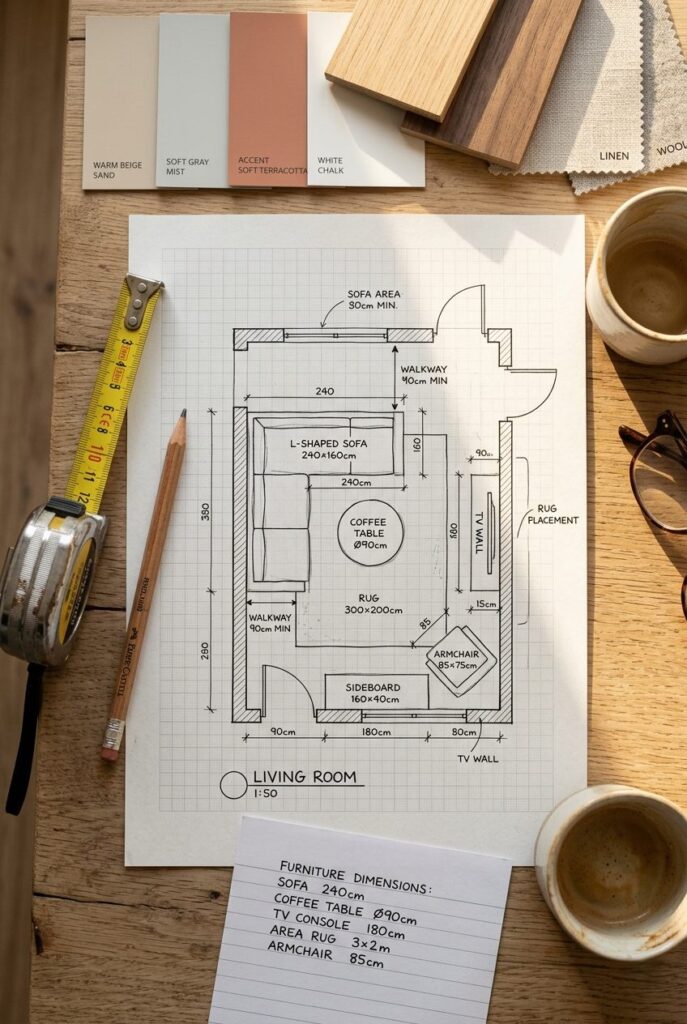
Here’s the honest truth, most people buy furniture first and wonder why their small living room doesn’t work. Do it backwards.
Measure your space. Draw it to scale (even just on graph paper). Figure out traffic flow where do people walk? Mark windows and doors. Then choose furniture that actually fits your specific space with intention. An accent chair that works perfectly in a 300-square-foot living room might be wrong for your 150-square-foot one, and that’s fine.
This sounds like extra work. It’s not. It’s the difference between a living room that feels accidentally crowded and one that feels purposefully designed. Spend 20 minutes on this, and you’ll waste zero dollars on furniture that doesn’t work.
The Measurement Game
Get a tape measure. Seriously. Measure width, length, and ceiling height. Measure doorways to understand what furniture can even physically fit. Measure window placements because this affects where you can put furniture.
Then measure furniture before you buy. A sofa that’s 84 inches long might be perfect in one room and completely wrong for another. A chair that’s 32 inches wide might take up your entire seating area in a small room. These measurements change everything.
Create a Visual Layout
Draw your room to scale on graph paper. Each square = 1 foot (or 1 meter, depending on your preference). Then cut out paper furniture to the same scale and arrange different configurations. This takes 10 minutes and saves you from buying furniture that doesn’t work.
Or use online tools like Roomsketcher or Floorplanner for a digital layout. But honestly, paper and pencil is faster and forces you to actually think about dimensions.
Traffic Flow Matters
Where do people naturally walk through your living room? Hallways to bedrooms? Routes to the kitchen? Don’t block these with furniture. If your natural pathway is blocked, the room instantly feels cramped and awkward.
Leave at least 18 inches of walking space on all sides of seating areas. This seems obvious, but I’ve seen countless small living rooms where someone’s legs will hit the coffee table every time they walk through that’s poor planning.
FAQ’s
How much furniture is actually too much for a small living room?
If you’re measuring furniture rather than counting pieces, you’ve got too much. Choose quality over quantity; empty space is your friend.
What’s the biggest mistake people make when designing small living rooms?
Buying furniture first, then wondering why nothing fits. Measure, plan, and draw your space to scale before purchasing anything.
Does paint color really make a small living room feel bigger?
Absolutely. Lighter walls reflect light and create openness, though warm whites and soft grays work better than sterile pure white.
Can you use dark colors in a small living room without making it feel cramped?
Yes use dark colors as accents on one wall or through textiles. Keep walls light and let darker hues add personality intentionally.
What’s the smartest storage solution for a small living room that doesn’t look cluttered?
Closed credenzas, baskets under tables, and curated open shelving with negative space. Hide daily clutter; display only intentional pieces.
CONCLUSION
Small living rooms get a bad reputation they don’t deserve. They’re not temporary situations to suffer through they’re spaces where every choice matters more, which means they can actually feel more intentional and livable than rooms where people just threw in standard furniture. Your small living room isn’t a limitation. It’s an opportunity to design something that genuinely works instead of something that just looks normal.
Start with what you actually do in that space, treat your walls as valuable real estate, and choose furniture that earns its place. Go vertical, let light in, use storage strategically, and plan before you buy. These aren’t tricks or hacks they’re the fundamentals of good design applied thoughtfully.
The irony? Some of my favorite living rooms have been the smallest ones I’ve seen not despite their size, but because someone took time to make them intentional. That’s available to you too.
Your living room doesn’t get bigger by these ideas. But it’ll feel better. And honestly, that’s what matters.