
farmhouse bathroom ideas
By Anna Grace | 14 May 2026
Farmhouse Bathroom Ideas That Turn Builder-Grade Boring Into Rustic Charm
My aunt spent three years perfecting her farmhouse bathroom, and the first thing guests notice isn’t the clawfoot tub or the shiplap. It’s the smell of cedar from a $12 tray she keeps by the sink. That tells you everything about farmhouse style the big-ticket items set the stage, but the small, honest details steal the show.
Farmhouse bathrooms hit that rare sweet spot between cozy and clean. They feel lived-in without looking cluttered, rustic without going full log cabin. And here’s the good news: you don’t need a 200-year-old homestead or a renovation budget the size of a small car to pull one off. Whether you’re gut-renovating a primary bath or giving a tiny powder room a weekend refresh, these farmhouse bathroom ideas will get you there.
Start With the Vanity , It Sets the Whole Tone
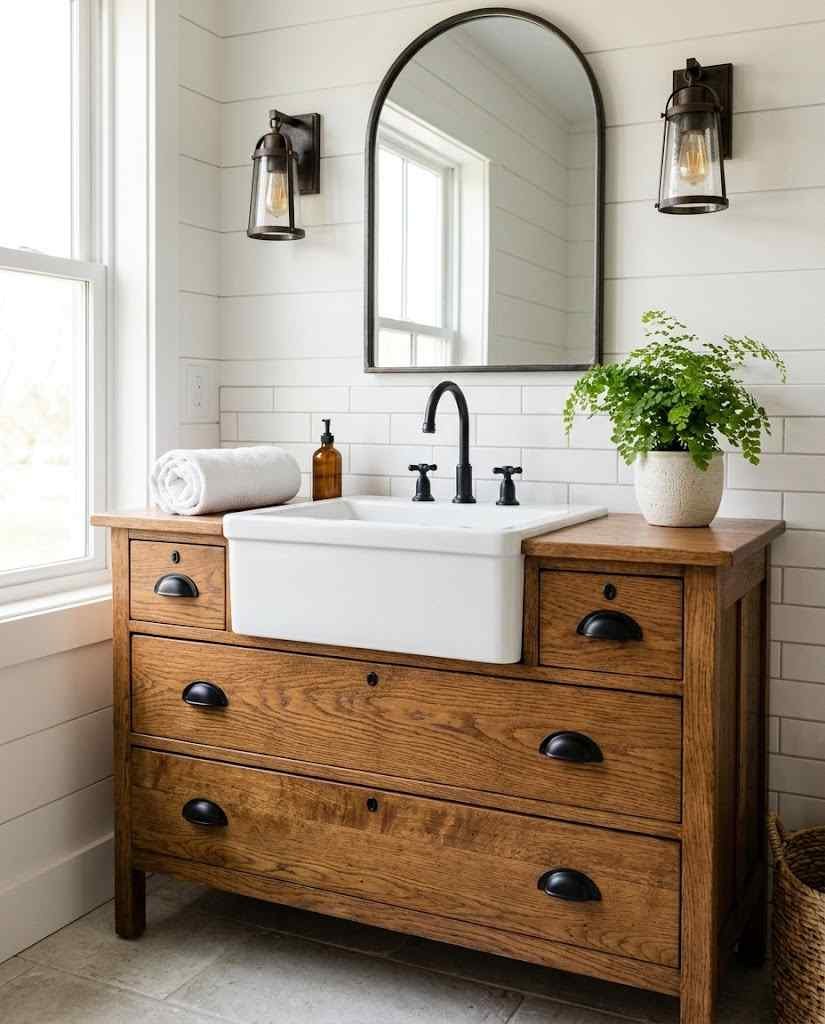
If you change one thing in your bathroom, make it the vanity. A builder-grade cabinet screams “apartment complex, 2009.” A repurposed dresser with a vessel sink? That whispers “I have taste and possibly chickens.”
The classic farmhouse move is converting an antique dresser or console table into a vanity. Cut a hole for the plumbing, seal the top properly, and you’ve got a one-of-a-kind piece with actual character. Estate sales and Facebook Marketplace are goldmines for this I once watched a friend snag a solid oak dresser for $40 that would’ve cost $1,200 as a “farmhouse vanity” at a boutique retailer. Same wood. Same dovetail joints. Wildly different price tag.
Not into DIY plumbing adventures? Fair enough. Look for these features when buying new:
Furniture-style legs instead of a boxy base that sits flat on the floor
Shaker or beadboard cabinet doors flat-panel modern doors kill the vibe instantly
A weathered or painted wood finish in white, sage, navy, or natural oak
Cup pulls or black iron hardware rather than sleek chrome bars
Pair whatever you choose with a farmhouse sink the deep apron-front kind if your space and budget allow. It’s the single most recognizable element of the whole style, and honestly, rinsing out paintbrushes in one feels weirdly luxurious.
One thing nobody warns you about: sealing matters more than style. A gorgeous antique dresser with an unsealed top will bubble, warp, and grow sad little water rings within a month of daily tooth-brushing. Three coats of marine-grade polyurethane or a waterproof epoxy finish will save you the heartbreak and yes, it’s worth the extra afternoon of drying time.
Sizing is the other trap. Measure your rough plumbing location before you fall in love with a piece, because moving supply lines turns a $40 dresser flip into a $600 plumber visit real fast. If your pipes come out of the floor instead of the wall, look for dressers with lower drawers you can sacrifice you’ll fake the drawer fronts and keep the storage up top. And if you’re going double vanity, hunt for a long sideboard or buffet instead of two matching dressers. One continuous piece anchors the wall better and gives you that counter space farmhouse mornings actually demand.
Color-wise, don’t feel chained to distressed white. A deep green or charcoal vanity against pale walls is having a serious moment in modern farmhouse design, and it hides toothpaste splatter far more graciously. Just keep the finish matte or satin high gloss on a farmhouse piece looks like it’s wearing a tuxedo to a barn dance.
Get the Walls Right Without Overdoing the Shiplap
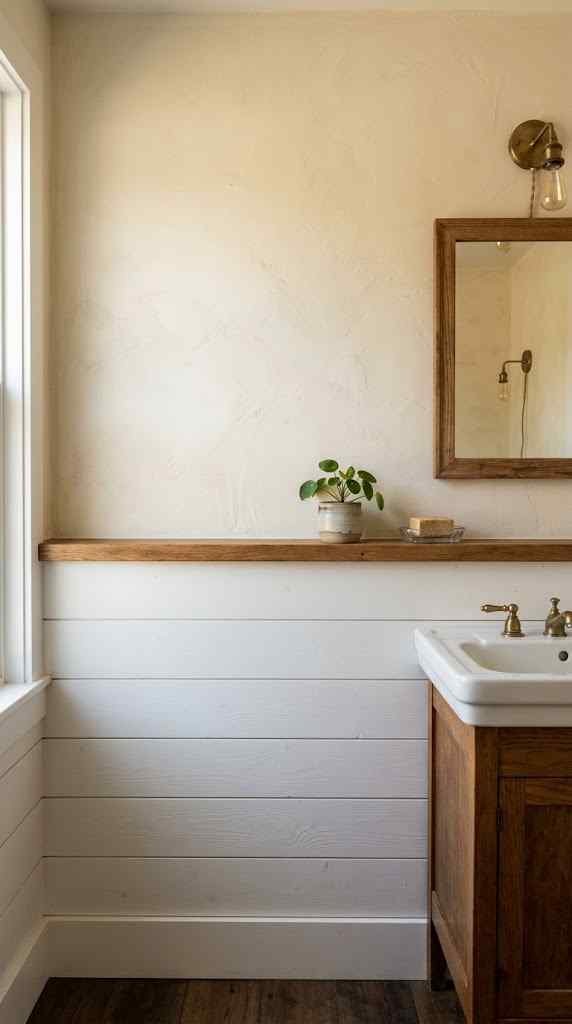
Shiplap gets a bad rap these days, mostly because it showed up in every home renovation show between 2015 and 2020 like an uninvited guest who wouldn’t leave. But used with restraint, horizontal wood paneling still works beautifully in a farmhouse bathroom. The trick is treating it as one ingredient, not the whole recipe.
Run shiplap or beadboard on the lower half of the wall as wainscoting, cap it with a simple ledge, and paint the upper portion a soft, warm neutral. You get texture and that hand-built farmhouse feel without your bathroom looking like the inside of a shipping crate.
Want alternatives? Board-and-batten paneling reads slightly more tailored and modern farmhouse. Vertical beadboard leans cottage. And a limewash or Roman clay paint finish gives walls a soft, aged depth that flat latex paint can’t touch it’s my personal favorite of the bunch, IMO, because it photographs like plaster from a Tuscan farmhouse but costs about the same as premium paint.
One rule worth bolding: pick one statement wall treatment and let everything else stay quiet. Shiplap AND patterned tile AND open shelving AND a gallery wall is how farmhouse turns into flea market.
A quick word on paint colors, because farmhouse whites are not all created equal. Stark, blue-toned whites read cold and clinical the opposite of what you’re going for. Reach for warm whites and creamy off-whites with a whisper of beige or gray underneath. Swatch three on the actual wall and watch them at morning and evening light before committing, because bathroom lighting lies more than a real estate listing.
If paneling feels like too much commitment, texture can come from tile instead. A white subway tile with a handmade, slightly wavy edge gives walls that hand-laid, old-farmhouse quality without a single plank of wood. Lay it in a classic offset pattern with warm gray grout bright white grout looks brand-new, and brand-new is exactly the feeling farmhouse style tries to avoid. Zellige-style tile takes this even further if the budget stretches; every piece catches light differently, and the imperfection does half your decorating for you.
And whatever wall route you take, paint your trim and door the same color as the paneling or a shade close to it. Contrasting bright-white trim chops a small bathroom into pieces. A unified, tonal envelope makes the room feel calm, custom, and quietly expensive three words every farmhouse bathroom should aspire to.
Textures and Materials That Make the Space Breathe
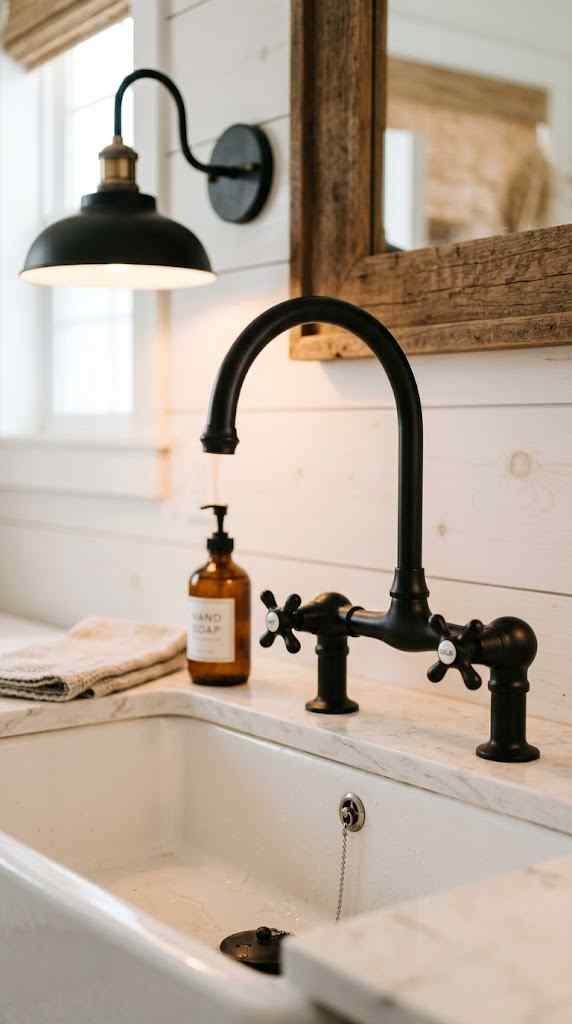
Ever notice how a bathroom can have gorgeous bones and still feel off? Nine times out of ten, the hardware is the culprit. Shiny chrome faucets on a rustic wood vanity clash like socks with sandals.
Farmhouse bathrooms lean on three finishes that consistently work:
● Matte black crisp, graphic, and perfect for modern farmhouse looks
● Oil-rubbed bronze warmer and more traditional, ideal if your space skews vintage
● Brushed brass or antique gold adds warmth and pairs beautifully with white and sage
Whichever you pick, commit to it. Faucet, towel bars, cabinet pulls, light fixtures, even the toilet paper holder matching finishes make a space feel intentional, and intention is what separates “designed” from “assembled.”
Don’t Sleep on the Mirror
A chunky wood-framed mirror, an arched metal-frame mirror, or even a salvaged window frame converted into a mirror can carry an entire wall. It’s also one of the cheapest swaps with the biggest visual payoff. Under $100, twenty minutes of work, completely different room.
For lighting, skip the frosted-glass builder strip above the mirror. A pair of gooseneck barn sconces flanking the mirror is the farmhouse classic for a reason. Lantern-style pendants work too, and if you’ve got the ceiling height, a small wood-and-iron chandelier over a freestanding tub is pure drama in the best way. FYI, most barn-style sconces now come in damp-rated versions, so double-check the listing before you buy bathrooms and non-rated fixtures are a bad marriage.
Before you order anything, check the spread and mounting style of your existing faucet. Widespread, centerset, and wall-mounted faucets are not interchangeable, and nothing deflates a Saturday project like discovering your dream bridge faucet needs three holes when your sink has one. Bridge faucets, by the way, are the underrated farmhouse hero that exposed horizontal pipe between the handles looks like it came straight off a 1920s washstand, and cross handles seal the deal.
Shower hardware deserves the same attention as the sink. An exposed-pipe shower system in matte black or bronze turns even a basic alcove shower into something with presence, and a rainfall head on a vintage-style arm splits the difference between old-world looks and a modern soak. If a full swap isn’t in the cards, replacing just the trim kit handle and escutcheon plate refreshes the look for a fraction of the cost, no wall demolition required.
One last hardware truth: buy the slightly heavier version. Hollow, lightweight pulls and hooks feel cheap in the hand every single day, while solid ones feel permanent. Farmhouse style is fundamentally about things built to last, and weight is the fastest shortcut to communicating that.
Texture, Textiles, and the Stuff That Makes It Feel Like Home
Here’s my slightly controversial opinion the accessories matter more than the renovation. You can have a perfectly average white bathroom, and with the right layers, it’ll read farmhouse. You can also have a $30,000 remodel that feels sterile because someone forgot the soul.
So what counts as soul? Texture, mostly. Farmhouse style is built on natural materials that show a little life:
● Woven baskets for towels and toilet paper storage
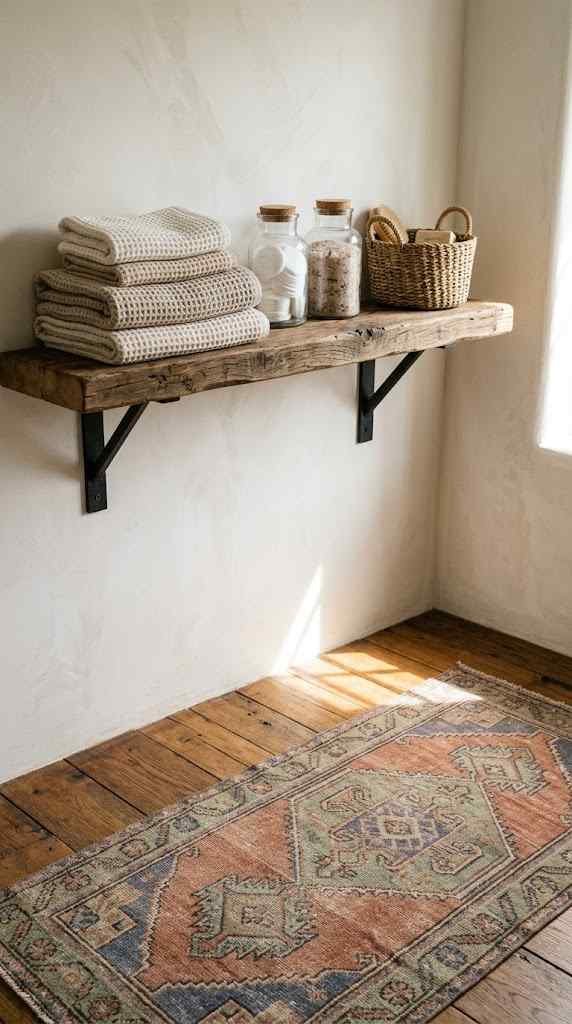
● A vintage-style runner rug Turkish or Persian patterns in faded reds and blues work surprisingly well against rustic wood
● Linen or waffle-weave towels in white, oatmeal, or muted sage
● Glass apothecary jars for cotton balls and bath salts
● A wooden stool or small bench beside the tub useful and charming, the farmhouse double threat
● Art prints or small textiles hung at different heights
Open shelving made from reclaimed wood and iron brackets gives you a place to display the pretty stuff while keeping the not-so-pretty stuff (looking at you, drain unclogger) hidden in baskets below. Add one live plant a fern or pothos that tolerates humidity and suddenly the room breathes.
Would a minimalist call this clutter? Maybe. But farmhouse was never about empty surfaces. It’s about surfaces that hold things you actually use, arranged like you care.
Scent is the layer most people forget. A cedar soap dish, a eucalyptus bundle hung from the shower head, or a small dish of dried lavender does more for the “cozy farmhouse” feeling than another decorative sign ever could. Speaking of which you can skip the “Wash Your Hands” wall plaque entirely. Everyone already knows. The room will survive without instructions.
Rotate textiles with the seasons if you want the space to stay interesting. Heavier waffle-weave and a wool-blend runner in winter, lighter linen and a flatweave cotton rug come summer. It costs almost nothing since you’re swapping, not buying doubles of everything, and it keeps the bathroom from feeling frozen in the month you decorated it.
Storage-wise, think in odd numbers and varied heights when styling open shelves. Two baskets, a stack of three folded towels, one tall jar groupings like that look collected rather than staged. And leave at least a third of every shelf empty. Breathing room is what separates “curated farmhouse” from “grandma’s hutch exploded,” and trust me, that line is thinner than it looks.
Keep the palette light and limited. White, warm wood, one accent color, black hardware. Done. A small farmhouse bathroom that tries to include every trend ends up feeling like a very charming closet you can’t move in. 🙂
Small Bathroom? Farmhouse Might Be Your Best Friend
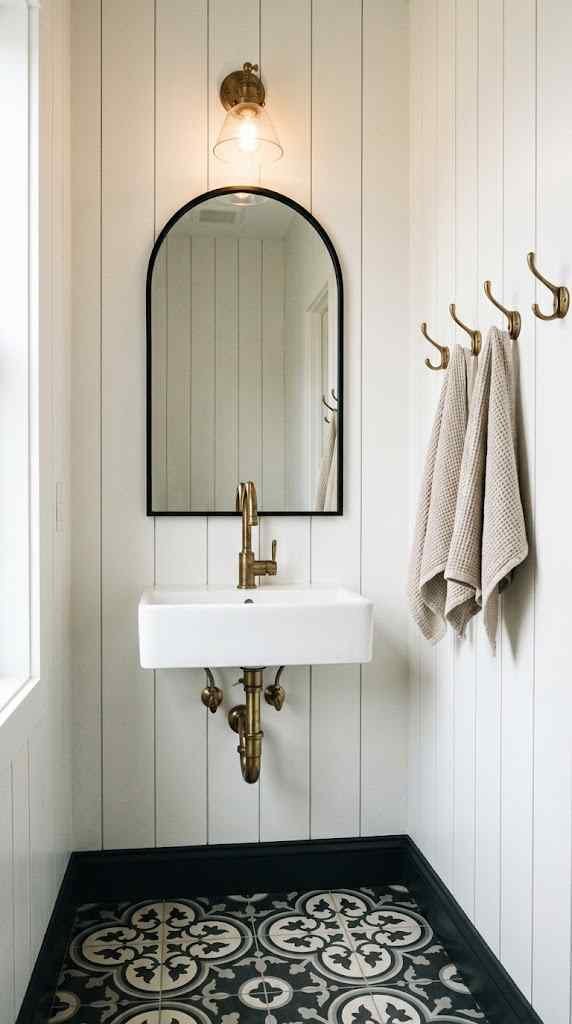
People assume farmhouse style needs square footage sprawling double vanities, freestanding tubs, room to twirl. Not true. Some of the best farmhouse bathrooms I’ve seen are powder rooms the size of a phone booth.
Small spaces actually play to farmhouse strengths. A tiny room lets you splurge on details that would blow the budget at scale: a patterned cement-look tile floor, a wall of beadboard, a genuinely great antique mirror. In 40 square feet, even premium materials stay affordable.
A few moves that work especially hard in compact farmhouse bathrooms:
● A wall-mounted or pedestal sink with a small wood shelf above for essentials
● A sliding barn door saves the swing space a regular door eats up (just add a privacy lock, learn from other people’s mistakes)
● Vertical shiplap to draw the eye upward and stretch the ceiling
● One oversized light fixture instead of several small ones counterintuitive, but it makes the room feel grander
Mirrors pull double duty in tight quarters. A mirrored medicine cabinet with a wood or black metal frame gives you hidden storage plus reflected light two wins in one fixture, which is the kind of math small bathrooms love. Mount it slightly larger than you think you need; undersized mirrors make small rooms feel smaller, like the room is apologizing for itself.
Hooks beat towel bars in compact spaces, full stop. A row of black iron or aged brass hooks holds more, fits narrower walls, and bonus actual humans use hooks, while towel bars mostly display towels nobody’s allowed to touch. Mount them on the back of the door if wall space is truly gone.
Finally, take advantage of the ceiling. Painting it the same warm white as the walls, or even cladding it in tongue-and-groove planks, wraps the little room in one continuous material and blurs its boundaries. Small farmhouse bathrooms don’t need to pretend they’re big. They just need to feel deliberate a jewel box, not a broom closet.
FAQ’s
Can I turn an old dresser into a farmhouse bathroom vanity?
Yes ! cut plumbing holes, seal the top with waterproof finish, and add a sink.
What paint colors work best for a farmhouse bathroom?
Warm whites, creamy off-whites, sage, or soft charcoal keep the space cozy, not clinical.
Is shiplap still in style for farmhouse bathrooms?
Yes, when used sparingly try half-wall wainscoting instead of covering every wall.
What hardware finish suits farmhouse bathroom ideas best?
Matte black, oil-rubbed bronze, or brushed brass pick one finish and match everything.
Does farmhouse style work in a small bathroom?
Absolutely! light colors, a pedestal sink, hooks, and one statement mirror do wonders.
CONCLUSION
Actual farmhouses weren’t decorated in a weekend. They accumulated a mirror from one generation, a stool from another, towels worn soft from use. That’s the energy worth copying.
Start with the bones: a characterful vanity, a wall treatment with texture, cohesive black or bronze hardware. Then layer in the living parts the baskets, the rug, the plant, the jar of cotton balls that somehow makes everything feel finished. Resist the urge to buy the entire “farmhouse aesthetic” aisle in one trip, because rooms assembled in a day tend to look like it.
Start with the bones: a characterful vanity, a wall treatment with texture, cohesive black or bronze hardware. Then layer in the living parts the baskets, the rug, the plant, the jar of cotton balls that somehow makes everything feel finished. Resist the urge to buy the entire “farmhouse aesthetic” aisle in one trip, because rooms assembled in a day tend to look like it.
And keep a running photo folder on your phone of details you love a grout color at a friend’s house, a faucet shape from a café bathroom. When decision fatigue hits mid-project (it will), that folder becomes your compass. The bathrooms that feel the most personal are always built from a hundred small noticing moments, not one big shopping cart.