
japandi bathroom
By Anna Grace | 19 May 2026
The Japandi Bathroom: Where Japanese Calm Meets Scandinavian Warmth (And Your Sanity Comes Back)
My friend Nora gutted her bathroom three separate times before she gave up chasing whatever was blowing up on Pinterest that month. First it was all-grey industrial. Then a “spa vibe” drowning in fake orchids. Finally she landed on a japandi bathroom warm wood, a stone basin, one perfect little stool and now it’s the only room in her whole house that guests actually stop and stare at. Funny how the quietest design ended up being the loudest.
That’s the strange magic here. A japandi bathroom doesn’t shout. It slows you down, makes you breathe out a little, and somehow still photographs like a boutique hotel. If you’ve been staring at your own dated bathroom wondering how people pull off that serene, expensive-looking calm without a celebrity budget, you’re in the right place.
So What Is Japandi, Really?
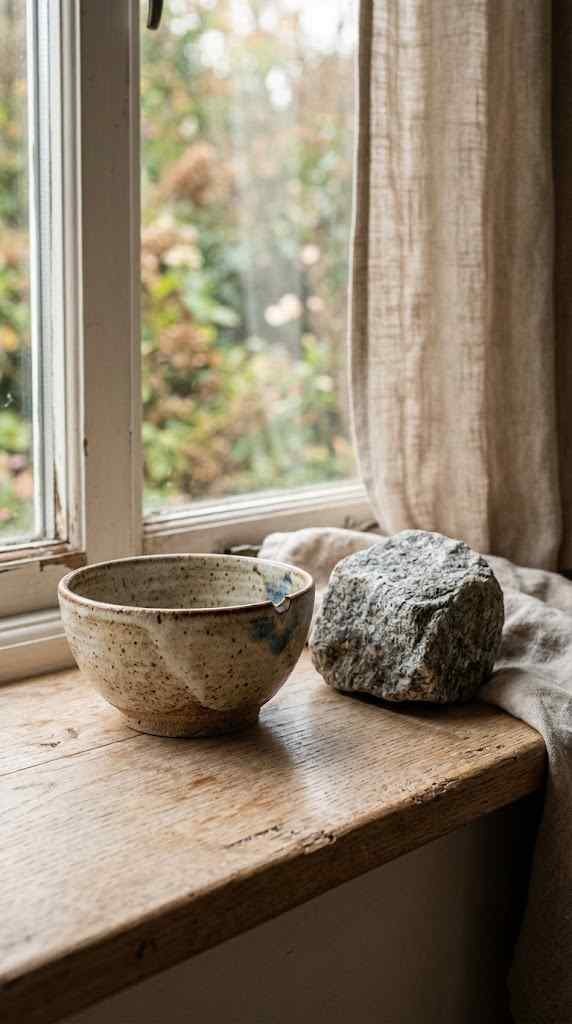
Japandi is exactly what the smushed-together name suggests: Japanese design principles crossed with Scandinavian ones. On paper they sound like an odd couple. In practice they share a spine.
Japanese aesthetics lean on wabi-sabi a love for imperfection, natural aging, and things that feel handmade rather than mass-produced. A stone with a crack in it isn’t broken; it’s honest. A hand-thrown ceramic bowl that’s slightly uneven has more soul than a flawless factory one. Scandinavian design brings hygge, that cozy, functional, light-drenched comfort the Danes talk about constantly the feeling of being warm and content while the weather does its worst outside. Put those two ideas in the same room and you get spaces that feel both disciplined and genuinely comforting, which is a rarer combination than it sounds.
What’s wild is how well the two cultures agree without ever having met. Both prize craftsmanship over flash. Both treat natural materials as sacred. Both believe a home should calm you down, not hype you up. So when designers started blending them a few years back, it didn’t feel like a forced mashup it felt like two old friends finally sharing a room.
For a bathroom, that translates into a space with almost nothing extra, but everything that stays there earns its spot. No clutter army of half-used shampoo bottles. No decorative towels nobody’s allowed to touch. Just clean lines, natural materials, and a color story so soft it practically hums.
Here’s the part people miss, though. Japandi isn’t minimalism for the sake of looking empty. The goal is intention, not deprivation. Every object should feel chosen, useful, and a little bit beautiful. A cold, sterile bathroom with three items in it isn’t japandi it’s just a showroom nobody lives in.
The Color Palette: Muted, Warm, and Quietly Confident
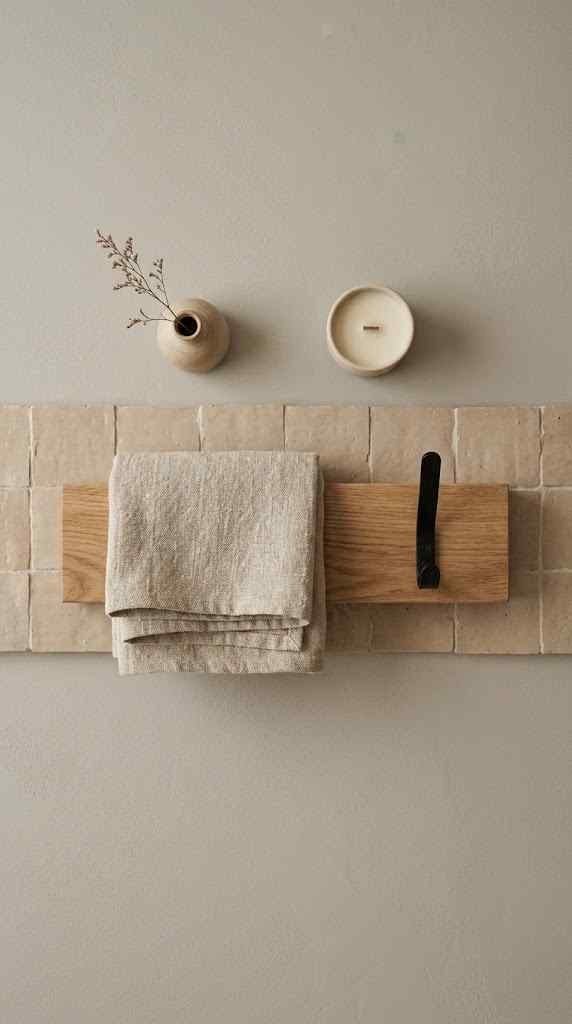
Want to know the fastest way to tell a japandi bathroom from a generic modern one? Look at the colors. There’s not a single harsh contrast anywhere.
The whole palette sits in the warm neutral zone soft whites that lean cream instead of blinding, oatmeal beiges, warm greiges, muted taupes, and gentle earthy browns. Occasionally you’ll spot a charcoal or deep ink accent, but it’s used like seasoning, not the main course. These tones do something sneaky: they bounce natural light around and make even a windowless bathroom feel less like a bunker.
If you’re picking paint or tile and feeling overwhelmed, keep it simple with a loose three-tier approach:
● Base tones (about 70%): warm white, greige, or soft sand on walls and larger surfaces
● Secondary tones (about 20%): natural wood, light stone, or a slightly deeper neutral for vanities and floors
● Accents (about 10%): matte black, aged brass, deep green from a plant, or a charcoal towel
Notice what’s not on that list. No jarring primary colors, no glossy jewel tones, nothing that screams for attention. IMO the biggest mistake beginners make is treating “neutral” as boring and panic-adding a bright feature wall. Resist that urge. The calm is the feature.
One small confession: I used to think beige bathrooms were where personality went to die. Then I saw a japandi one done with layered warm tones and different textures, and I completely flipped. It’s not that beige is boring it’s that flat, textureless beige is boring. Layer it, and it sings.
Materials and Texture: The Real Star of the Show
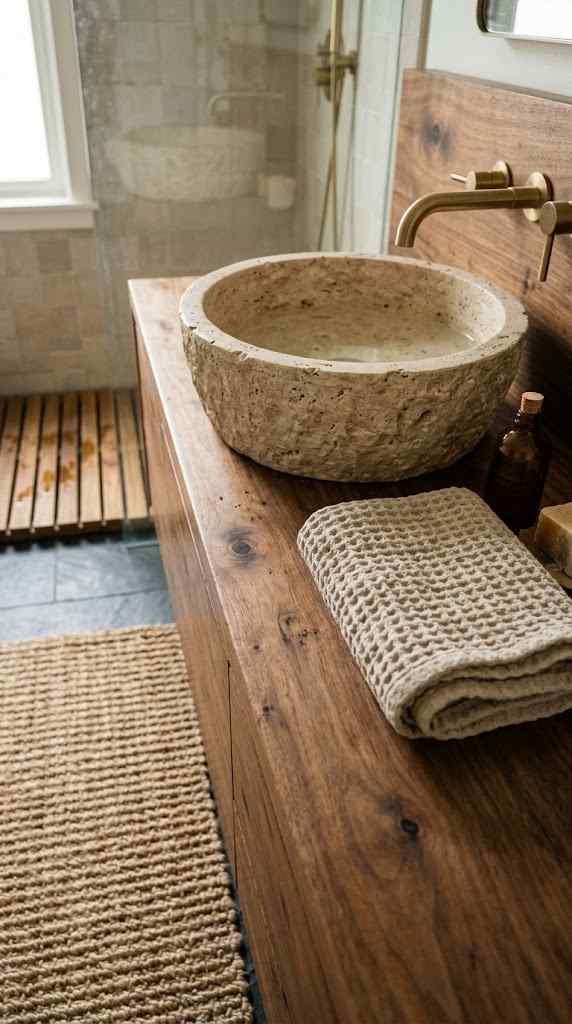
Since the colors stay quiet, the materials have to carry the personality. This is honestly where japandi bathrooms live or die.
Farmhouse bathrooms lean on three finishes that Wood is non-negotiable. Light-to-medium warm woods oak, ash, walnut, teak, or bamboo show up on vanities, shelving, stools, and sometimes ceiling slats. The grain adds movement and warmth that no paint color can fake. In a wet room you’ll want properly sealed or water-resistant wood, obviously, unless you enjoy watching your beautiful vanity warp into a Pringle.consistently work:
Where does the wood go, though? A few placements punch above their weight: a slatted wood accent wall behind the vanity, a single wooden stool that doubles as a plant perch or towel drop, floating oak shelves instead of a bulky cabinet, and a teak duckboard mat on the shower floor. You don’t need all of them. Two well-placed wood moments read warmer than a whole room clad in timber, which can tip into sauna territory fast.
Stone and concrete bring the grounding weight. Think honed (not shiny) natural stone basins, microcement walls, terrazzo with subtle flecks, or river-rock pebble flooring in the shower that feels ridiculously good under bare feet. Matte finishes matter here high-gloss surfaces read as flashy, and flashy is the opposite of the vibe.
Then there’s the tactile layer people forget: textiles and organic bits. Waffle-weave linen towels, a woven jute mat, a rough-glazed ceramic soap dish, a single sculptural branch or a pot of eucalyptus. These little imperfect, natural touches are the wabi-sabi heartbeat of the room.
A quick material cheat sheet if you’re shopping:
● Warm timber: oak, ash, walnut, teak, bamboo (sealed for wet zones)
● Natural stone & mineral surfaces: honed marble, travertine, microcement, terrazzo
● Matte metals: blackened steel, brushed brass, aged bronze for taps and hardware
● Organic textiles: linen, cotton, jute, rattan for storage baskets
● Living elements: a hardy plant or two that won’t die in the humidity
Speaking of plants ferns, pothos, and snake plants basically thrive on bathroom steam, so they’re doing you a favor. Free décor that also cleans your air? I’ll take it. 🙂
The Pieces That Anchor the Room
You don’t need a hundred things. You need a few right ones. A japandi bathroom usually hangs its whole mood on three or four anchor pieces, so it’s worth getting those correct.
The Bath
If your space and budget allow, a freestanding soaking tub is the crown jewel. The Japanese ofuro a deep, upright soaking tub is the spiritual ancestor here, though most people go for a simple oval or squared-off freestanding design in stone resin or matte white. Set it near a window if you can. Even a tiny slice of natural light beside a soaking tub turns bath time into an actual ritual instead of a chore.
No room for a freestanding tub? Totally fine. A walk-in shower with a low-profile stone tray, a simple glass panel, and a wooden slatted floor mat pulls the same energy for less money and less square footage.
The Vanity
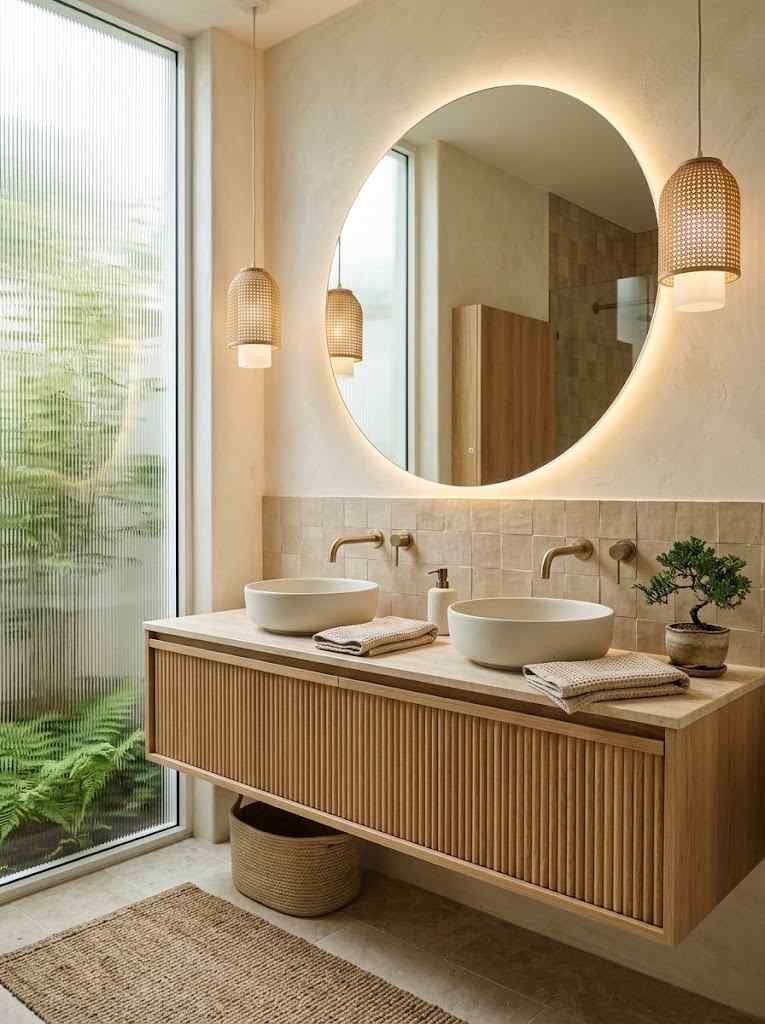
The vanity is the workhorse and usually the biggest wood moment in the room. Floating (wall-mounted) vanities are a japandi favorite because they show floor underneath, which makes small bathrooms feel bigger and airier. Pair it with a vessel basin in stone or matte ceramic, and keep the countertop nearly bare a soap dispenser, maybe a small tray, and that’s it.
Hidden storage is the secret weapon. The whole serene look collapses the second your countertop turns into a cosmetics graveyard, so you want drawers, niches, and closed cabinets doing the heavy lifting out of sight.
Fixtures and Lighting
Taps, showerheads, and handles should be matte and understated matte black and aged brass are the go-to finishes. Wall-mounted taps look especially clean because they free up the counter and add that architectural, deliberate feel.
Lighting deserves real thought too. Skip the harsh, blue-white bulbs that make you look like you’re being interrogated. Warm, layered lighting a soft overhead, maybe a rice-paper-style pendant, and a gentle glow near the mirror keeps the whole mood consistent. Dimmable if you can swing it. Your future self, sinking into a late-night bath, will thank you.
Making It Work in a Small (or Rented) Bathroom
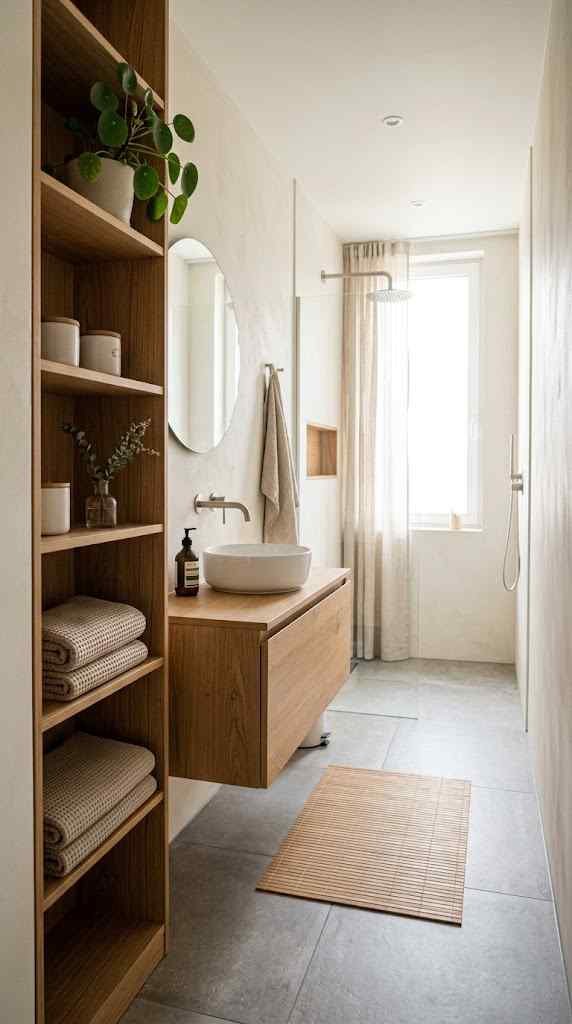
Here’s a question I get constantly: does japandi only work if you have a huge, sun-flooded bathroom straight out of a design magazine? Nope. If anything, this style was practically built for small spaces.
Japanese homes have dealt with tight square footage for centuries, and their design language reflects that everything folds, hides, or does double duty. So a compact bathroom is a feature, not a failure. You just have to be ruthless about editing.
For small japandi bathrooms, lean on these moves:
● Go vertical. Slim floor-to-ceiling shelving or wall niches store more without eating floor space.
● Float everything. Wall-mounted vanities and toilets expose more floor and trick the eye into seeing space.
● Use large-format tile or microcement. Fewer grout lines equals a calmer, larger-looking surface.
● Keep the palette tight. One or two tones max in a tiny room stops it from feeling chaotic.
● Add one warm wood element. Even a single oak shelf or stool warms the whole space up instantly.
Renting and can’t rip out tile? You’ve still got options. Peel-and-stick wood-look shelving, a linen shower curtain in a warm neutral, woven storage baskets, a bamboo bath mat, matte accessories, and a plant or two will fake the vibe convincingly. Landlords never have to know you basically redecorated. :/
Honestly, some of the best japandi bathrooms I’ve seen were tiny rentals where the person couldn’t change the bones and had to nail the feeling through texture and restraint alone. Constraints breed better taste. Weird but true.
One more small-space tip that punches way above its cost: swap out the lighting and the hardware. A warm bulb and a set of matte black or brass towel hooks can quietly re-frame a whole builder-grade bathroom for the price of a takeout dinner. You’re not renovating you’re editing. And editing is exactly what this style asks of you anyway.
Making It Work in a Small (or Rented) Bathroom
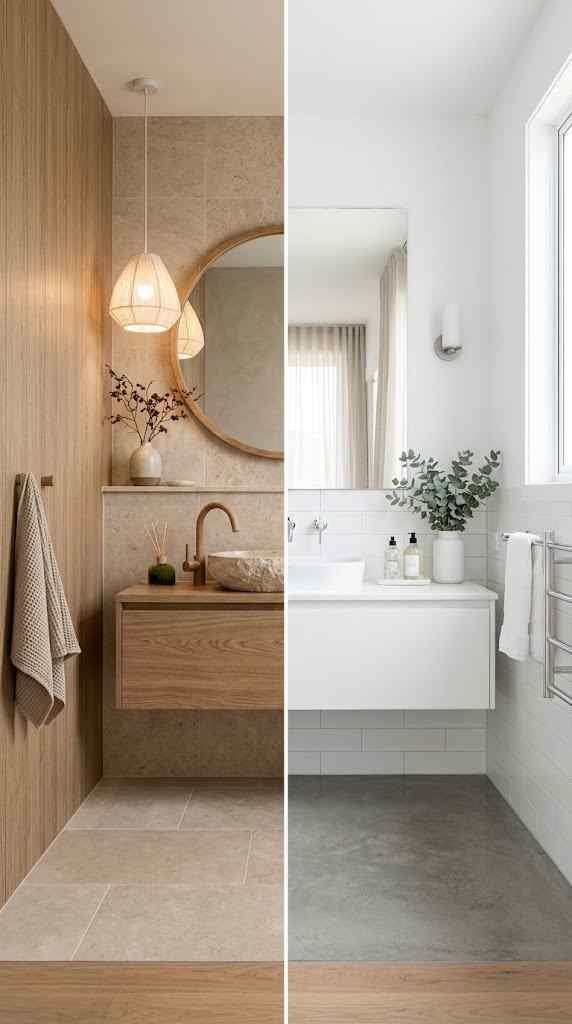
People mix these styles up all the time, so it helps to know what makes japandi its own thing. A few neighbors on the design spectrum look similar at a glance but pull in different directions.
Take pure Scandinavian bathrooms. They share the light woods and clean lines, but they run cooler and brighter crisp whites, lots of pale grey, an almost airy lightness. Japandi drops the temperature down a notch, adds darker grounding tones, and brings in more of that earthy, handcrafted texture. Think of japandi as Scandi that spent a thoughtful year in Kyoto.
Then there’s straight-up modern minimalism, the all-white, hard-edged, gallery-cube look. It nails the “few objects” rule but often forgets the warmth, which is why those bathrooms can feel gorgeous and completely uninviting at the same time. Japandi keeps the discipline but refuses to be cold the natural wood and imperfect materials are doing constant emotional work.
And you’ve probably seen modern farmhouse or industrial bathrooms everywhere. Farmhouse leans rustic and decorative with shiplap and vintage bits; industrial goes hard on exposed pipes, black metal, and concrete grit. Both carry way more visual “stuff” and busier surfaces than japandi ever would.
Here’s a quick side-by-side to keep it straight:
● Japandi: warm neutrals, wood + stone, matte finishes, deeply calm, intentional
● Scandinavian: cool whites, pale wood, bright and airy, light-focused
● Minimalist modern: stark, high-contrast, often cold, all about empty space
● Farmhouse / industrial: decorative or raw, busier, more materials and clutter
The reason japandi keeps winning, in my opinion, is that it grabbed the best trait from each camp the calm of minimalism, the coziness of Scandi, the soul of Japanese craft and quietly left the flaws behind. Not a bad party trick for a style with such a goofy name.
Common Mistakes That Kill the Vibe
Since I’ve watched plenty of well-meaning renovations go sideways, let me save you some grief. A japandi bathroom is surprisingly easy to get almost right and then wreck with one wrong move.
The most common one? Confusing empty with intentional. A stripped-bare bathroom with harsh lighting and zero texture isn’t zen it’s clinical. Warmth, natural materials, and a couple of soft imperfect touches are what separate a spa from a dentist’s office.
Second offender: going too matchy. Buying a single “japandi bathroom set” where every item is the identical shade of beige flattens the whole thing. The style thrives on layered neutrals and mixed textures wood against stone against linen not one monotone note repeated ten times.
A few more traps worth dodging:
● Overusing glossy or chrome finishes: they fight the muted, matte foundation
● Cramming in trendy gadgets and loud accessories: clutter is the enemy, even cute clutter
● Forgetting greenery; without something living, the room can tip into cold
● Ignoring lighting temperatur: cool white bulbs sabotage every warm tone you carefully chose
● Fake plants everywhere: one or two are forgivable a jungle of plastic reads as try-hard
And please, for the love of good design, don’t feel pressure to spend a fortune. Japandi rewards restraint, which means a modest budget spent on a few quality natural pieces beats a giant budget dumped on a pile of stuff. The whole philosophy is basically anti-splurge, which is refreshing when every other trend seems to require a second mortgage.
FAQ’s
Is a japandi bathroom expensive to create?
Not necessarily! the style rewards restraint, so a few quality natural pieces beat a cart full of trendy accessories.
What flooring works best in a japandi bathroom?
Warm wood-look tile, microcement, or honed stone in muted tones matte finishes and few grout lines keep it calm.
Which colors should I avoid?
Skip bright primaries, jewel tones, and cool blue-greys they fight the warm, muted neutrals a japandi bathroom depends on.
Can japandi work without a freestanding tub?
Absolutely! a walk-in stone shower with a wooden mat and glass panel gives the same serene feel for less.
How do I keep a japandi bathroom from feeling cold?
Layer in warm wood, soft lighting, linen textiles, and a plant or two texture and warmth beat empty minimalism.
CONCLUSION
Strip away the jargon and a japandi bathroom really comes down to three quiet commitments: warm natural materials, a muted layered palette, and only the things you actually need. Wood meets stone. Function meets calm. Japanese restraint shakes hands with Scandinavian coziness, and the result is a room that feels expensive precisely because it isn’t trying to.
If you take one idea with you, make it this start with subtraction, not addition. Clear the clutter, edit down to what matters, then slowly layer in warmth through texture, wood, and soft light. You’ll get further with a single beautiful stone basin and a bare counter than with a cart full of trendy accessories.
So here’s my nudge: before you order a single new thing, go stand in your bathroom and count how many objects on the counter you’d genuinely miss if they vanished tomorrow. My bet? It’s a short list. That short list is where your japandi bathroom quietly begins.