
Bathroom Faucet
By Anna Grace | 9 June 2026
Bathroom Faucet Buying Guide: How to Pick One You Won’t Regret
A faucet gets turned on and off roughly 20 times a day in the average household bathroom. That’s over 7,000 uses a year from one small piece of hardware more action than your couch, your oven, and possibly your gym membership combined. Yet most people spend more time choosing a shower curtain.
I learned this the hard way. A few years ago I grabbed the cheapest bathroom faucet at the hardware store because “they’re all basically the same, right?” Eighteen months later it was dripping like a leaky metronome at 2 a.m., the finish had peeled near the handle, and I was back at the same store buying its replacement. Same aisle. Same fluorescent lighting. Slightly more humility.
So consider this your shortcut past that mistake. We’re going to cover faucet types, finishes, what’s actually inside the thing (spoiler: it matters more than the outside), water efficiency, and what installation really costs. By the end, you’ll know exactly which bathroom faucet deserves your sink and which ones deserve to stay on the shelf.
Know Your Faucet Types Before You Fall in Love With a Photo
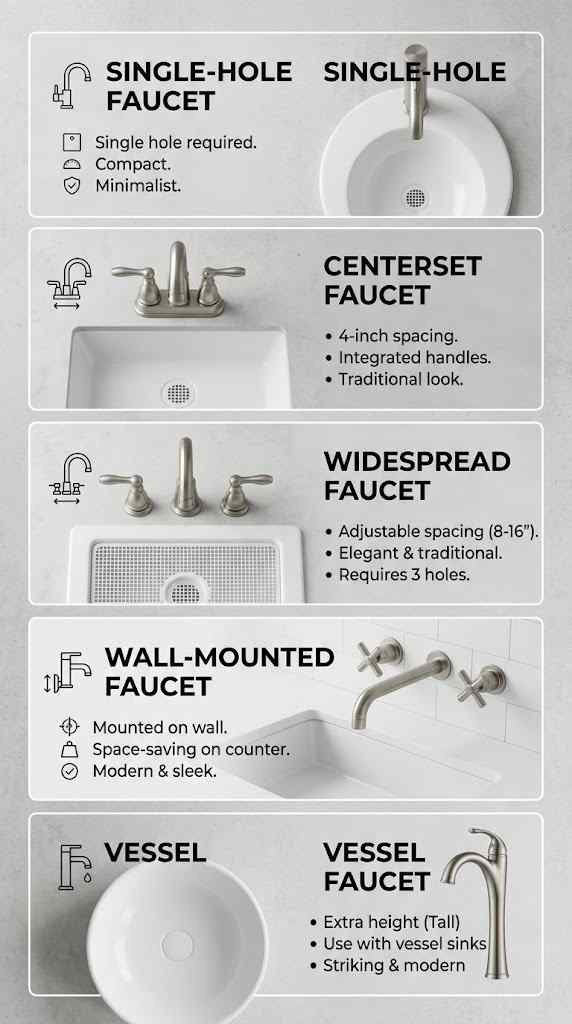
Here’s the trap: you scroll Pinterest, spot a gorgeous wall-mounted faucet, order it, and then discover your sink has three pre-drilled holes that make it physically impossible to install. The configuration of your sink decides your options long before your taste does.
Measure your sink’s hole setup first. Everything else comes second.
There are five main bathroom faucet types, and each one matches a specific hole configuration:
● Single-hole faucets one handle, one hole, one clean look. Perfect for small vanities and modern bathrooms. They’re also the easiest to clean around, which your future self will appreciate.
● Centerset faucets designed for sinks with three holes spaced 4 inches apart. The handles and spout sit on one compact base. This is the most common setup in older homes and apartments.
● Widespread faucets three separate pieces (two handles, one spout) for holes spaced 8 to 16 inches apart. They look expensive because they usually are. Great for larger vanities where a centerset would look like a toy.
● Wall-mounted faucets mounted above the sink, on the wall. Stunning with vessel sinks, but they require plumbing inside the wall. Not a casual weekend swap.
● Vessel faucets extra-tall single-hole faucets built to clear the rim of a bowl-style vessel sink. Buy a regular-height faucet for a vessel sink and you’ll be washing your knuckles instead of your hands.
Already have a sink? Count your holes and match accordingly. Renovating from scratch? Then you get to pick the faucet first and buy a sink to suit it the fun order of operations.
One more thing people forget: spout reach. The water stream should land near the center of the basin, not dribble down the back wall of the sink. Check the spec sheet for “spout reach” before you buy. It’s one number, and it saves you from a faucet that technically fits but practically annoys you every single morning.
Finishes: Where Style Meets “Will This Look Terrible in Two Years?”
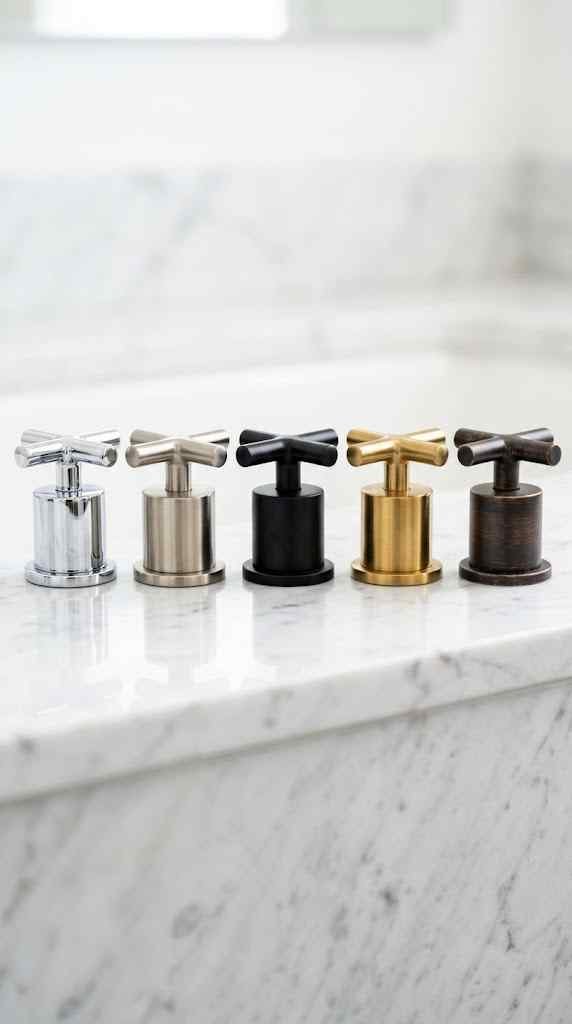
The finish is what everyone shops by, and fair enough it’s the part you see. But finishes age at wildly different rates, and some of them demand more upkeep than a needy houseplant.
Let’s run through the popular ones:
●Chrome the classic. Cheap, shiny, durable, and matches almost anything. The downside? It shows every fingerprint and water spot like it’s collecting evidence. If you have kids, prepare to wipe it down constantly.
● Brushed nickel warm, soft, and forgiving. Water spots practically disappear into the brushed texture. IMO, this is the best all-around choice for busy family bathrooms, and it plays nicely with both warm and cool color schemes.
●Matte black dramatic and very current. It hides fingerprints well but can show mineral deposits in hard water areas, and scratches reveal the base metal underneath. Buy quality here or don’t buy it at all.
● Polished brass / brushed gold luxurious and making a serious comeback. The good modern versions use PVD coating (more on that in a second) so they won’t tarnish like your grandmother’s fixtures did.
● Oil-rubbed bronze moody, traditional, and great at hiding grime. Some versions are “living finishes” that change over time. Some people love that. Some people file warranty claims over it. Know which person you are.
Here’s the term that actually matters: PVD, or physical vapor deposition. It’s a process that molecularly bonds the finish to the faucet, making it dramatically more resistant to scratching, tarnishing, and peeling than standard electroplating. A PVD finish costs a bit more upfront and saves you an entire faucet replacement later. My peeling bargain faucet from earlier? Electroplated. Lesson absorbed.
Whatever finish you land on, skip the abrasive cleaners. A soft cloth and mild soap handle 95% of faucet grime, and a 50/50 vinegar-water mix dissolves the stubborn mineral crust just rinse it off promptly on black and bronze finishes, since prolonged acid contact can dull them. Scouring pads, on the other hand, will sand your beautiful finish into a cautionary tale in about four enthusiastic scrubs.
Should your faucet finish match your cabinet hardware and light fixtures? The old rule said yes, everything identical. The current thinking is more relaxed mixing two complementary finishes (say, matte black faucets with brushed gold hardware) looks intentional and designed. Just cap it at two finishes per bathroom. Three starts looking less “curated” and more “clearance bin.”
The Inside of the Faucet Is Where Your Money Actually Goes
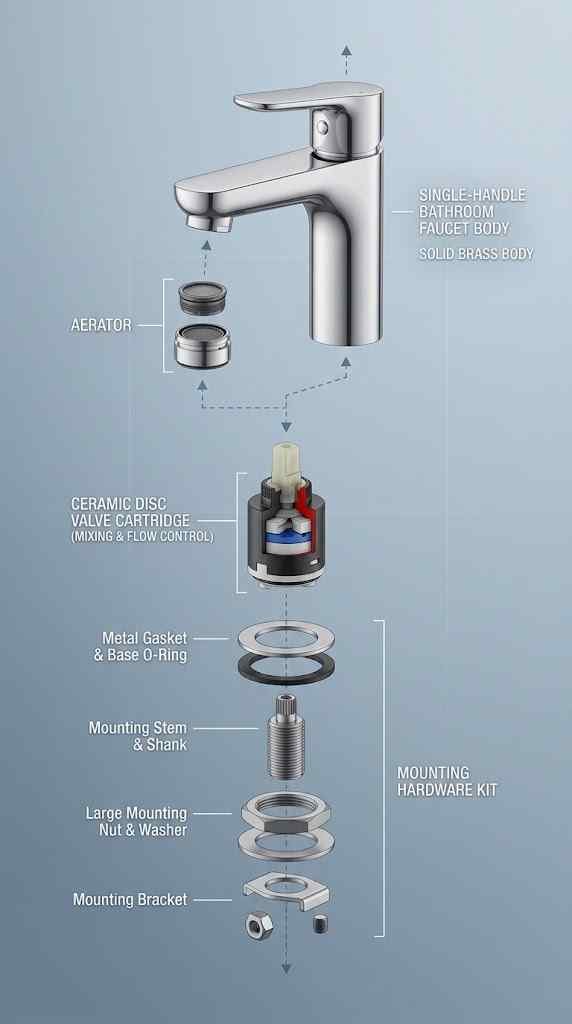
Two faucets can look identical in a product photo and be separated by $150 in price. The difference lives inside, in three places: the body material, the valve, and the drain assembly.
Body material: brass or bust
Solid brass bodies are the gold standard for a bathroom faucet. Brass resists corrosion, handles decades of hot-and-cold cycling, and gives the faucet that satisfying weight when you pick it up. Zinc alloy bodies are lighter and cheaper fine for a rarely-used powder room, risky for a bathroom that gets daily traffic. Plastic bodies exist, and the kindest thing I can say about them is that they’re recyclable. :/
Quick test if you’re shopping in person: pick the faucet up. A solid brass faucet feels dense and substantial. If it feels like a prop from a school play, put it back.
Valves: the part that decides whether you’ll ever hear dripping again
The valve controls water flow and temperature, and it’s the component that fails first in cheap faucets. Your options, ranked:
Ceramic disc valves two polished ceramic discs that slide against each other. Nearly impervious to wear, sediment, and hard water. Most quality faucets use these now, and they routinely last the life of the faucet.
Cartridge valves reliable and easy to replace when they wear, which they eventually do.
Ball valves older tech with more moving parts, meaning more things that can leak.
Compression valves the ancient rubber-washer design responsible for basically every dripping faucet in every old movie. Avoid.
If the product listing doesn’t mention a ceramic disc valve, assume it doesn’t have one. Manufacturers who spend money on good valves are not shy about saying so.
Warranty tells you what the manufacturer really thinks
Reputable brands back their bathroom faucets with limited lifetime warranties covering both function and finish. A one-year warranty is a manufacturer quietly telling you how long they expect their product to survive. Believe them.
Water Efficiency: Small Numbers, Real Savings
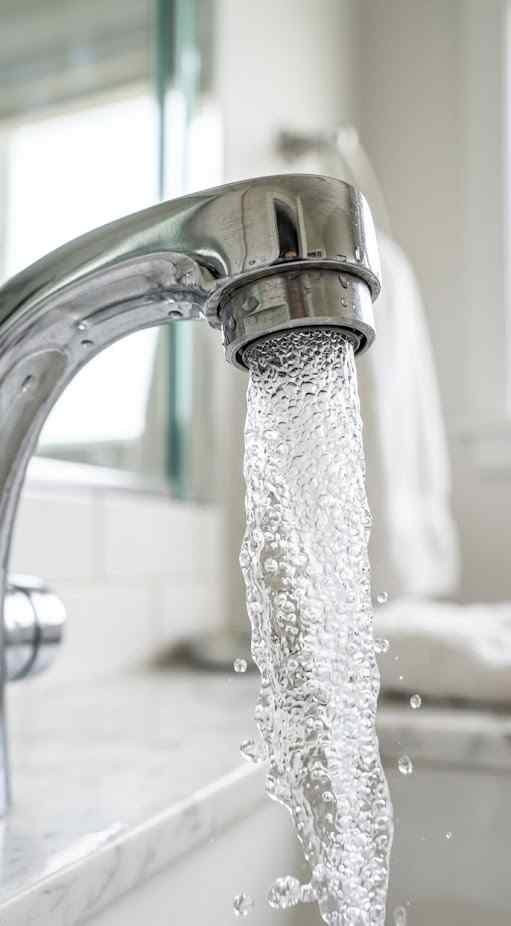
Would you notice if your faucet used 32% less water? Genuinely would you? Because that’s the gap between an older 2.2 gallon-per-minute faucet and a modern WaterSense-certified model at 1.5 GPM, and in a blind test, most people can’t tell the difference at the sink.
Look for the WaterSense label. It’s the EPA’s certification that a faucet uses at most 1.5 GPM while still passing independent performance testing. Translation: it saves water without making you feel like you’re rinsing your toothbrush under a sad trickle.
The savings stack up quietly. A family of four can save roughly 700 gallons of water a year by switching to WaterSense bathroom faucets that’s about 45 loads of laundry worth of water, achieved by doing absolutely nothing differently. Your water bill shrinks, your water heater works less, and you get to feel mildly smug about it. Everybody wins.
The magic happens in the aerator, the small screened tip at the end of the spout. It mixes air into the water stream so the flow feels full while using less volume. Two practical notes on aerators:
● They unscrew. Clean yours every few months, especially in hard water areas a clogged aerator is behind most “my water pressure died” complaints, and the fix costs nothing.
● They’re replaceable. You can retrofit a lower-flow aerator onto an existing faucet for a couple of dollars if you’re not ready to replace the whole fixture.
Do touchless bathroom faucets belong in a home? They’ve dropped in price, they cut down on germ transfer, and kids who forget to turn off taps can’t fight a sensor. The trade-offs are batteries (or wiring) and one more electronic component that can fail. For a family bathroom, I’d call them a nice-to-have. For anyone with mobility or arthritis concerns, they’re legitimately life-improving and worth every penny.
Installation and Real Costs: What You’ll Actually Spend
Faucet pricing follows a rough logic, and knowing the tiers keeps you from overpaying or under-buying:
● Under $75 zinc bodies, basic valves, short warranties. Acceptable for a guest bathroom that sees six uses a year.
● $75–$200 the sweet spot. Solid brass construction, ceramic disc valves, PVD finishes, and lifetime warranties all live in this range. Most people should shop here and stop.
● $200–$500+ designer names, sculptural shapes, specialty finishes, smart features. You’re paying for aesthetics and brand at this point, not extra durability. Nothing wrong with that if the look matters to you just know what the money buys.
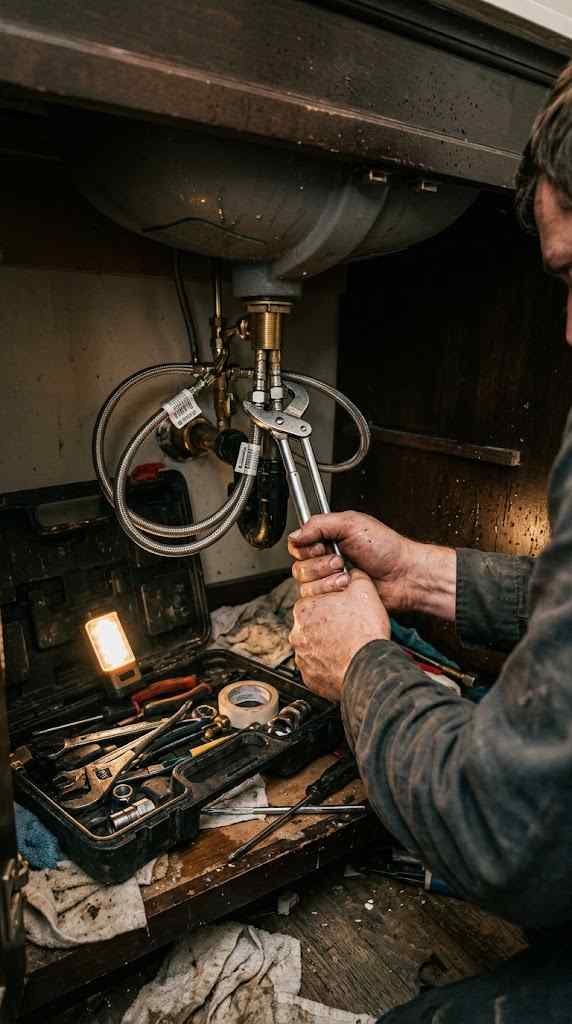
Now, can you install a bathroom faucet yourself? For a straightforward swap same configuration, accessible shutoff valves, no surprises yes, and thousands of people do it every weekend. You’ll need a basin wrench (about $15, and non-negotiable for reaching the mounting nuts behind the sink), plumber’s tape, a bucket, and around two hours the first time.
The honest DIY checklist:
● Shut off the water at the valves under the sink, then open the old faucet to drain the lines.
● Disconnect the supply lines and unbolt the old faucet. This is the step where you’ll question your choices those nuts are always corroded.
● Clean the sink deck thoroughly. Old plumber’s putty is stubborn a plastic scraper helps.
● Set the new faucet with its gasket or a bead of putty, tighten from below, and connect the supply lines.
● Turn the water back on slowly and check every connection for drips. Check again the next day. Then once more, because paranoia is cheaper than water damage.
Call a plumber instead if your shutoff valves are ancient and won’t turn (forcing them can snap them a genuinely bad afternoon), if you’re switching configurations, or if you’re doing a wall-mounted install. A plumber typically charges $150–$350 for a standard faucet installation. FYI, that’s a lot less than the cost of fixing a cabinet after a slow leak has soaked it for a month, so there’s zero shame in the professional route
Whatever you do, replace the supply lines while you’re in there. New braided stainless steel lines cost about $10 a pair, and the old rubber ones under your sink are quietly plotting against you.
FAQ’s
ow long does a good bathroom faucet last?
A quality brass bathroom faucet with a ceramic disc valve typically lasts 15–20 years or more.
What does GPM mean when buying a faucet?
GPM means gallons per minute the faucet’s flow rate. WaterSense bathroom faucets use 1.5 GPM or less.
Why is my faucet’s water pressure suddenly low?
Usually a clogged aerator. Unscrew the spout tip, rinse out mineral buildup, and pressure returns.
Can I put a widespread faucet on a centerset sink?
No widespread faucets need holes 8+ inches apart. Centerset sinks have 4-inch spacing.
Is matte black a practical faucet finish?
Yes, if it’s PVD-coated. It hides fingerprints well but may show hard water spots.
CONCLUSION
A good bathroom faucet comes down to five decisions made in the right order: match the type to your sink’s holes, pick a finish with PVD if you want it to last, insist on a brass body and ceramic disc valve, grab the WaterSense label for free savings, and be honest about whether the install is a DIY job or a plumber call.
Spend in the $75–$200 range from a brand with a lifetime warranty and you’ll buy this thing exactly once. Cheap out and you’ll do what I did buy it twice, with a side of 2 a.m. dripping in between.
Your faucet works 7,000 shifts a year. Hire a good one. 🙂