
Bathroom sconces
By Anna Grace | 11 June 2026
Why the Right Bathroom Sconces Beats Any Fancy Mirror You’ll Ever Buy
My old bathroom had one of those big builder-grade light bars screwed above the mirror five bulbs, all pointing straight down like a lineup of tiny interrogation lamps. Every morning I’d lean in to shave and swear my under-eye bags had multiplied overnight. Turns out they hadn’t. The lighting was just casting shadows in all the wrong places, aging me by a solid decade before 7 a.m.
Then I swapped it for a pair of wall sconces mounted on either side of the mirror, and the transformation felt almost embarrassing. Same face, same tired human but suddenly I looked like a version of myself that got eight hours of sleep. That’s the quiet power of good bathroom sconces, and honestly, most people underestimate them until they see the difference in person.
So let’s get into everything worth knowing before you buy a set the safety ratings nobody explains, the mounting heights that actually flatter your face, the styles that won’t embarrass you in two years, and whether you should grab a screwdriver or dial a pro.
I’ve now installed sconces in three different bathrooms across two homes, made a couple of dumb mistakes along the way, and figured out what actually matters versus what the design blogs overhype. Consider this the guide I wish someone had handed me before my first purchase.
Why Side Lighting Flatters You and Overhead Lighting Doesn’t

Here’s the thing about light coming from above: it dives into every crevice on your face and fills it with shadow. Your eye sockets go dark. Your nose throws a shadow across your mouth. You get that raccoon-under-a-streetlamp effect, which is fantastic for horror films and terrible for putting on mascara.
Sconces solve this by hitting your face from the sides, at roughly eye level. Light traveling horizontally wraps around your features instead of carving into them, which is exactly why makeup artists and professional photographers obsess over side lighting. Your dermatologist’s exam room probably uses it too.
Ever notice how you look great in some bathrooms and vaguely unwell in others, even with identical bulbs? Nine times out of ten, it’s the angle doing the work, not the wattage. A single overhead fixture is fighting a losing battle against your own bone structure.
That’s the whole case for sconces in a nutshell. They’re not just decorative they change how you see yourself, and that’s not a small thing when you stare into that mirror multiple times a day.
Damp-Rated vs Wet-Rated: The One Detail People Skip
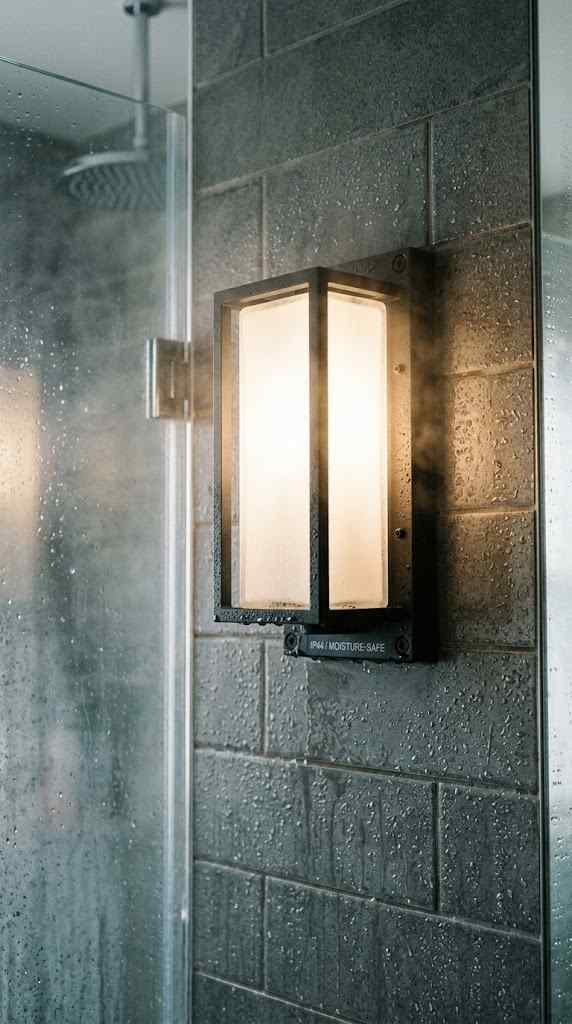
This is the part where I get slightly bossy, because ignoring it can genuinely fry a fixture or trip your breaker. Bathrooms are humid boxes, and not every light is built to handle moisture. Lighting carries safety ratings for exactly this reason, and picking the wrong one is a mistake you only make once.
Here’s the quick breakdown:
● Dry-rated: Meant for living rooms and hallways. Keep these far away from any splash zone. If you install one near a shower, you’re rolling dice with electricity.
● Damp-rated: Built to survive moisture in the air condensation, steam, general bathroom humidity. This is the safe default for most vanity walls that don’t get directly sprayed.
● Wet-rated: Sealed to handle actual water contact. These are the ones you want inside a shower enclosure or right beside a soaking tub.
FYI, the rating is almost always printed on the box or listed in the product specs, so you don’t have to guess. If a listing doesn’t mention one at all, that’s a small red flag worth noticing.
My rule of thumb is simple. Anywhere near the vanity? Damp-rated minimum. Inside the shower or over the tub? Wet-rated, no exceptions. It costs a few dollars more and saves you from a very unfun electrical surprise later.
Where to Actually Mount Them (Height and Spacing)
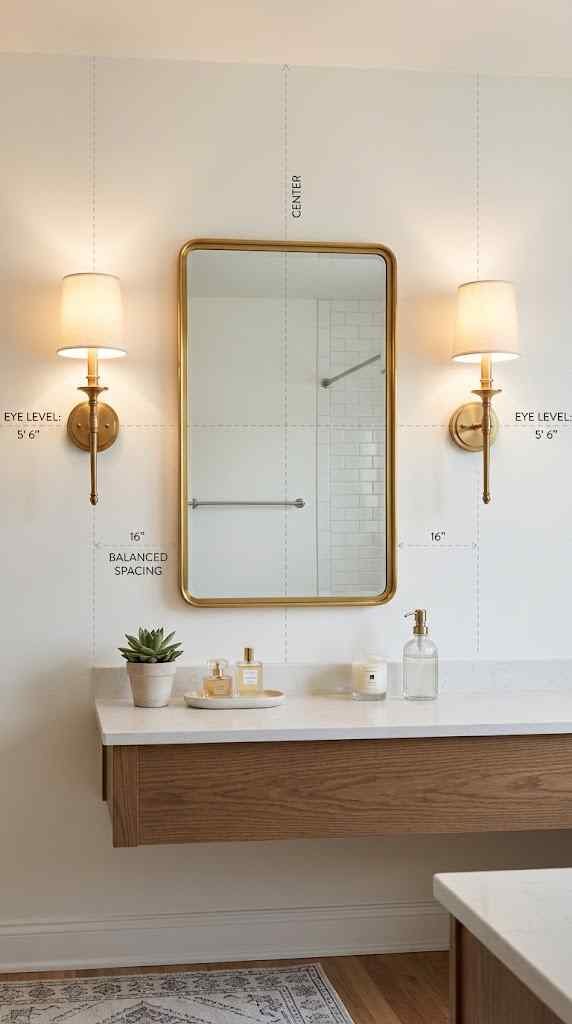
You bought the sconces. Great. Now comes the part everyone eyeballs and half of them get wrong placement. Mount them too high and you’re back to shadow-city. Mount them too far apart and the light won’t reach your face evenly.
For horizontal spacing, aim to separate the two fixtures by about 28 to 36 inches, with your mirror centered between them. This lets the light cross over your face from both sides and cancel out shadows. Think of it like two friends holding flashlights at your cheeks instead of one hovering over your scalp.
A few practical pointers:
Center each sconce at eye level, adjusting slightly if everyone in your household is notably tall or short.
Keep the mirror between the two lights, not one light off to the side pulling double duty.
If you only have room for a single sconce, mount it above the mirror rather than cramming it awkwardly to one edge.
Leave enough clearance so nobody’s forehead meets the fixture when they lean in.
If your mirror is unusually wide, IMO you’re better off with a pair flanking it than trying to stretch one light across the whole span. One fixture simply can’t spread even light over four feet of glass physics isn’t on your side there.
Choosing a Style That Won’t Look Dated in Two Years
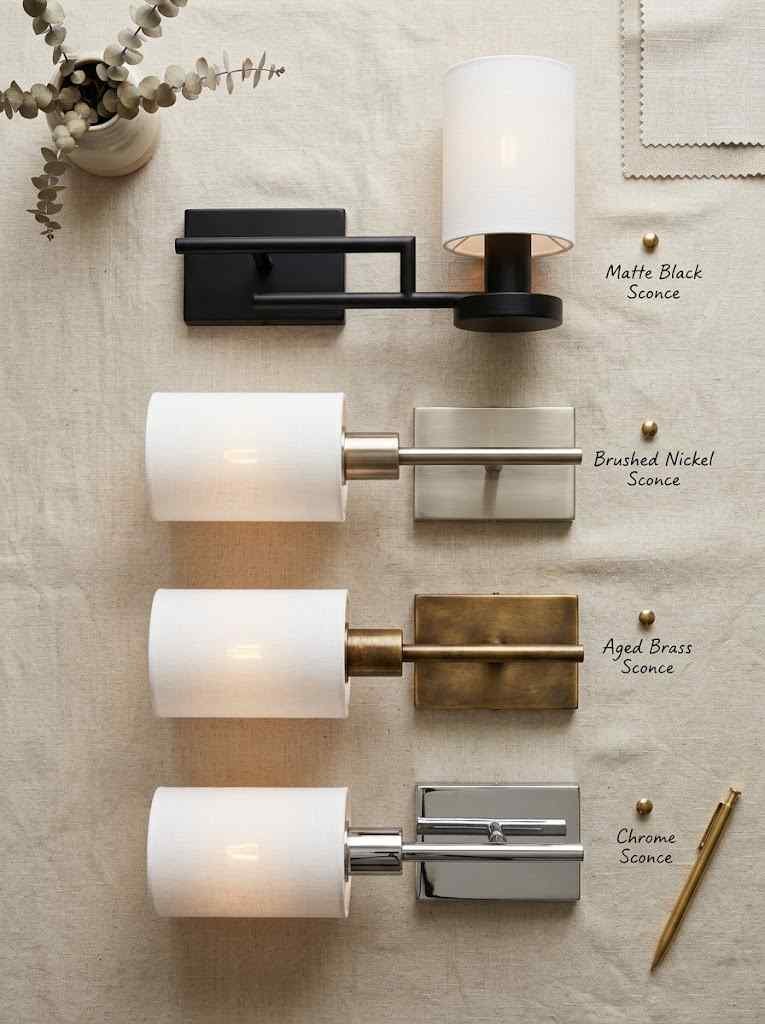
Design trends move fast, and nothing screams “renovated in a specific year” like a fixture chasing whatever was hot that season. So how do you pick something you’ll still like when the trend cycle inevitably turns? You lean toward shapes and finishes with staying power, then add personality in smaller doses.
Let me save you some scrolling with the finishes that tend to age gracefully:
● Matte black: Crisp, modern, hides water spots like a champ. Genuinely low-maintenance, which I appreciate more every year.
● Brushed nickel: The reliable middle-of-the-road choice. It plays nice with almost any color scheme and never fully goes out of fashion.
● Aged or antique brass: Warm, a little vintage, currently everywhere but the good news is brass has cycled in and out for a century, so it’s less of a gamble than it looks.
● Chrome: Bright and clean, leans traditional, and pairs beautifully with classic subway tile.
Beyond finish, think about the shade. Frosted or opaque glass diffuses light softly and hides the bulb, which flatters skin. Clear glass or an exposed bulb looks striking but throws harsher, more direct light pretty in a photo, less forgiving on your actual face.
Here’s my genuinely held opinion after living with a few of these: skip anything with fabric shades in a bathroom. They soak up humidity, discolor over time, and start smelling faintly like a damp basement. Glass and metal are your friends in a wet room. 🙂
One more small thing worth remembering match the scale of the sconce to the wall. A dainty little fixture next to a huge vanity mirror looks lost, and a chunky industrial piece can swallow a small powder room. Proportion sells the whole look more than the price tag does.
Bulbs and Color Temperature, The Detail That Makes or Breaks It
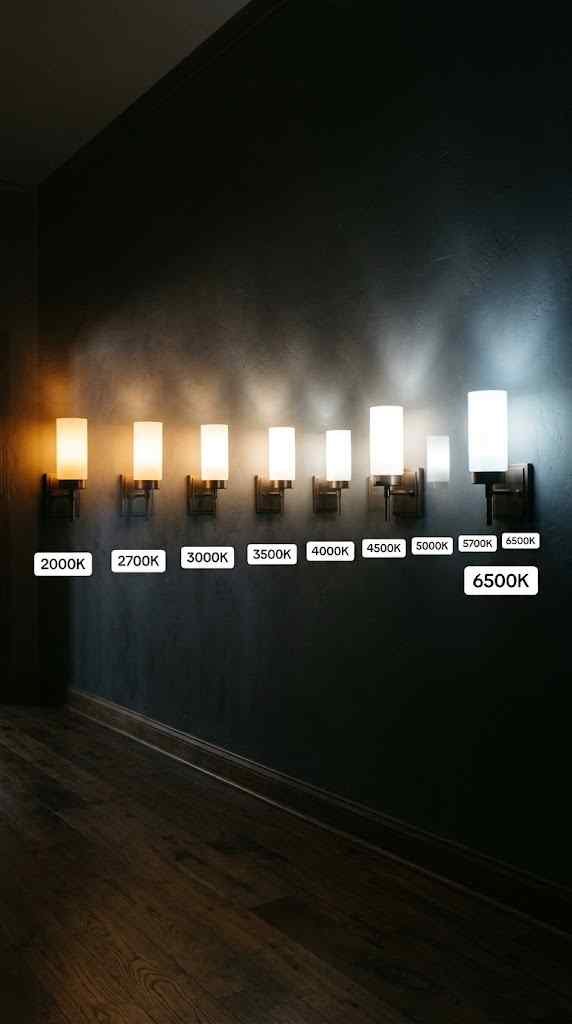
You can buy the most gorgeous sconces on the market and still hate the result if the bulb inside is wrong. This is the sneaky variable nobody warns you about, and it’s the difference between “spa retreat” and “hospital corridor.” Color temperature is measured in Kelvins, and for a bathroom the range you want sits in a fairly narrow band.
Here’s how the numbers translate to real life:
● 2700K: Warm and cozy, like a table lamp. Lovely for relaxing, but it can make it hard to see true colors when you’re doing makeup or checking whether that shirt is navy or black.
● 3000K: Soft white with a slightly warm edge. My personal favorite for bathrooms flattering without being murky.
● 3500K to 4000K: Bright and neutral, closer to daylight. Excellent for grooming accuracy, though it can feel a touch clinical if you’re after a relaxing vibe.
● 5000K and up: Cool daylight. Great for a garage. In a bathroom, it’ll make you feel like you’re being processed at the DMV.
For most people, a bulb in the 2700K to 3000K range hits the sweet spot warm enough to feel inviting, accurate enough to get ready under. If you do detailed makeup, nudge slightly cooler toward 3500K.
Also pay attention to CRI, or Color Rendering Index. A CRI of 90 or above means colors look true to life, which matters a lot when you’re matching foundation to your actual skin tone. Cheap bulbs with low CRI make everything look faintly off, and you won’t know why your makeup looks weird in daylight later. LED sconces have come a long way here, and most quality LED bulbs now offer high CRI without the buzzing or slow warm-up of older tech.
One more tip that saves headaches down the road: buy all your bathroom bulbs in the same color temperature and from the same batch if you can. Mixing a 2700K bulb with a 3500K one in the same room creates a subtle mismatched glow that your brain notices even if you can’t name it. Consistency reads as intentional; a mismatch reads as an afterthought.
Installation: Grab a Screwdriver or Grab Your Phone?
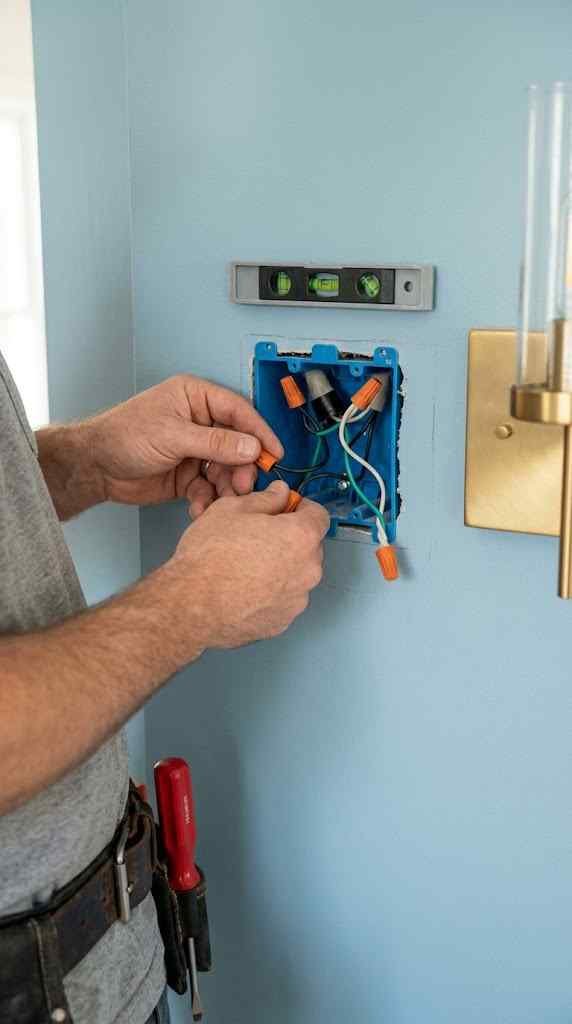
Now the honest conversation about actually getting these on the wall. Some sconce swaps are genuinely beginner-friendly. Others quietly require rewiring, moving a junction box, or fishing cable through a wall and those are firmly in “call someone” territory.
If you’re replacing an existing fixture with new wiring already in place, a straight swap is doable for a confident DIYer. The general flow looks like this:
● Kill the power at the breaker then test the wires to confirm it’s actually off. Don’t trust the switch alone.
● Unscrew and remove the old fixture, noting how the wires connect.
● Match the new sconce’s wires to the existing ones usually black to black, white to white, ground to ground.
● Secure the mounting bracket, attach the fixture, add the bulb, and restore power.
That said, if there’s no existing wiring where you want the sconce, you’re now talking about cutting into drywall, running new cable, and possibly adding a box. That’s a licensed electrician’s job, and it’s worth every penny botched electrical work in a wet room isn’t the place to save a hundred bucks.
Would I wire a brand-new circuit myself? Not a chance. But I’ll happily swap a like-for-like fixture on a Saturday morning with a cold drink nearby. Know which category your project falls into before you commit, and you’ll save yourself a very frustrating afternoon.
One last safety note: bathrooms usually require GFCI protection on the circuit. If yours doesn’t have it, add that to the pro’s to-do list. It’s a small upgrade that seriously reduces shock risk in a room full of water.
Dimmers and Layering, The Upgrade Nobody Mentions
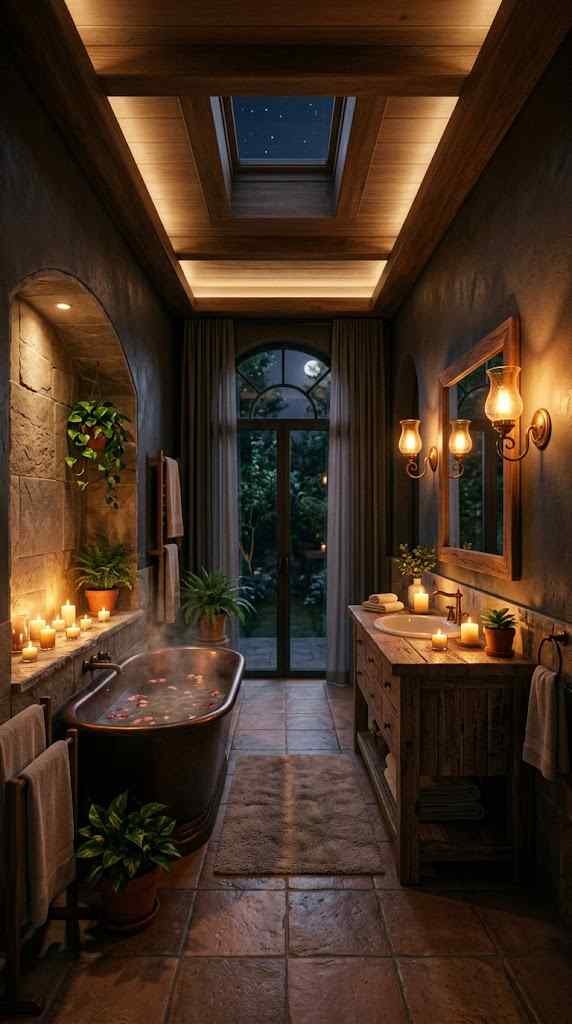
Here’s a small change that punches absurdly above its weight: put your sconces on a dimmer. A bathroom has two completely different jobs, and one bulb setting can’t serve both. You need bright, honest light for shaving and makeup, but you also want a soft glow for a late-night trip that doesn’t blast your retinas awake at 2 a.m.
A dimmer bridges that gap for less than the cost of the fixture itself. Crank it up when you’re getting ready, dial it down for a relaxing soak. Dimmable sconces essentially give you two rooms for the price of one switch. Just double-check that your LED bulbs are labeled dimmable plenty aren’t, and a non-dimmable LED on a dimmer will flicker, buzz, or straight-up refuse to cooperate.
Layering matters too. Sconces shouldn’t be the only light source carrying the whole room. Pair them with a soft overhead or a recessed can for general fill, and let the sconces handle the face-level work. When you combine ambient light with task light, the room stops feeling flat and starts feeling designed.
Would I skip the dimmer to save twenty bucks? Never again. I did exactly that in my first apartment and spent two years squinting at the harshest possible glow while brushing my teeth. Learn from my stubbornness.
Small Room, Big Impact, Sconces in Tight Spaces

Not everyone’s working with a spacious master bath, and powder rooms bring their own puzzle. When wall space is scarce, you have to get a little clever. The good news? Sconces are actually a small-space secret weapon, precisely because they don’t eat up counter or floor real estate the way a lamp would.
In a cramped half-bath, a single well-placed sconce beside a slim mirror can do more visual lifting than you’d expect. It draws the eye up, adds a warm glow, and makes the whole room feel intentional rather than forgotten. Vertical light in a tiny room tricks the eye into perceiving more height and openness.
For narrow vanities, slim vertical sconces mounted flush to the wall keep everything from feeling crowded. Skip the wide, projecting fixtures here anything that sticks out too far becomes a shoulder hazard in a room where you’re already turning sideways to reach the towel. Isn’t it funny how the smallest bathrooms demand the most careful planning? :/
The takeaway for tight spaces is restraint. One thoughtful fixture beats three fighting for attention, and a compact profile keeps the room breathable.
FAQ’s
Can bathroom sconces go over the mirror instead of beside it?
Yes, if you lack side space. But side-mounted bathroom sconces flatter your face better by cutting harsh shadows.
How many bathroom sconces do I need for a double vanity?
Usually three or four one beside each mirror edge, or one placed evenly between each sink.
Do bathroom sconces need a special junction box?
Yes, they mount to a wall-rated electrical box. New locations require running wiring, so hire a licensed electrician.
Are LED bathroom sconces worth the extra cost?
Absolutely. LED bathroom sconces last longer, run cooler, dim smoothly, and offer high-CRI bulbs for accurate skin tones.
Can I install bathroom sconces in a rental?
Only with landlord permission, since wiring changes are permanent. Ask first, or look into plug-in sconce alternatives instead.
CONCLUSION
Bathroom sconces are one of those upgrades that punch way above their price and effort. For the cost of a decent dinner out, you can fix the lighting that’s been quietly making you look tired for years and unlike a dinner, this one keeps paying you back every single morning.
Get the safety rating right, mount them at eye level, choose a warm-ish bulb with good color accuracy, and pick a finish you’d still nod at in five years. Do those four things and you’ve basically nailed it. Everything else is just personal taste, which is exactly how it should be.
So here’s my parting nudge: go stand in your bathroom right now and actually look at where your light comes from. If it’s beaming down from a single fixture overhead and you’ve been blaming your skincare routine for those shadows well, now you know who the real culprit is. Time to give those side walls a job.