
small backyard ideas
By Anna Grace | 20 July 2026
Small Backyard Ideas That Feel Like a Private Retreat
My first apartment came with a backyard roughly the size of a parking space. The landlord called it a “garden patio.” I called it a concrete rectangle with delusions of grandeur. But over two summers, that sad slab became my favorite room in the house and it taught me something most home magazines gloss over: a small backyard isn’t a limitation. It’s an editing exercise.
Big yards forgive bad decisions. You can plop a random gazebo in one corner, forget about it, and the lawn swallows the mistake. Small yards? Every square foot has a job. That constraint is exactly what makes small backyard ideas so satisfying to execute. When the space is tight, each choice matters, and the results feel intentional in a way sprawling yards rarely do.
This guide walks through the strategies that actually work not the Pinterest fantasies that require a trust fund and a team of landscapers, but real ideas for real yards. Whether you’re working with a narrow side strip, a townhouse courtyard, or a modest patch of grass behind a starter home, you’ll find something here worth stealing.
Start With Function, Not Furniture
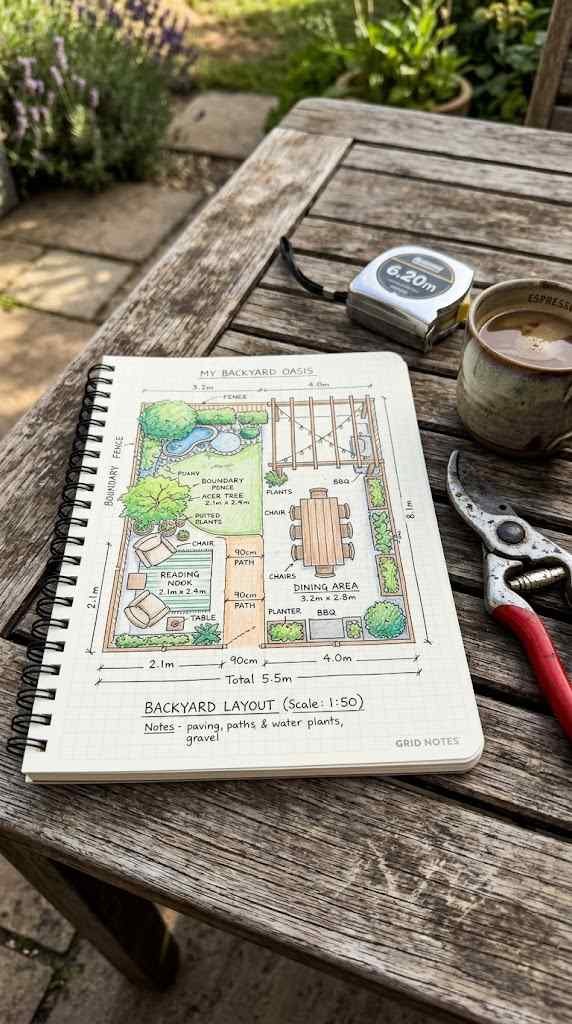
Here’s the mistake almost everyone makes: they see a cute bistro set on sale, buy it, and then try to build a backyard around it. Backwards. Completely backwards.
Before you spend a dollar, answer one question: what do you want to do out there? Your honest answer changes everything.
● Morning coffee and quiet reading calls for one comfortable chair, a small side table, and shade not a dining set for six.
● Hosting friends means prioritizing seating capacity and a food-friendly surface over plants and decor.
● Gardening as a hobby shifts the budget toward raised beds, good soil, and a potting station.
● Kids or pets demand durable ground cover and open play space, which means resisting the urge to fill every corner.
Most small yards can genuinely support one primary function and one secondary function. Trying to cram in all four gives you a yard that does everything badly. I learned this the hard way when I tried to squeeze a fire pit, a vegetable garden, a dining area, and a hammock into my concrete rectangle. The hammock hovered over the tomatoes. Guests kept kicking the fire pit. It was chaos, and honestly, kind of a fire hazard.
Pick your yard’s job first, and let everything else audition for the remaining space.
Once you’ve named the function, sketch it. Nothing fancy graph paper or a free app works fine. Measure your actual dimensions (don’t eyeball it; everyone eyeballs generously) and block out zones at real scale. A standard dining chair needs about two feet of pull-out clearance behind it. A grill needs three feet of breathing room from anything flammable. These numbers feel boring until you skip them and end up sidling past your own patio table like you’re on a ledge
The one-in-one-out rule
Small yards accumulate clutter fast. A good discipline: for every new item that enters the yard, something leaves. The wobbly plant stand, the cracked planter, the chair nobody sits in because it faces the neighbor’s AC unit out. Ruthlessness reads as design. Clutter reads as a storage unit with grass.
Think in Cubic Feet, Not Square Feet
Your yard’s footprint is fixed. Its volume is negotiable. The single biggest unlock in small-space design is realizing that walls, fences, and air are all usable real estate.
Vertical gardening is the obvious starting point, and for good reason it works. A bare fence is basically an empty bookshelf. Fill it:
● Pocket planters turn a six-foot fence panel into twenty planting spots for herbs, strawberries, or trailing flowers.
●Trellises with climbing plants (clematis, star jasmine, climbing roses) add lushness with a footprint of inches.
● Wall-mounted shelving displays potted plants in tiers instead of scattering them across precious floor space.
● Hanging baskets pull color up to eye level, which makes the whole yard feel fuller without eating ground area.
But vertical thinking goes beyond plants. Mount your string lights high and let them define a “ceiling” this one trick makes a tiny patio feel like an outdoor room instead of a leftover slab. Install a fold-down murphy-style table on the fence that disappears when you’re not eating. Hang a mirror (yes, outdoors use an acrylic one rated for exterior use) and watch your yard visually double. IMO, an outdoor mirror is the most underrated trick in this entire article, and it costs less than a decent houseplant.
Ever notice how the best small restaurants feel bigger than they are? They’re doing exactly this drawing your eye up and around instead of letting it hit a back wall and stop. Your yard can borrow the same psychology.
One caution: check weight limits and fence ownership before drilling. Shared fences often legally belong to your neighbor or belong to both of you jointly, depending on where you live. A five-minute conversation beats a property-line feud that outlasts the petunias.
Borrow the view
If anything attractive exists beyond your fence line a neighbor’s mature tree, a distant hillside, even decent sky frame it rather than blocking it. Landscape designers call this “borrowed scenery,” and it’s free square footage for your eyes. Keep plantings lower on that side and place your main seating to face the view. Your yard suddenly extends to the horizon, no permits required.
Zone Your Yard Like a Studio Apartment
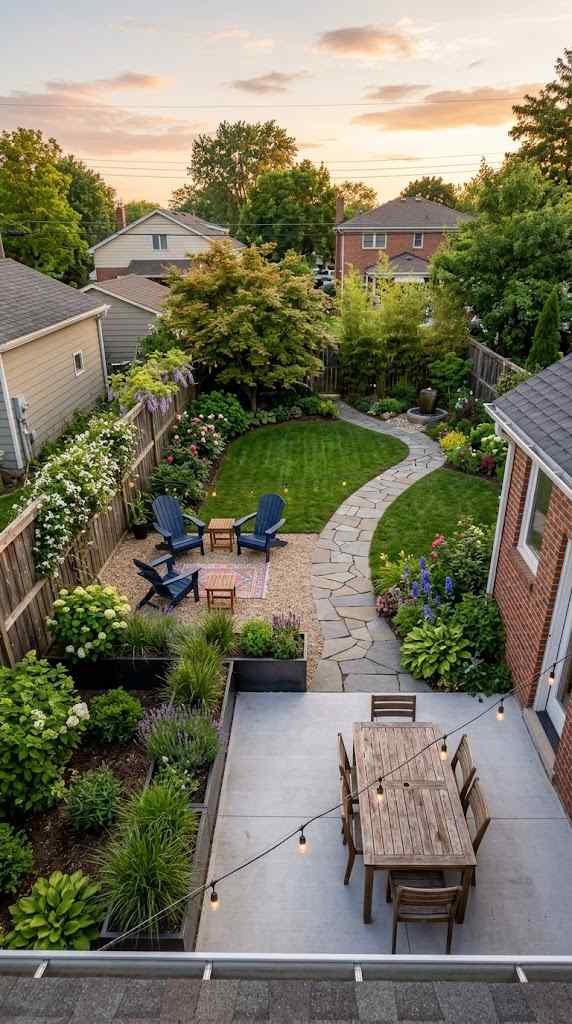
A studio apartment with a bed in one corner, a sofa in another, and a desk by the window feels like three rooms. A studio with everything shoved against one wall feels like a storage locker. The same principle governs small backyards, and it’s weirdly counterintuitive: dividing a small space makes it feel bigger, not smaller.
Why? Because zones create a journey. When your eye (and your feet) move from a gravel seating nook to a stepping-stone path to a raised-bed garden corner, your brain registers distance and variety. When everything sits on one undifferentiated patch, your brain clocks the whole thing in half a second and files it under “small.”
You don’t need walls to create zones. You need transitions:
● Change the ground material. Pavers to gravel, gravel to ground cover, deck boards running in a different direction each shift signals a new “room.”
● Use planters as soft walls. A row of three tall planters creates separation without blocking light or sightlines.
● Vary the levels. Even a single step up to a small deck platform creates dramatic spatial separation. Sunken or raised areas read as destinations.
● Light zones differently. Warm string lights over the seating area, subtle path lights along the walkway, a spotlight on your best plant. Nighttime zoning is criminally overlooked.
In my current yard bigger than the concrete rectangle, still modest I carved out three zones: a dining spot near the back door, a two-chair fire pit corner diagonally opposite, and a skinny gravel path connecting them past the raised beds. Guests routinely guess the yard is nearly twice its actual size. I do not correct them. 🙂
Diagonal layouts deserve a special mention here. The longest sightline in any rectangle is corner to corner, so orienting a path or a strong visual axis diagonally exploits the maximum dimension your yard has. It feels like a designer trick because it is one, but it costs nothing to implement.
Scale your zones honestly
A zone can be tiny and still succeed. A “reading nook” can be one chair, one plant, and one small table maybe fifteen square feet. What kills a zone is ambiguity: a chair floating in the middle of nowhere isn’t a nook, it’s a lost chair. Anchor each zone with a rug, a ground-material change, or a defined boundary, and even a closet-sized corner earns its keep.
Choose Hard-Working Plants and Multi-Tasking Furniture
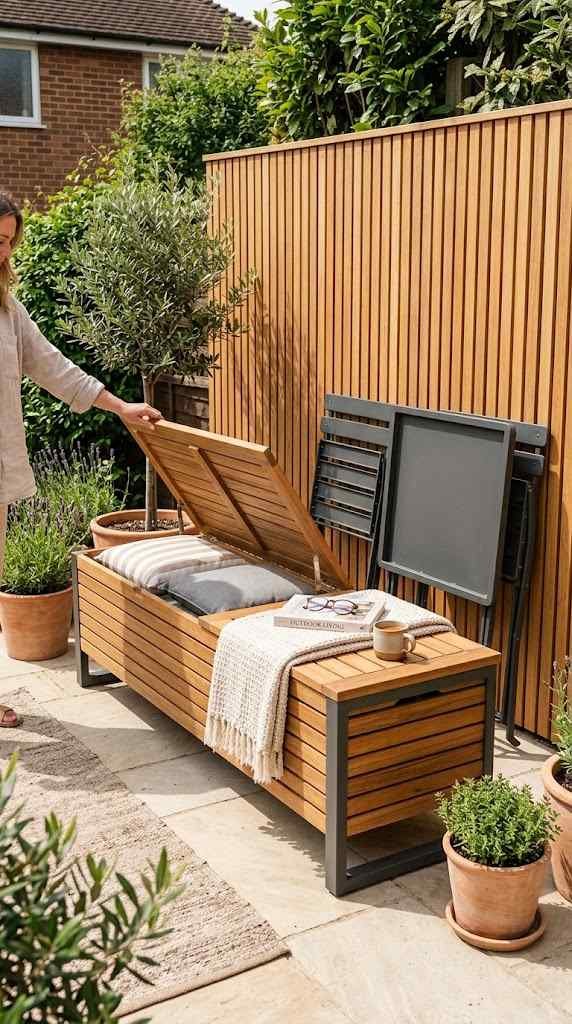
In a small backyard, nothing gets to have just one job. Not the plants, not the furniture, not even the storage. Everything multitasks or gets voted off the island.
Start with the plants. Skip anything that looks good for two weeks and sulks for fifty. You want the overachievers:
● Dwarf fruit trees (columnar apples, patio peaches) deliver spring blossoms, summer shade, and actual fruit from a container.
● Herbs like rosemary, thyme, and lavender are evergreen structure, fragrance, pollinator magnets, and dinner ingredients in one.
● Ornamental grasses provide movement, sound, four-season interest, and near-zero maintenance.
● Evergreen climbers like star jasmine give you privacy screening, greenery, and perfume without claiming floor space.
Container gardening deserves its own applause in small yards. Containers let you rearrange your entire landscape on a whim, chase the sun through the seasons, and control soil quality precisely. Group pots in odd numbers and vary heights a cluster of three at different levels always beats five identical pots in a row. FYI, oversized containers are also more forgiving than small ones; they dry out slower and give roots room, so beginners actually do better with big pots.
Now the furniture, where multitasking really pays:
● Storage benches seat three people and swallow cushions, tools, and toys.
● Folding bistro sets host dinner, then flatten against the fence when you need floor space.
● Ottomans and poufs work as seats, footrests, and side tables depending on the hour.
● A grill cart with shelving is prep station, storage, and serving surface in one footprint
Would you buy a couch for your living room that only worked on Tuesdays? Of course not so don’t buy a yard piece that only earns its space one weekend a month.
Color and material choices matter here too. Lighter tones pale gravel, whitewashed fences, cream cushions reflect light and expand space visually, while a dark fence paradoxically can also work by making the boundary recede and letting green plants pop forward. Pick one strategy and commit. The yards that feel cramped are usually the ones hedging with five competing colors and three clashing materials.
Nail the Details: Lighting, Privacy, and Maintenance Reality
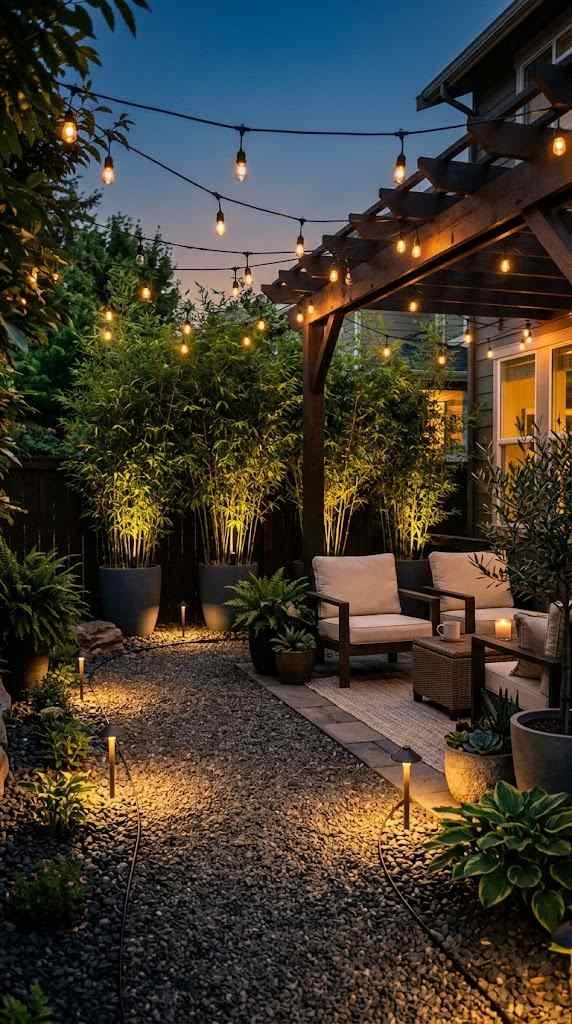
The last mile separates yards that photograph well from yards you actually use every evening. Three details do most of that work.
Lighting comes first. A small backyard with layered lighting gets used four more hours a day than one with a single glaring flood light. Aim for three layers: ambient (string lights or lanterns overhead), task (brighter light near the grill or table), and accent (solar spotlights on plants, path lights along walkways). Solar options have improved enormously and require zero wiring, which makes this the highest-return upgrade per dollar in the entire backyard universe. Warm white bulbs around 2700K flatter everything. Cool white makes your cozy patio feel like a loading dock.
Privacy comes second, but barely. Nothing shrinks a yard psychologically like feeling watched. You rarely need to fortress the entire perimeter, though you need to screen the specific sightline into your main seating zone. Options by budget:
● Free-ish: reposition seating so backs face the exposure, or shift a zone entirely.
● Cheap: bamboo or reed fencing panels zip-tied to existing chain link.
● Mid-range: a single privacy screen or slatted panel placed strategically, not a full fence rebuild.
● Living: tall grasses, clumping bamboo in containers (clumping never running, unless you enjoy lawsuits), or a trellis with an evergreen climber.
Maintenance reality comes third, and it’s the one nobody wants to discuss. Every element you add is a future chore. Real wood furniture wants annual sealing. Lawns want weekly mowing even when they’re the size of a bath towel. Twenty small pots want daily summer watering; five large ones want it twice a week. Design for the gardener you are, not the gardener you imagine becoming in some ambitious parallel life. A simple yard you maintain beats an elaborate one you resent.
If watering is your weak spot, a drip irrigation kit on a cheap timer transforms container gardening from a daily obligation into a monthly check-in. It’s the least glamorous purchase in this article and possibly the most life-improving.
FAQ’s
What should I plan first in a small backyard?
Define one primary function dining, gardening, or relaxing before buying anything.
How do zones make a small backyard feel bigger?
Distinct areas create visual journeys, so your brain registers more perceived space.
Which plants work hardest in small yards?
Dwarf fruit trees, evergreen herbs, ornamental grasses, and climbing vines multitask beautifully.
What’s the cheapest way to add backyard privacy?
Screen only the main sightline using bamboo panels, tall grasses, or repositioned seating.
Do small backyards need special lighting?
Yes layer ambient string lights, task lighting, and solar accents for evening use.
CONCLUSION
Somewhere along the way, we absorbed the idea that a good backyard must be a big one that outdoor happiness scales with acreage. My concrete rectangle disagreed, and so does every courtyard garden in Kyoto, every Parisian balcony, every London terrace plot that packs more charm into 150 square feet than most suburban half-acres manage.
Small yards force decisions, and decisions are where design lives. Choose one primary function. Build upward. Zone the floor plan. Make every plant and piece of furniture earn its footprint twice over. Light it in layers, screen the one sightline that matters, and be honest about the maintenance you’ll actually do.
Then and this is the step people skip go sit in it. Tonight, if the weather allows. A small backyard’s greatest advantage is that it’s finishable. You can genuinely complete it, refine it, and then spend your weekends enjoying it instead of maintaining it. The half-acre crowd can’t say that.
Start with one zone this weekend. The rest of the yard will tell you what it wants next.