
Bathroom pendant lighting
By Anna Grace | 5 June 2026
Bathroom Pendant Lighting: How to Get It Right Without Regretting It Later
My friend Nora poured four thousand dollars into her bathroom remodel and then lit the whole thing with a single builder-grade dome light that made every guest look faintly hungover. Gorgeous tile. A vanity worth photographing. And lighting you’d expect in a parking garage stairwell. The rescue cost her less than a nice dinner out a pair of small pendants beside the mirror and the room suddenly read like it cost twice what she actually spent.
That little story sums up why I keep pushing people toward pendants in the bathroom. They’re one of the cheapest swaps in the entire room, and one of the few that shifts the whole mood the second you flip the switch. Recessed cans get the job done, sure, but they light a room the way fluorescent tubes light a break room. Pendants do something different. They give a bathroom a point of view.
So let’s sort out how to actually pull this off safely, at the right height, in a size that doesn’t swallow your mirror, and with light that makes you look like a person instead of a suspect in a lineup.
Why Pendants Beat the Usual Bathroom Lighting
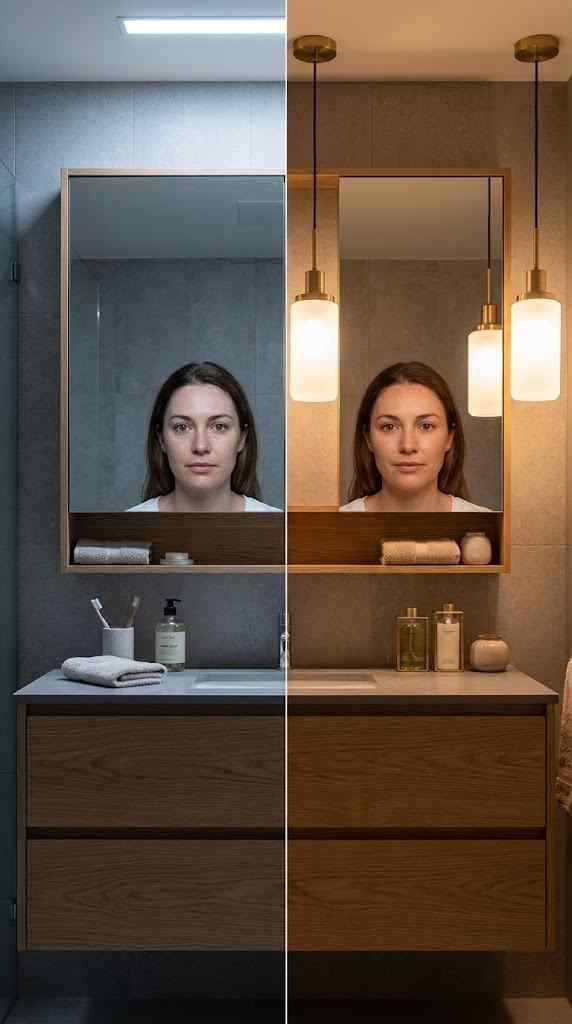
Most bathrooms get lit by whatever the builder installed and nobody bothered to question. A flush dome in the ceiling, maybe a bar of exposed bulbs above the mirror that hums when you turn it on. Functional? Barely. Flattering? Not even a little
Pendant lights change the equation because they bring the light source down to human level. Instead of blasting everything from directly overhead which carves harsh shadows under your eyes and chin a well-placed pendant throws light across your face at an angle that’s actually kind to you. Ever noticed how you look great in one bathroom and terrible in another, even though both have mirrors? The height and angle of the light matter more than the brightness.
There’s also the design side, and I won’t pretend it doesn’t count. A single sculptural pendant over a freestanding tub turns an ordinary bathroom into something you’d screenshot from a hotel. Two matching pendants flanking a mirror read as intentional in a way recessed cans never will. You’re not just lighting the room you’re decorating it and lighting it in one move, which is a rare two-for-one.
And here’s a small confession I think the “pendant beside the mirror instead of a wall sconce” trick is one of the most underused ideas in home design. It costs about the same, delivers softer and more even light, and looks custom even when it isn’t.
Safety Comes First (This Part Isn’t Optional)
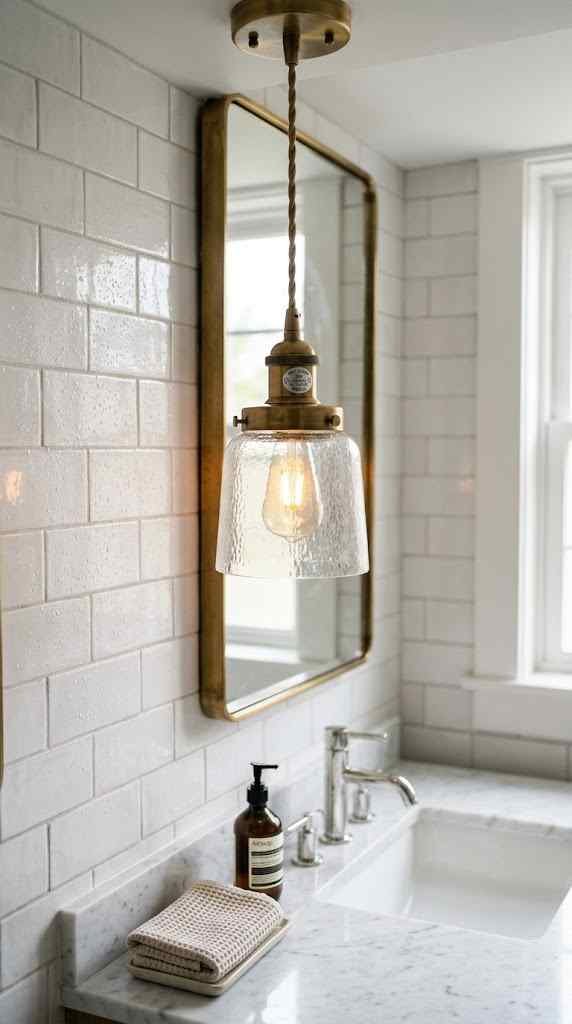
Water and electricity have a famously bad relationship, so before you fall in love with a fixture, you need to know where it’s allowed to hang. This is the one area where I’ll turn off the jokes, because getting it wrong is genuinely dangerous.
In the U.S., bathroom fixtures need the right rating for moisture. A damp-rated fixture handles humidity and the occasional bit of condensation fine for a pendant over the vanity or in a powder room. A wet-rated fixture can take direct water contact, which is what you want anywhere near a tub or shower where splashing is a real possibility. Check the label or spec sheet for a UL listing that says “damp location” or “wet location.” If it doesn’t say, assume it isn’t rated and keep it away from water.
There’s also a placement rule people love to ignore. In the U.S., electrical code keeps hanging fixtures pendants and chandeliers included out of a zone that extends roughly three feet horizontally and eight feet vertically from the rim of a tub or the threshold of a shower. Translation you can’t dangle a pendant directly over your shower or in arm’s reach of the tub. A pendant over a freestanding tub works when the tub sits far enough away from the shower and the fixture hangs high enough and off to the position that keeps it out of that zone.
If you’re outside the U.S., you’ll run into the IP rating system and bathroom “zones” instead. The short version:
● VZone 0 inside the bath or shower itself. Needs the highest protection; a pendant almost never belongs here.
● Zone 1 directly above the bath up to about 2.25 meters. Requires a solidly water-resistant fixture (IPX4 or better).
● Zone 2 the 0.6-meter buffer beyond Zone 1, plus around the sink. Still needs splash protection.
● Outside the zones more freedom, though a moisture-rated fixture is still smart in a humid room.
Whichever country you’re in, do yourself one favor: hire a licensed electrician for the install. I’m all for DIY on shelves and paint, but ceiling wiring above a wet room is not the hill to die on. An electrician also knows your local code better than any blog ever will, mine included.
Where to Actually Hang Them

Placement is where good intentions either become a stunning bathroom or a fixture you keep smacking with your forehead. Different spots call for different moves, so let’s walk through the usual suspects.
Flanking the Mirror
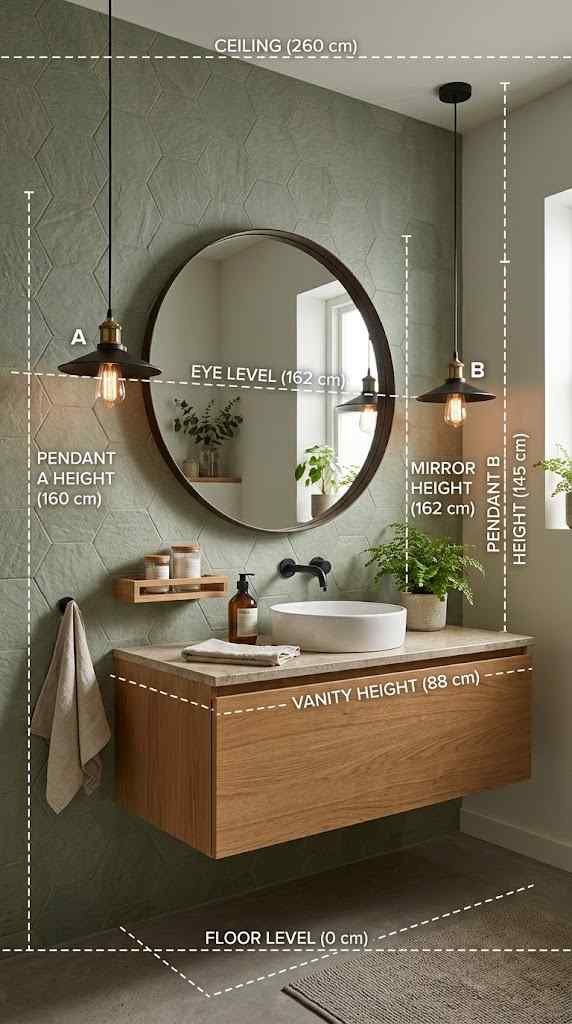
It works beautifully for grooming, makeup, and not-scaring-yourself-at-6am purposes. Keep the two pendants symmetrical and matched, and mount them so the bottom of each sits around 60 to 66 inches off the floor basically at the height of the average person’s face when they’re standing at the sink.
Over a Freestanding Tub
Want the dramatic, spa-hotel look? A single statement pendant over a freestanding tub delivers it. This is your chance to go a little bigger and bolder than you would elsewhere, because the fixture becomes the room’s centerpiece.
Just respect the safety zone we covered, keep the fixture wet-rated, and hang it high enough that nobody clonks their head climbing in. Most people aim for at least seven feet of clearance above the tub floor, more if the tub sits raised.
Powder Rooms and Small Baths
A powder room is a playground because there’s no shower to worry about and guests only spend a few minutes there. Go dramatic. A single oversized pendant or a tiny cluster can turn a closet-sized half-bath into the most talked-about room in the house.
Since these rooms are small, one well-chosen fixture usually does all the work. You don’t need a pendant and sconces and recessed lights fighting for attention pick the star and let it shine.
Getting Size and Height Right
Here’s where a lot of otherwise-good ideas fall apart. People buy a pendant they love in the store, bring it home, and only then realize it’s the size of a beach ball hovering over their tiny sink. Scale is everything, and a fixture that’s wrong for the space looks wrong no matter how pretty it is on its own.
For pendants flanking a mirror, stay modest. A diameter of five to eight inches usually looks right big enough to matter, small enough that the pair doesn’t crowd the glass. Two dinner-plate-sized globes next to a bathroom mirror is a lot of look, and rarely in a good way.
For a single statement pendant over a tub or in a powder room, you’ve got more room to breathe. A rough starting point: measure the width of the surface below it (the tub, the vanity) in inches, and aim for a fixture diameter somewhere between a third and a half of that. It’s not a law, just a sanity check that keeps you from going wildly too big or too timid.
Height needs the same care. Here’s a quick cheat sheet for common spots:
Beside a mirror: bottom of the pendant around 60–66 inches from the floor, roughly at eye level.
Over a vanity, hanging from the ceiling: leave about 28–38 inches between the countertop and the bottom of the fixture.
Over a freestanding tub: at least seven feet of clearance above the tub floor, adjusted up for tall folks or raised tubs.
One more thing that trips people up: cord and rod length. Many pendants ship with an adjustable cord or a set of stackable rods, but not all of them. If you’ve got soaring ceilings, double-check that the fixture can actually drop far enough before you buy I’ve watched someone end up with a gorgeous pendant marooned nine feet in the air because the cord maxed out. :/
Choosing the Fixture, the Bulb, and a Dimmer You’ll Thank Yourself For
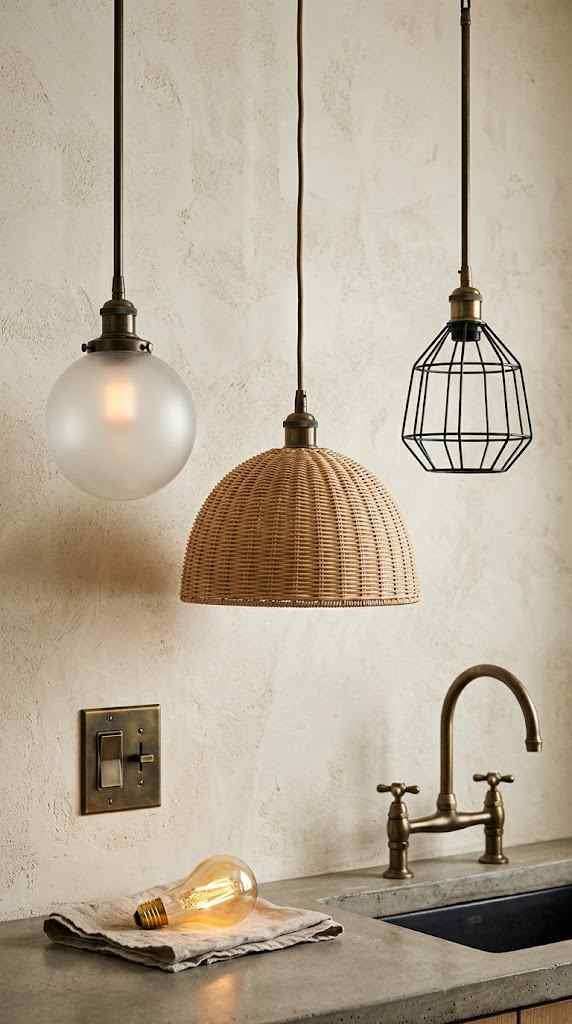
Style is the fun part, and it’s also the part where I’ll resist telling you what to like. Glass globes feel clean and modern. Woven or rattan shades add warmth and texture. A little brass lantern leans traditional a matte black cage leans industrial. Pick what plays nicely with your tile, hardware, and general vibe rather than chasing whatever’s trending this month, because trends age and your bathroom shouldn’t.
One trick that makes any pendant look intentional: tie its finish to something already in the room. If your faucet and cabinet pulls are brushed nickel, a pendant with matching metal reads as planned rather than random. Same goes for black hardware, warm brass, or chrome. You don’t need everything to match perfectly a little contrast keeps a room from feeling like a showroom but pulling the pendant’s metal from your existing palette is the easiest way to make a cheap fixture look like it belonged there all along. When in doubt, echo the faucet it’s usually the metal your eye lands on first.
But the fixture is only half the story. The bulb inside it does more heavy lifting than most people realize, and this is where bathrooms live or die.
Color temperature is the number to watch, measured in Kelvin. Warm light around 2700K to 3000K feels cozy and flatters skin great for a relaxing soak or a room you want to feel inviting. If you do a lot of grooming or makeup at the mirror, nudge toward 3000K–3500K for a cleaner, more accurate light without tipping into that cold, clinical glare. Anything up around 5000K reads as harsh blue daylight, which is honest to a fault it shows you every pore and rarely makes anyone happy at dawn.
Then there’s CRI, or Color Rendering Index, which basically measures how truthfully a bulb shows colors. Look for CRI 90 or higher in a bathroom, especially near the mirror. High CRI is the difference between your foundation matching in real life and looking orange the moment you step outside. FYI, this one small spec spares a lot of frustration.
And please, install a dimmer. A pendant blazing at full strength is fine when you’re getting ready, but nobody wants floodlights at 2am when you’re just stumbling in for a glass of water. A dimmer lets one fixture serve both moods, and it’s a cheap add during any install. IMO it’s the single most underrated upgrade in a bathroom small cost, daily payoff.
If you want a rough shopping checklist to keep in your pocket:
● Moisture rating: damp-rated near the vanity, wet-rated near water.
● Color temperature: 2700K–3000K for ambiance, 3000K–3500K for grooming.
● CRI: 90+ wherever you’ll look at your own face.
● Dimmable bulbs plus a compatible dimmer switch.
● Correct size and drop length for the specific spot.
Don’t Ask Pendants to Do Everything
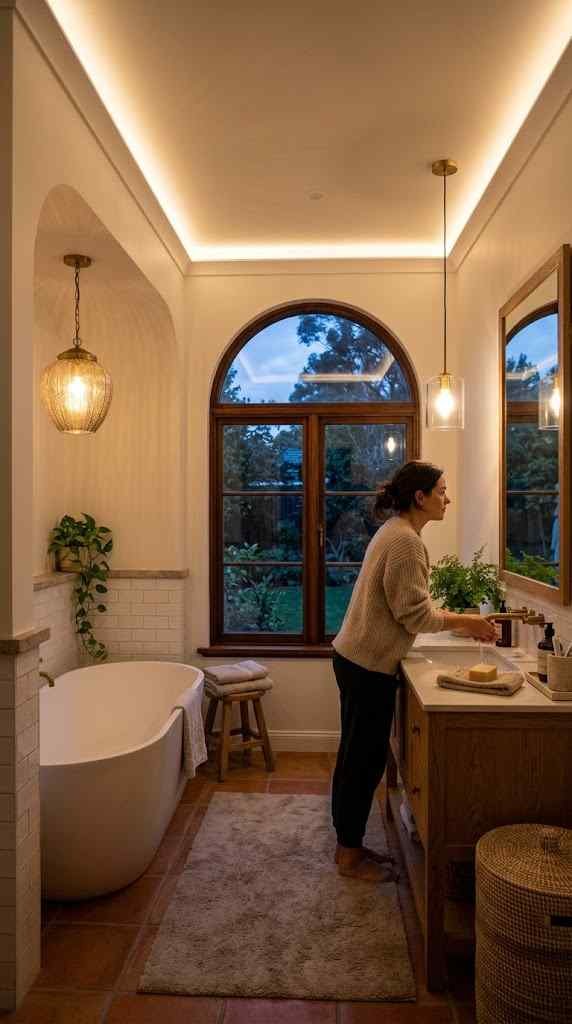
Here’s a mistake I see constantly: someone falls hard for a pendant, installs it, tears out every other light in the room, and then wonders why the corners feel like a cave. Pendants are wonderful, but they’re accent and task lighting, not a whole-room floodlight. Ask one fixture to do every job and it’ll fail at most of them.
The bathrooms that actually work use layers. Think of it as three jobs the room needs done, and each layer handles one:
Ambient light fills the room evenly and keeps the corners from going dark. A ceiling fixture or a few recessed cans usually cover this.
Task light hits your face at the mirror for shaving, makeup, and contact lenses. This is exactly where pendants shine.
Accent light adds drama and warmth a pendant over the tub, a strip under a floating vanity, a small fixture that makes the room feel finished.
Your pendants slot neatly into the task and accent layers. Keep a bit of ambient light in the mix so the room stays usable when you’re cleaning it or hunting for a dropped earring, and let the pendants handle the parts that need to look good rather than just be visible.
The other common slip-up? Forgetting about the switch layout. If your gorgeous mirror pendants and your ceiling light all fire from a single switch, you’ve lost the flexibility that made layering worth the effort. Wire them separately, or put them on their own dimmers, so you can run just the pendants for a relaxed soak and the full stack for a serious grooming session. It’s a small ask during installation and a daily convenience afterward.
And while we’re listing regrets, watch out for reflections. A bright, bare-bulb pendant positioned right in front of a large mirror will bounce glare straight back at you and undo all that flattering side lighting. If your fixture has an exposed bulb, either choose a frosted or shaded style near the mirror, or angle the placement so you’re not staring into a reflected sun. Small detail, big difference in whether the room feels calm or slightly interrogation-room.
FAQ’s
Are pendant lights safe to install directly above a shower or bathtub?
Only wet-rated fixtures placed outside code-restricted zones; always have a licensed electrician confirm safe bathroom pendant lighting placement.
What color temperature works best for pendant lights near a bathroom mirror?
Aim for 3000K–3500K with CRI 90+, so your skin and makeup look accurate rather than washed out.
Can I replace bathroom wall sconces with pendant lights?
Yes, and it often looks more custom hang matched pendants at eye level on either side of the mirror.
How big should a pendant over a freestanding tub be?
Choose a fixture roughly one-third to one-half the tub’s width, hung with seven-plus feet of clearance.
Do I really need a dimmer for bathroom pendant lighting?
Yes! a dimmer lets one fixture handle bright grooming and soft late-night light, making it the cheapest worthwhile upgrade.
CONCLUSION
Bathroom pendant lighting sits in that sweet spot where a modest budget buys a big change. You’re not knocking down walls or re-tiling you’re swapping a fixture, choosing a smarter bulb, and maybe convincing an electrician to spend an afternoon with your ceiling. For that, you get a room that feels considered instead of accidental.
So think about Nora and her hungover dinner guests. The tile was never the problem, and neither was the vanity. The room just needed light that came from the right place, at the right height, in a color that treated everyone kindly. Get those three things sorted and even a plain bathroom starts to feel like somewhere you actually want to linger.
Now go look up at your own bathroom ceiling. Is that fixture doing you any favors or is it time you gave the room the lighting it deserves?