
bedroom office
By Anna Grace | 2 April 2026
The Bedroom Office: Making Your Sleep Sanctuary Double as a Productive Workspace
Your alarm goes off at 6 AM. You roll over, grab your phone, and suddenly you’re checking emails from the exact spot where you were dreaming two minutes ago. Sound familiar? The bedroom office blurs the lines between rest and work so severely that your brain barely knows which mode to activate anymore. Yet millions of us have made this exact setup work sometimes brilliantly, sometimes chaotically, usually somewhere in between.
The truth nobody talks about: combining your bedroom with your office isn’t inherently doomed. It just requires a strategy that most people skip over entirely. You need intention, not just a desk shoved in the corner.
Why a Bedroom Office Can Actually Hurt Your Sleep (If You’re Not Careful)

Your bedroom has one job in your brain’s worldview: sleep. It’s the place your nervous system associates with rest, relaxation, and all the wind-down signals that help you drift off. The moment you introduce a desk, a monitor, Slack notifications, and deadline stress into that space, you’re essentially telling your nervous system, “Hey, remember that whole wind-down thing? Forget about it.”
This isn’t about being minimal for minimalism’s sake. It’s about prioritizing what matters and removing what doesn’t. Your mid-century bedroom should feel uncluttered but never cold. There’s personality in the restraint.
This isn’t just psychology it’s neuroscience. Your brain creates environmental cues that trigger specific behaviors and mood states. Your bed triggers sleepiness. Your bedroom triggers rest mode. But your laptop screen, your work files, and that backlog of tasks? Those trigger fight-or-flight mode.
The real damage happens at night. You’re lying in bed, you glance at your desk, and suddenly you’re mentally reviewing tomorrow’s meeting. Or you wake up at 3 AM and your brain won’t shut off because your workspace is literally three feet away. Sleep quality takes a hit before you even realize what’s happening.
The bedroom office setup forces you to be intentional about psychological separation the feeling that work stays in work mode and sleep stays in sleep mode, even if they’re physically in the same room.
The real culprit here involves cortisol and melatonin your stress hormone and sleep hormone, respectively. When your brain registers work-related stress in your bedroom, cortisol spikes right when melatonin should be climbing. Over weeks, this trains your body to produce the wrong hormones at the wrong times. Your sleep becomes fragmented. You wake up at odd hours. You need three coffees just to function during the day. The bedroom office amplifies this because there’s literally no geographic escape from the stress response. Your eyes close at night, but your nervous system is still in threat-assessment mode because your work environment is five feet away. This isn’t laziness or weakness it’s basic neurology working against you. The good news? This pattern reverses quickly once you establish proper boundaries. Give yourself two weeks of intentional separation and you’ll feel the difference.
Layout and Furniture That Respects Both Functions
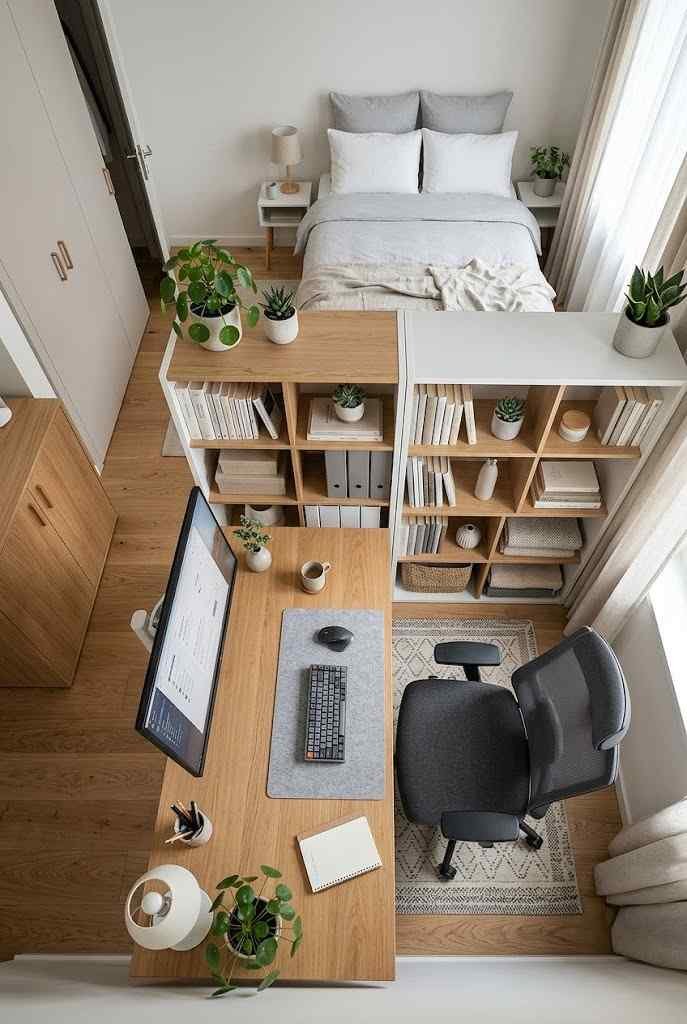
Here’s where most bedroom offices fail: people treat them like afterthoughts. They buy a tiny desk, cram it wherever it fits, and wonder why they hate spending time there.
Start with a real desk. Not a nightstand with a keyboard. Not a folding table. A proper desk that you’d actually put in a dedicated office. This sounds obvious, but you’d be shocked how many people skip this step and wonder why their back hurts and their productivity tanks.
Position your desk so you’re not staring at your bed while you work. This is the easiest way to maintain mental separation. If your room layout forces this (small bedroom, unavoidable angles), use a visual barrier. A tall bookshelf, a room divider, or even a curtain rod with fabric can trick your brain into thinking work and sleep are separate zones.
Ergonomics matter just as much in a bedroom office as anywhere else. Your chair needs proper lumbar support. Your monitor needs to be at eye level. Your keyboard and mouse need to sit where your arms bend at 90 degrees. Yes, it’s boring advice and yes, it’s non-negotiable if you want to avoid wrecking your neck.
Storage is the hidden MVP of bedroom offices. Everything needs a home that’s not visible during sleep hours. File cabinets, closed shelving, or a desk with drawers let you physically put work away when you’re done. This small ritual (putting things away, closing the drawer, leaving the desk) helps train your brain to switch modes.
If you’re renting and can’t commit to permanent changes, portable solutions work surprisingly well. A rolling filing cabinet becomes your office drawer when work hours end roll it into a closet. A folding room divider (the kind that stands without wall anchors) creates immediate visual separation. Even a tall potted plant positioned between your bed and desk signals to your brain that these are different zones. For the desk itself, depth matters more than width. A deeper desk (24–30 inches) gives you room to actually work, plus space to position your monitor far enough away for comfortable viewing angles. If you’re stuck with a shallow surface, your neck suffers within weeks. Go vertical instead use wall space for shelving or mounting your monitor on an articulating arm. One detail most people miss: the desk should face away from your bed whenever possible. Not just for ergonomics, but because your peripheral vision shouldn’t catch your bed frame while you’re working. That constant visual reminder breaks focus and resets your “sleep mode” thoughts throughout the day. Test your setup for a full workday before committing to it. Your body will tell you if something’s wrong.
Lighting Transforms Everything
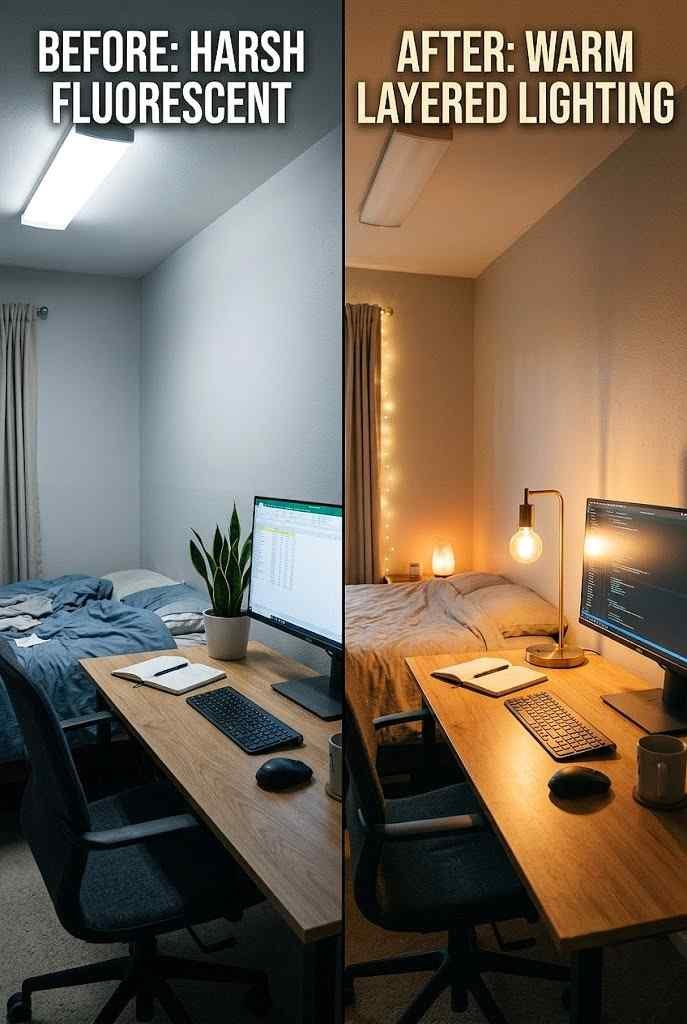
The lighting you choose determines whether your bedroom feels like a bedroom that happens to have a desk, or a bedroom that’s been invaded by an office.
Your main overhead light is probably too harsh and too white for a bedroom, but too dim for focused work. Solve this with layered lighting: a quality desk lamp with warm-ish LEDs (around 4000K color temperature, not bright blue-white) for work hours, and dimmable overhead lights that shift toward warm tones in the evening.
Position your desk lamp so it illuminates your work surface without bouncing off your screen. Glare is a concentration killer and also signals to your brain that you’re in work mode even when you’d rather be resting.
Pro tip: if your desk faces a window, use blackout curtains during work hours to control light, and open them wide in the evening when you want your room to feel peaceful again. Light cues matter more than you’d think for separating work time from wind-down time.
our circadian rhythm depends on light cues more than you’d think. Exposure to blue-spectrum light during work hours signals your brain to stay alert and focused which is exactly what you want when you’re tackling emails. But that same blue light at 8 PM tricks your brain into thinking it’s midday, suppressing melatonin production when you need it most. This is why your bedroom office desk lamp matters so much. If it produces cool (blue-white) light, your brain stays wired even if you’re physically relaxed. A warm-toned LED (3000K or lower) lets you work effectively without hijacking your sleep schedule. The monitor itself also emits blue light, so wearing blue-light-blocking glasses during afternoon work sessions acts as a cheap insurance policy for your evening sleep. You won’t notice a dramatic difference after one day, but after a week of consistent use, your sleep quality improves noticeably. Another often-overlooked detail windows. If your bedroom office has a window, catch morning light for 15–20 minutes when you first start work. This anchors your circadian rhythm and makes it easier to feel sleepy at night. The room’s overall lighting strategy isn’t complicated it’s just intentional. Bright and cool during work hours, dim and warm during wind-down.
The Psychological Tricks That Keep You Sane

You can have the perfect desk setup, the right lighting, and proper ergonomics and still feel like your bedroom office is slowly driving you nuts. The missing piece is usually ritual.
Create a morning switch: when you sit down at your desk, do something specific that signals “work mode activated.” Maybe it’s making a cup of coffee, adjusting your chair, or putting on a particular playlist. The action itself barely matters. The consistency does.
Same idea at the end of your workday: close your laptop, put your mouse away, switch off your desk lamp, maybe do a 2-minute walk around your place. Your brain needs a clear transition to know that work hours are over.
IMO, this is where people sabotage themselves. They work from their desk, then scroll on their laptop in bed, then wonder why they can’t sleep. You’ve got to make leaving work mode obvious. Close the laptop. Put it away if you can. Do something physical to mark the shift.
One more thing if you’re struggling to stop working, set a hard cutoff time and stick to it. Your brain will resist at first. After about three weeks, it’ll start recognizing the pattern and actually help you disengage.
Beyond personal rituals, consider enlisting external structure. Tell a friend or colleague your work schedule and have them check in on you if you’re still working after 6 PM. Sounds juvenile, but accountability works. You’re less likely to blow past your cutoff time if someone else is watching. Another underrated trick set a visual timer on your desk during the final hour of work. Not a phone timer that you’ll ignore an actual physical timer you can see. Watching those minutes count down creates urgency and trains your brain to wind down as the workday closes. Some people use a Pomodoro timer, others use a sand timer. The tool barely matters. The visible countdown does. The last psychological lever is environmental change. After work ends, change your clothes even just taking off your work shoes and putting on house slippers signals a major mode shift. Your brain recognizes the clothing change as strongly as it recognizes the desk. This might seem like costume-play nonsense, but it’s remarkably effective. Your body and mind treat clothing transitions as real transitions.
Productivity in Small Spaces Requires Fewer Distractions, Not More Stuff
A bedroom office often means limited space, which actually forces you to be smarter about what you keep on and around your desk.
Only keep essentials within arm’s reach: your monitor, keyboard, mouse, and maybe a notebook. Everything else papers, files, office supplies, that mug you’ve been meaning to wash lives somewhere else. Visual clutter eats focus. A bedroom office can’t afford that luxury.
Use vertical space aggressively. Wall-mounted shelves, pegboards, or floating shelves keep things off your desktop without making them inaccessible. Your brain notices the difference between a clean surface and an invisible problem.
And here’s something weirdly specific avoid having your phone within grabbing distance of your desk. That’s not about productivity philosophy. It’s about survival. If your phone is right there, you will reach for it at 2 PM when you should be working, and at 11 PM when you should be sleeping. Put it across the room, or better yet, in another room entirely during work hours.
The bedroom office doesn’t penalize you for having less space it penalizes you for being sloppy about what you keep visible.
Specifically, keep only three categories on your desk surface: active work items (current project, reference materials), ergonomic essentials (monitor, keyboard), and one personal morale item (a plant, a photo, something that makes you smile). Everything else backup supplies, charging cables, yesterday’s notes, that book you’re reading lives in drawers or on shelves. This isn’t minimalism for aesthetics. It’s minimalism for neuroscience. Your brain can only focus on so many things at once, and every visible object competes for attention. A cluttered desk literally reduces your cognitive bandwidth. For cable management specifically, use clips or cable sleeves to bundle everything behind your desk so cords don’t dangle into your visual field. These seem like tiny details, but they compound. In a small bedroom office, every distraction removal doubles your effective focus time. One final hack: use a “do not disturb” signal. Close your bedroom door during work hours, or hang a specific sign. This tells anyone in your household that you’re working, and it trains your own brain into work mode. The signal doesn’t have to be elaborate a simple “In focus, back in one hour” note works. When you remove it at day’s end, you’ve created another ritual transition. Small spaces force efficiency because they don’t tolerate waste.
FAQ’s
Is a bedroom office actually productive, or am I just fooling myself?
A bedroom office can be highly productive if you establish clear boundaries, proper lighting, and dedicated work furniture that separates zones mentally.
What’s the fastest way to improve sleep quality if my bedroom is my office?
Create a 10-minute wind-down ritual after work change clothes, close the laptop, dim lights to signal your nervous system that work mode ends.
Can I work from my bed sometimes in a bedroom office setup?
Working from bed blurs work-sleep boundaries and trains your brain to associate your bed with stress, significantly harming sleep quality long-term.
How far should my desk be from my bed in a bedroom office?
Position your desk at least 6–8 feet from your bed, or use a visual barrier like a bookshelf between them to maintain psychological separation.
What’s the single most important investment for a successful bedroom office?
A proper ergonomic chair and warm desk lighting together make the biggest impact on both productivity and sleep quality versus cost.
CONCLUSION
The bedroom office isn’t a perfect solution, and it’s not right for everyone. If you work in video calls all day and your bedroom is your family’s walkway, this setup might torture you. But if you can be intentional about the space, the lighting, the furniture, and the rituals that separate work from sleep? You’ll find that a bedroom office can actually give you a serious advantage no commute, total flexibility, and a workspace that’s private and yours.
The key is treating it like a real office, not a bedroom that temporarily hosts your laptop. Set it up properly, protect your sleep, and leave work mode when you’re done for the day. Do that, and your bedroom office stops being a problem and starts being genuinely efficient.