
eclectic kitchen
By Anna Grace | 16 feb 2026
How to Mix Eclectic Kitchen Styles Without Chaos (The Honest Guide)
Your kitchen doesn’t have to whisper. It can absolutely scream personality, contradiction, and yes, even chaos, but the good kind of chaos. An eclectic kitchen throws together vintage brass fixtures, modern minimalist cabinetry, reclaimed wood shelving, and a paint color nobody else would dare to try, and somehow it works. Not despite the contradictions, but because of them.
Here’s the thing nobody tells you eclectic kitchen style isn’t about breaking rules..it’s about making your own. It’s the opposite of scrolling through a design magazine and buying everything from one collection. It’s the kitchen that says, “I’ve got taste, I’ve got stories, and I’m not pretending to be something I’m not.”
If you’ve ever felt trapped by the idea that your kitchen needs to match, to be cohesive, to fit neatly into one design category, this article’s for you. Let’s talk about how to actually pull off an eclectic kitchen without it looking like your styling choices had a meltdown.
The beauty of going eclectic is that you’re giving yourself permission to break the “rules” that have been shoved down our throats for decades. Design magazines have spent years telling us that kitchens need to be one of three things: sleek and modern, farmhouse-cozy, or minimalist-zen. But what if you want a kitchen that’s all of those things wrapped into one? What if you want a space that evolves as you find pieces you love, rather than staying frozen in a single aesthetic from the day you renovated?
An eclectic kitchen is actually more honest than a perfectly coordinated one. It admits that life is messy, tastes change, and sometimes the best thing for your space is a vintage piece from a flea market that nobody else would think to pair with your contemporary appliances. Your kitchen becomes a running conversation between past and present, functional and beautiful, expected and wonderfully surprising.
What Actually Makes an Eclectic Kitchen Work
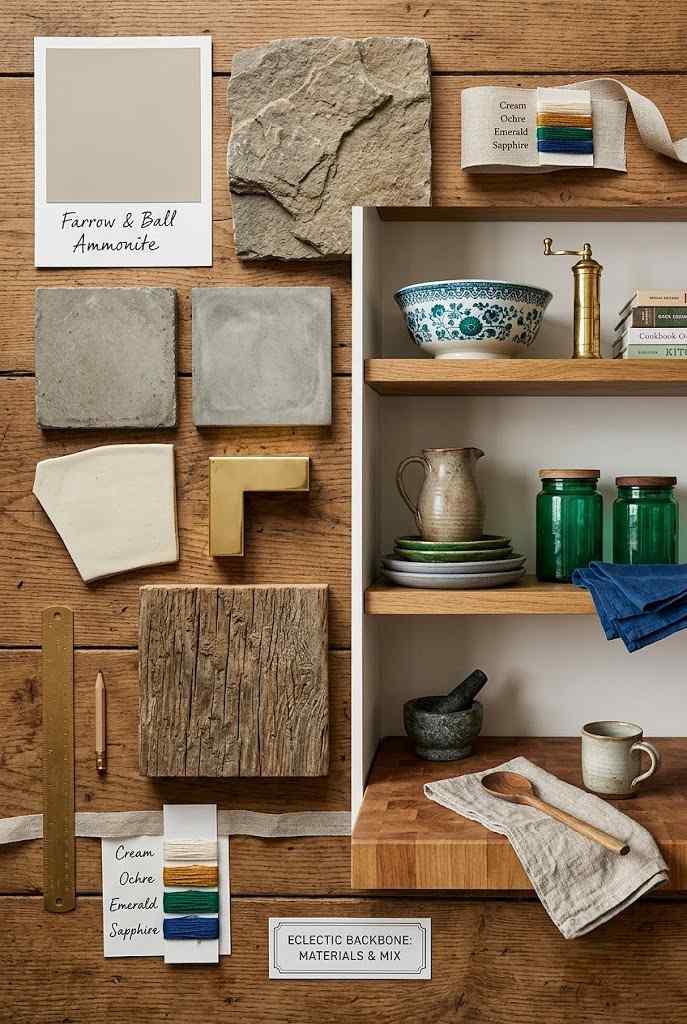
You know what the secret is? It’s not throwing everything together and hoping it sticks. The best eclectic kitchens have a backbone. Without one, you’re just cluttered, and cluttered is a totally different vibe than intentionally eclectic (trust me, your guests can tell the difference).
That backbone is usually one of three things:
A unifying color palette keeps the visual chaos from becoming actual chaos. You might mix a vintage stove with sleek white countertops, hang mismatched pendant lights over a reclaimed wood island, and add a wild patterned backsplash but if everything lives within a color family of, say, warm neutrals plus jewel tones, your eye knows where to land. You’re mixing, not just scatter-shotting.
The second anchor is texture layering. An eclectic kitchen leans hard into this. Smooth concrete, rough stone, shiny metal, matte paint, glossy tile they’re all in conversation with each other. Wood in three different finishes in one room shouldn’t work, but it does when you’re intentional. The textural variety is what tells your brain, “This is curated, not accidental.”
The third pillar? Functional balance. Your eclectic kitchen still needs to work. Open shelving with vintage pieces is beautiful until you can’t find your spatula. A statement-making range hood that screams personality still needs to ventilate properly. If your design choices make the space less functional, you’ve crossed from eclectic into just plain impractical, and impractical never looks as good on Instagram as you hope it will.
Think about spaces you’ve walked into that instantly felt right. The common thread wasn’t that everything matched perfectly it was that there was a logic underneath the diversity. An eclectic kitchen operates the same way. You’re not creating visual noise; you’re creating visual rhythm.
One more thing people miss: the power of repetition within variety. Just because you’re mixing styles doesn’t mean you throw one of everything into the room and call it done. Repeat certain elements intentionally. Maybe you use black metal fixtures throughout your range hood, your bar stools, your shelving brackets so even though everything else is different, there’s a thread connecting it all. Or you pull your paint color through in small doses on cabinet interiors, wall art, or textiles. These repetitions anchor the chaos.
Lighting deserves its own mention because it’s often where eclectic kitchens either shine or stumble. When you’re mixing eras, mismatched light sources can either feel intentional and layered or accidentally chaotic. The secret? Vary the style of your lights, but keep the warmth consistent. Mixing a vintage brass pendant with a modern geometric fixture works beautifully as long as both emit similar color temperatures. Your eye accepts the stylistic difference when the light they cast feels cohesive.
Why People Are Actually Getting This Right Now
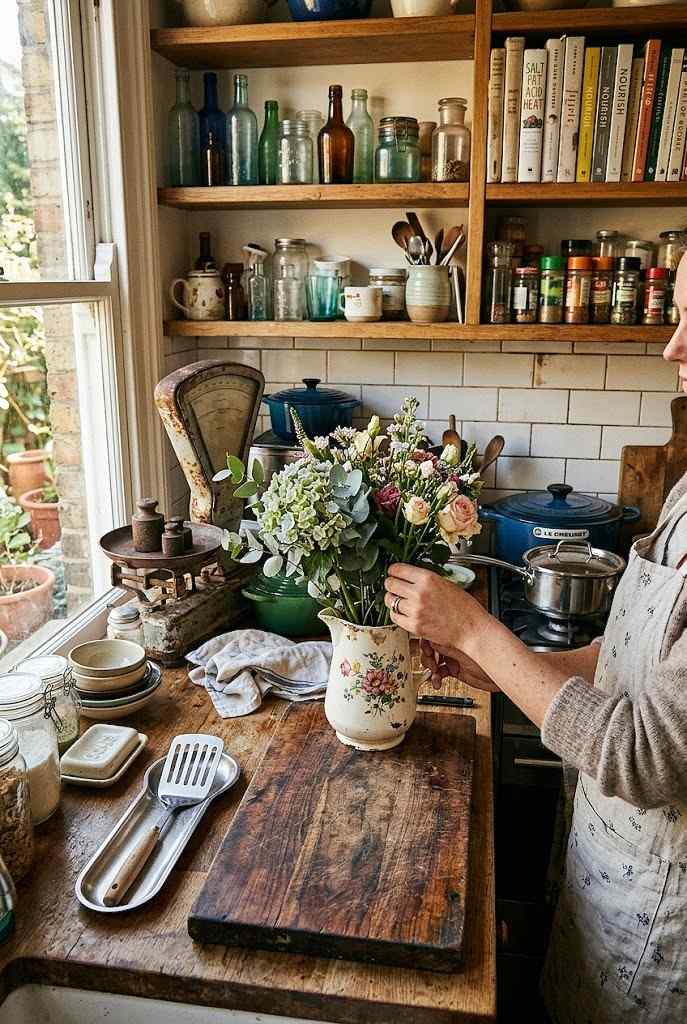
There’s something about the past few years that killed our obsession with the all-white kitchen. People started realizing that perfectly coordinated homes looked like showrooms, not like anyone actually lived there. The eclectic kitchen movement and yes, it’s a full movement at this point comes from a genuine cultural shift toward authenticity.
Your kitchen should feel like you, not like you hired an interior designer who has never met you. That’s the core of it.
Eclectic kitchens also speak to something deeper sustainability and intention. You’re not ripping out your perfectly good cabinets because an article told you they’re outdated. You’re keeping your grandmother’s vintage pieces if you love them, combining them with modern functionality. You’re hitting up salvage yards and antique markets because you’re hunting for specific stories, not just filling a room.
There’s also the economic angle. Full kitchen renovations with matched designer everything? That’s a luxury. But sourcing pieces from different eras, different places, different price points? That’s actually more accessible. You can spend money where it matters (your range, your countertops, your storage) and splurge creatively elsewhere.
The Instagram effect has actually pushed eclectic design forward, even though it started by pushing everything toward minimalism. Turns out, people got tired of liking perfectly styled homes that looked like nobody ever cooked a meal in them. The eclectic kitchen became the antidote it proved that real life and beautiful design aren’t mutually exclusive.
There’s also the generational angle. Millennials and Gen Z grew up with hand-me-downs, thrift store finds, and grandparents’ attics full of treasures. For them, “new” doesn’t automatically mean “better.” Mixing vintage with contemporary isn’t a design choice it’s just how they live. And that authenticity translates into a kitchen that doesn’t feel staged or temporary. You’re not collecting things for Instagram; you’re collecting things because they actually matter to you or make your daily life easier.
The rise of social media accounts dedicated to real (messy, lived-in, eclectic) homes has completely shifted what we think is “design-worthy.” Five years ago, a perfectly white kitchen was the gold standard. Now? People are celebrating kitchens with clashing patterns, bold paint colors, and unapologetically personal collections. The eclectic kitchen didn’t just become trendy it became honest.
How to Actually Design Your Own Eclectic Kitchen (Without It Falling Apart)
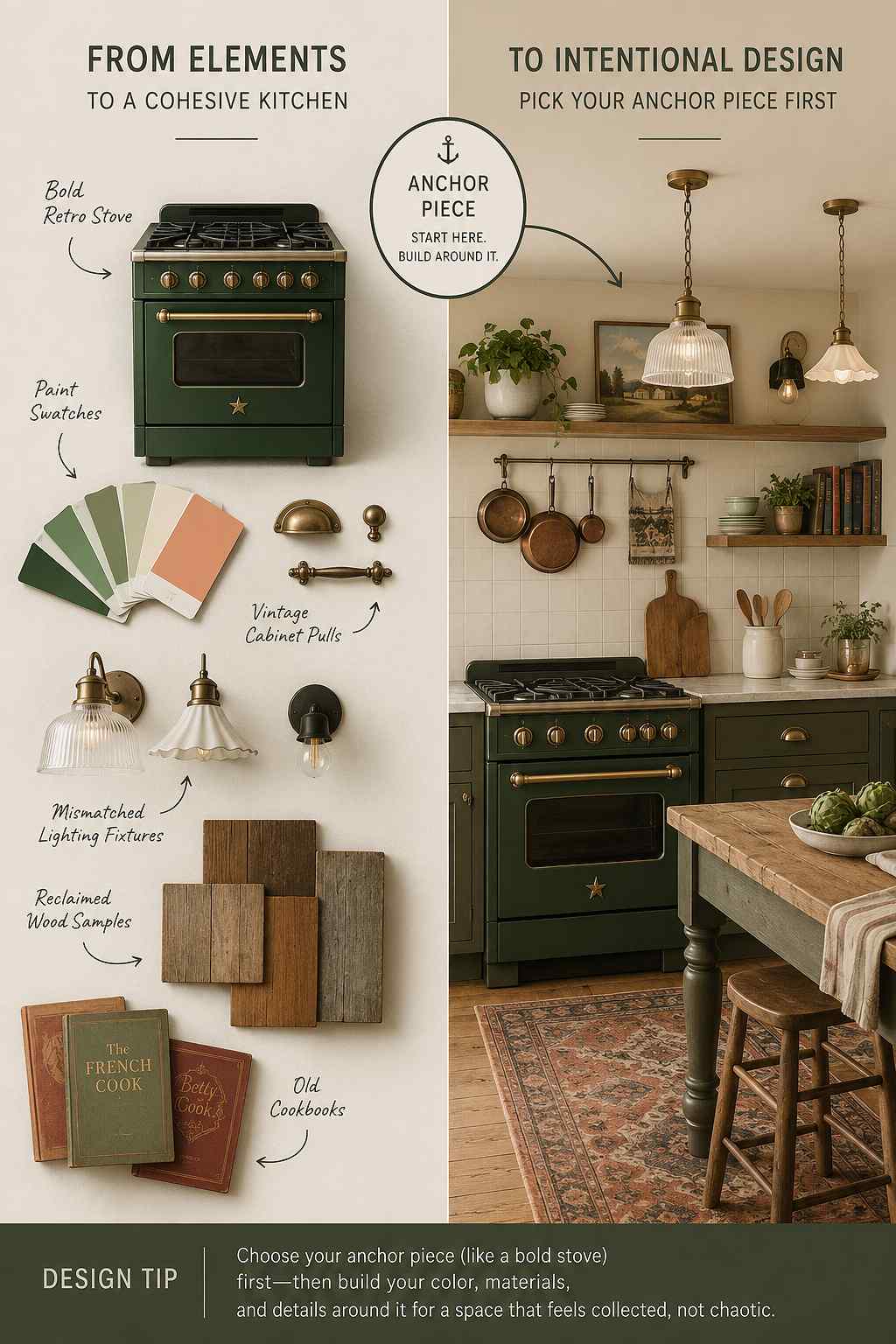
Here’s where most people get nervous. They love the idea of an eclectic kitchen but freak out when they’re actually in front of the paint swatch display. So, some practical moves:
Start with what you already have. Before you buy anything, catalog the kitchen elements you’re keeping. That vintage table your parents gave you. The color of your walls. The hardware on your current cabinets. One eclectic kitchen principle: you’re not starting from scratch; you’re building from what matters.
Choose your statement piece first. This might be your stove, a tile backsplash, a paint color, or even just a collection of artwork you want to display. Everything else filters through this anchor. If your statement piece is a bold, retro-looking range, suddenly all your other choices orbit around that energy. If it’s a soft sage green you’re painting the walls, everything else gets to be more varied because you’ve already set a tone.
Mix eras deliberately. Don’t just grab whatever looks cool. A Victorian-era sink paired with a 1970s light fixture paired with a 2020s minimalist stool works because you chose it with intention, not because you grabbed three random things. The intentionality is what reads as curated rather than careless.
Don’t forget the small stuff. Eclectic kitchens live in the details. Your cabinet pulls, your kitchen towels, your cutting boards, the way you style your open shelves these aren’t afterthoughts. They’re part of the personality. A well-chosen wooden spoon holder or a set of vintage canisters can tie the whole room together.
Here’s something that trips people up: overthinking the “rules” of eclectic design. The truth is, there aren’t many rules, which paradoxically makes it harder because you can’t just follow a checklist. Instead, approach it like you’re curating a collection at a museum everything earns its place through intention, not accident.
One tactical move that works surprisingly well is creating a digital mood board before you buy anything. Not a Pinterest board of random pretty pictures, but a cohesive collection of images where you can visually see how colors, textures, and eras talk to each other. Screenshot images of kitchens you love, add swatches of your paint color, include photos of pieces you already own. When you look at it all together, patterns emerge about what actually appeals to you versus what you think should appeal to you based on current trends.
Budget-wise, prioritize spending on pieces that anchor the room your cabinetry, countertops, and appliances. These are the bones, and they should reflect your style and work with your lifestyle. Then, get creative with the decorative layers. A $50 vintage pendant light over an island matters way less than investing in a range that you’ll use every single day for the next decade. Splurge on quality where it counts, then play with personality in the details.
The One Rule That Actually Matters
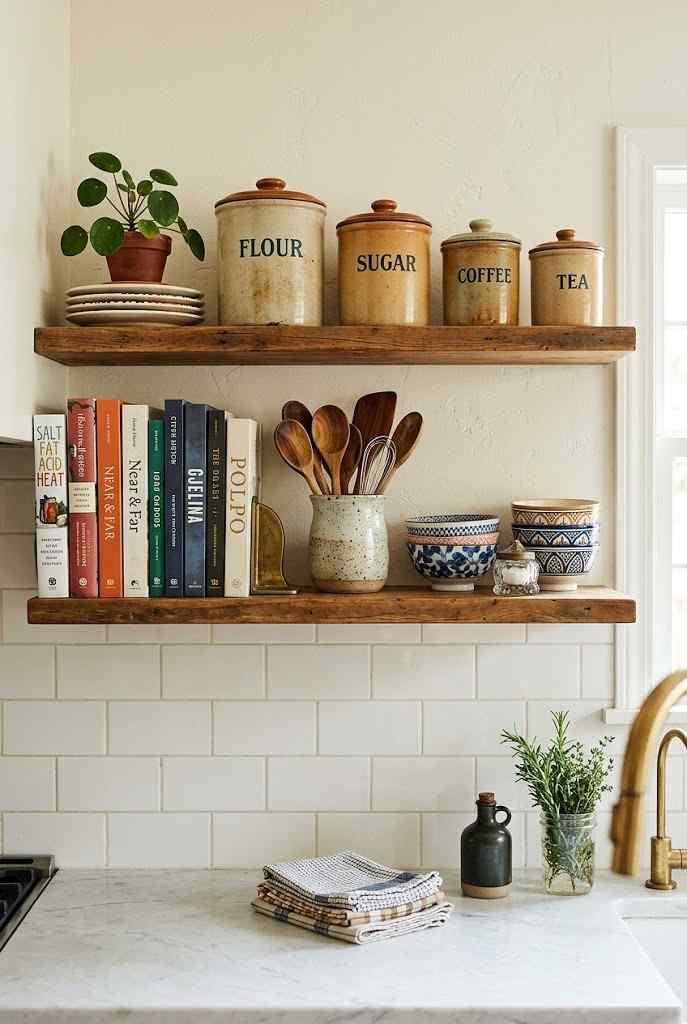
Want to know what separates an eclectic kitchen that makes you smile every time you walk in from one that stresses you out? Cleanliness and curation.
An eclectic kitchen thrives on being able to see what you’ve chosen. If your open shelving is gorgeous but buried under clutter, or your vintage finds are drowning in kitchen chaos, you’ve lost the plot. Eclectic doesn’t mean cluttered. It means every single thing you’ve included is there because you wanted it, and you can actually appreciate it.
This is why organization becomes almost more important in an eclectic kitchen than in a minimalist one. Your pieces need room to breathe. Your style needs space to be visible.
Also and this matters don’t be afraid to remove things that aren’t working. Eclectic is flexible. If you bring home a vintage piece and it just sits there making you go “meh” every time you see it, it doesn’t belong there because it came from the right era or fit your color palette on paper. Eclectic means trusting your gut, and your gut knows the difference between “this makes me happy” and “this was supposed to make me happy based on a design blog.”
The organization principle extends to how you display your eclectic pieces. Open shelving in an eclectic kitchen can be stunning or overwhelming, depending on curation. The difference is that every item visible has been intentionally chosen to be seen. Your everyday dishes aren’t just functional they’re visually interesting enough to live on a shelf. Your spice jars aren’t just containers; they’re part of the aesthetic because you chose ones that look good together.
One more practical note: eclectic kitchens benefit from designated storage. All those beautiful pieces on display work because the less photogenic stuff bulk pantry items, appliances you use twice a year, junk drawer chaos has a home that’s out of sight. Your eclectic kitchen isn’t actually more cluttered than any other kitchen; it’s just more visible about what it’s chosen to show.
Your Eclectic Kitchen Is Permission to Be Yourself
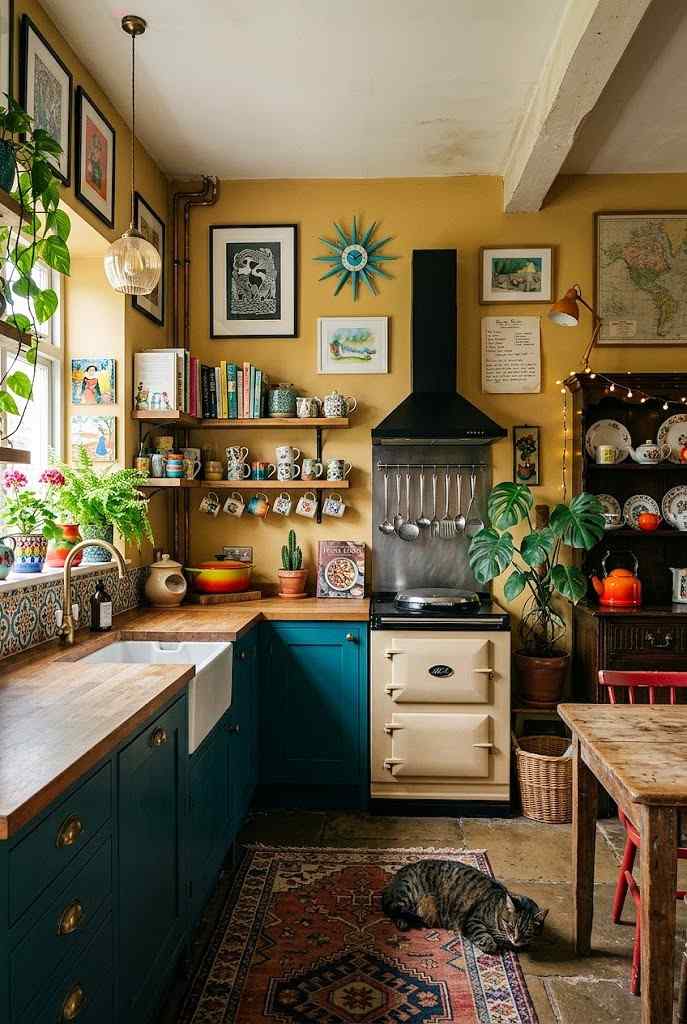
Here’s what nobody talks about enough: your eclectic kitchen is also permission to evolve. You don’t have to get it perfect on day one. In fact, the best eclectic kitchens grow over time. You find a piece at a market, bring it home, see how it feels for a month, and decide if it stays. You paint an accent wall, live with it for a season, then maybe shift to a different color because your taste refined or your lighting changed or you just got tired of it. There’s flexibility baked into the aesthetic.
That flexibility is actually liberating. It means you can experiment without feeling like you’ve “ruined” your kitchen design. If you bring home a vintage sign or swap out your cabinet hardware and absolutely hate it? Remove it, no drama. Your eclectic kitchen isn’t precious; it’s alive. It changes as you change, and that’s the whole point.
The final piece is letting go of what anyone else thinks. An eclectic kitchen is the ultimate act of design confidence because you’re saying, “I don’t care if this matches the ‘rules’ I love it.” That confidence is what makes the difference between a kitchen that looks eclectic and a kitchen that feels like home.
FAQ’s
Can you mix modern and vintage in an eclectic kitchen without it looking messy?
Absolutely. Anchor with a consistent color palette and texture story, repeat design elements strategically, and ensure every piece serves function or beauty intentionally.
What’s the best starting point when designing an eclectic kitchen on a budget?
Choose one statement piece (paint color, stove, or backsplash), keep bones simple, then layer personality through affordable vintage finds, thrifted pieces, and DIY touches.
How do you keep an eclectic kitchen from feeling too chaotic or cluttered?
Maintain organization systems, limit open shelving displays to curated pieces, reserve adequate negative space, and regularly remove items that no longer spark joy or function.
What unifies different styles and eras in an eclectic kitchen design?
A backbone combining consistent color temperature lighting, repeated metal finishes, matching texture types, and intentional color palette keeps diverse pieces visually cohesive together.
Is eclectic kitchen design more expensive than traditional kitchen styles?
Not necessarily. Eclectic kitchens let you mix high-investment pieces with thrifted treasures, making them actually more budget-friendly than coordinated designer kitchen renovations.
CONCLUSION
The coolest part of the eclectic kitchen trend? It gives you permission to stop waiting for the “perfect” cohesive design moment. You don’t have to save up for a full kitchen overhaul. You don’t have to pick one style and stick with it. You don’t have to apologize for loving a 1950s detail alongside a modern aesthetic.
Your kitchen can be weird, layered, unexpected and that’s exactly where the magic lives. Start with what you love. Build from there. Trust the contradictions. An eclectic kitchen is just a space where you’ve decided your own taste matters more than matching a magazine cover, and honestly? That’s the only rule you actually need.