
eclectic living room
By Anna Grace | 4 feb 2026
How Eclectic Living Room Design Actually Creates Visual Harmony
Your living room doesn’t need to look like it stepped out of a single designer’s mood board to be beautiful. In fact, the most interesting spaces are the ones that look like they have a story and that’s exactly what an eclectic living room delivers.
Most people think “eclectic” means “throw everything together and hope it works.” That’s the fear holding them back. But real eclectic design is actually intentional, layered, and deeply personal. It’s your favorite vintage armchair next to something modern, your grandmother’s rug clashing (or harmonizing) with contemporary art, color that shouldn’t work but somehow does. The magic is in knowing when to commit to the chaos and when to pull back.
Let me be honest I used to be a matchy-matchy person. I thought every piece in a room needed to “go together” in some safe, predictable way. Then I visited a friend’s eclectic living room mismatched mid-century chairs, Moroccan poufs, gallery walls, brass accents mixed with matte black, warm woods beside cool tones and I realized I’d been boring myself on purpose. Her space wasn’t random it was curated. The difference between a stunning eclectic living room and a cluttered one isn’t luck it’s intention.
The anxiety around eclectic design comes from one place people worry they’ll end up with a space that looks like they raided thrift stores with their eyes closed. But here’s what actually happens when you build an eclectic living room with intention you end up with a room that tells your specific story in a way no showroom display ever could. Your guests will walk in and feel something different. They’ll notice. They might even ask where you found things.
What makes this style less intimidating than it sounds is that eclecticism works with your natural collecting habits instead of against them. You probably already own things from different periods and styles. You’ve inherited furniture from relatives. You’ve picked up textiles from travels. You’ve bought pieces because you loved them in the moment, not because they matched something else. An eclectic living room simply validates what you’ve already been doing and helps you arrange it with confidence.
What Actually Makes a Living Room “Eclectic”?
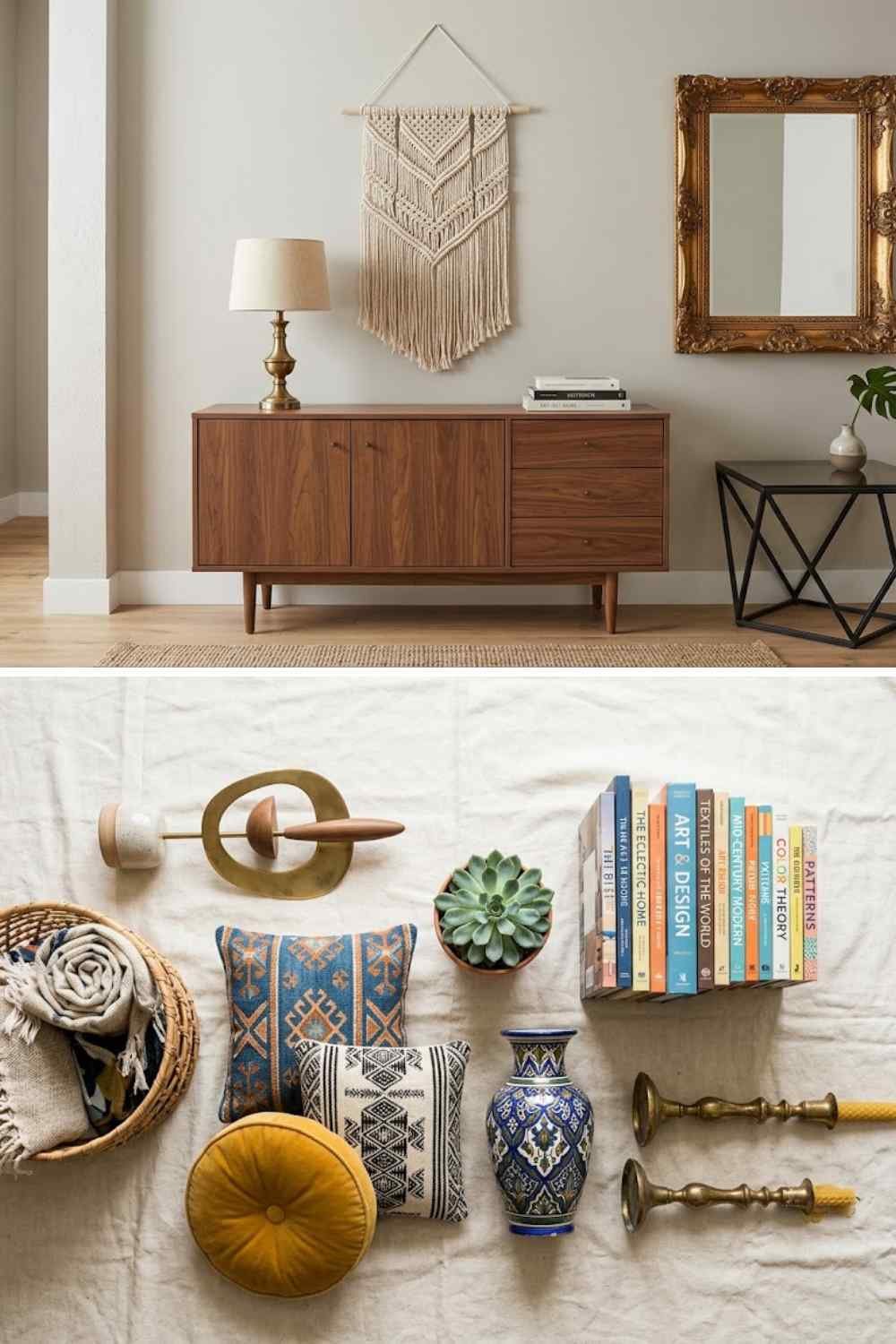
Eclectic style is basically permission to break the decorating rulebook. You’re mixing eras, aesthetics, and influences without apology. That could mean pairing mid-century modern furniture with Bohemian textiles, adding industrial accents to a romantic vintage setup, or blending Scandinavian minimalism with Maximalist color.
Here’s what separates eclectic from just… messy. An eclectic living room has a point of view. It’s not random objects scattered around; it’s a deliberate collection of pieces that reflect who you are, what you love, and how you actually live. You’re not following a trend you’re creating something uniquely yours.
The best part? Eclectic design is forgiving. You don’t need to buy matching sets or commit to a color palette for the next five years. Your style can evolve, and the room grows with you. Found an amazing vintage mirror at a market? Throw it in. Inherited your aunt’s ornate side table? Make it work. That’s the beauty of this approach.
The word “eclectic” itself comes from Greek and means “selecting the best from various sources.” Not everything from various sources the best from them. That’s an important distinction. You’re not grabbing random objects; you’re being selective, even if your selections span wildly different aesthetics.
Think of eclecticism as permission to be a maximalist with taste. A maximalist living room stuffs the space with color, pattern, and texture everywhere. An eclectic maximalist living room does the same thing but with intentional curation that prevents visual chaos. Maybe you’ve got patterned wallpaper, bold art, colorful textiles, and statement furniture but they all speak the same design language underneath. The color palette ties them together. The materials echo each other. The scale of objects balances out.
On the flip side, you can be a minimalist eclectic. Minimal furniture, but each piece is from a radically different era or style. White walls, but the four items you’ve chosen to display are wildly diverse in origin. The restraint in quantity is what prevents the eclecticism from overwhelming the space.
Why Eclectic Design Actually Works (Psychology Matters)
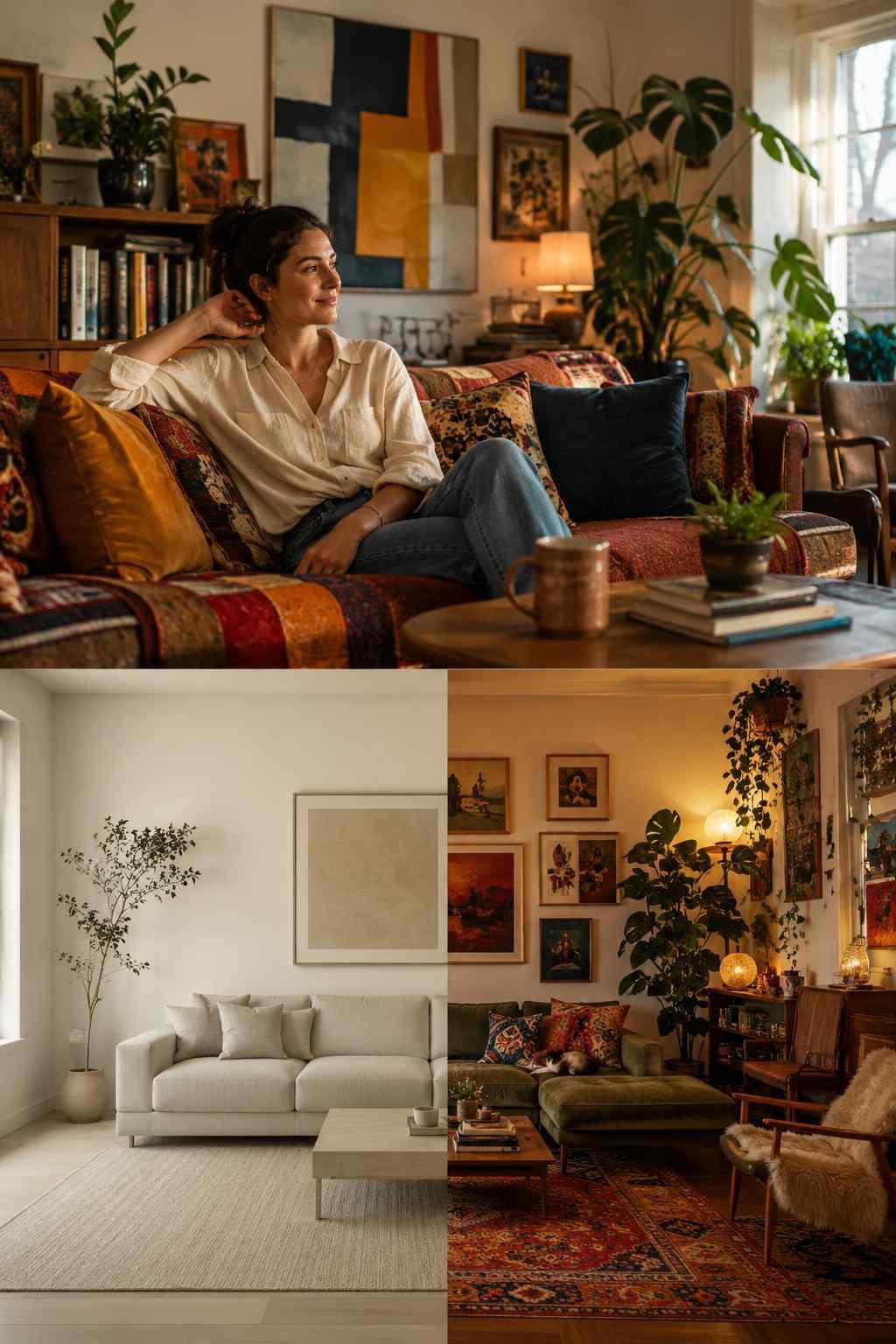
Your brain loves variety, even if it doesn’t always feel comfortable with it at first. Research on interior design preferences shows that spaces with intentional diversity feel more stimulating and personally connected than monochromatic, uniform rooms. We’re drawn to things that feel collected rather than purchased pieces that suggest stories, travel, inheritance, or passion.
Think about why you’re naturally drawn to certain homes. Usually it’s because they feel lived-in, not staged. An eclectic living room does that automatically. The client who brings in three generations of family furniture is already halfway there. The collector who travels and picks up textiles from different countries? Even better.
There’s also something psychologically comforting about seeing your own chaos reflected in your space. 🙂 If you’re the kind of person with diverse interests someone who listens to three different genres of music, reads both sci-fi and poetry, and can’t pick just one aesthetic your living room should reflect that multiplicity. An eclectic room says, “This is me, in all my contradictions,” and that’s oddly liberating.
There’s also a practical psychology at play here. When you design an eclectic living room intentionally, you’re subconsciously solving for novelty and familiarity simultaneously. Designers call this “optimal stimulation” your brain is getting enough visual interest to stay engaged, but it’s organized enough that you don’t feel stressed. A completely uniform room becomes boring to your nervous system. A chaotic room creates low-level anxiety. An eclectic room? It’s in that sweet spot.
Consider also that living with eclectic design builds decision-making confidence over time. Every time you add something new or rearrange a piece, you’re making a small act of creative choice. You’re not following instructions; you’re expressing judgment. After a while, that confidence bleeds into other areas of your life. Your living room becomes proof that you trust your own taste, which is surprisingly powerful.
Culturally, eclecticism also reflects how most of us actually live now. We consume globally. We work across cultures. We follow interests that span genres and decades. An eclectic living room is just the honest spatial representation of that reality.
The Golden Rule: Anchor Everything With Balance
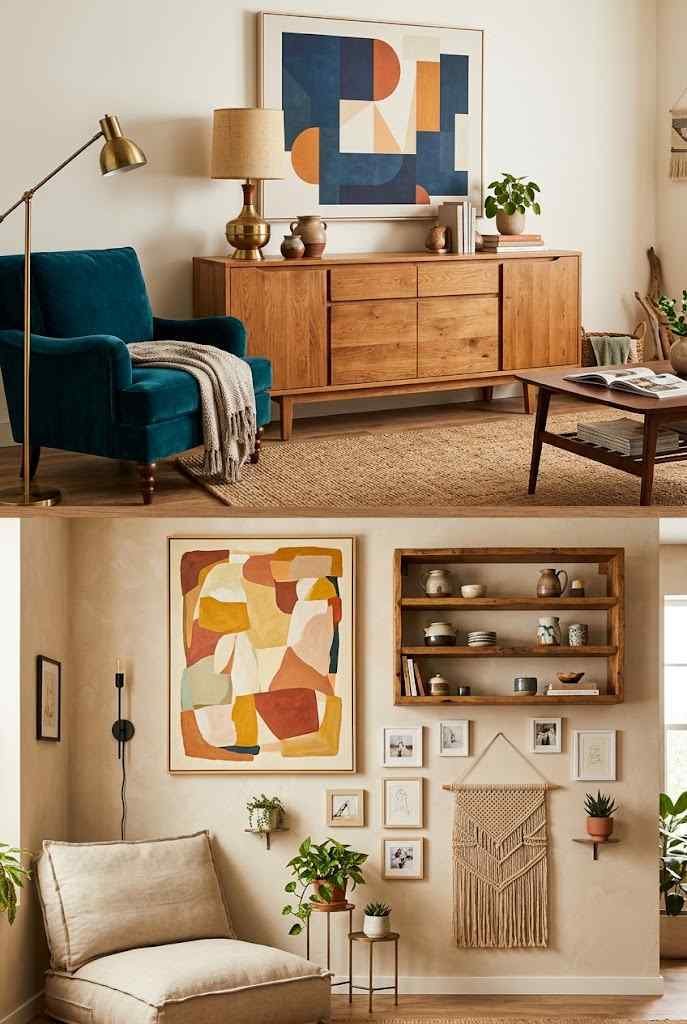
Here’s where people stumble: they think eclectic means “anything goes,” then they end up with sensory overload. What actually works is choosing one or two visual anchors and building around them.
The anchor could be a color (neutral walls with pops of jewel tones), a style period (mostly mid-century with bohemian textiles mixed in), a texture (lots of natural wood and woven materials), or even a shape (rounded furniture pieces throughout). This anchor keeps the room from feeling chaotic, even when everything else breaks the rules.
Let’s say your anchor is warm wood tones and natural textures. You can pull in a bright modern art piece, a vintage kilim rug, a sleek brass lamp, and a cozy bohemian throw, because they all exist in the same tonal family. The wood grounds it. Without that anchor, adding all those elements would feel overwhelming.
IMO, the second rule is variety in scale. Mix large statement pieces with smaller accessories. A chunky vintage sofa paired with delicate side tables. A massive gallery wall next to a single statement sculpture. This rhythm prevents the room from feeling either too empty or too crowded.
Once you’ve got your anchor, the next move is thinking about visual weight distribution. A heavy, carved wooden credenza has visual weight. So does a large piece of artwork. So does a bold color or busy pattern. These aren’t bad things in an eclectic room, but you can’t stack all of them in one corner. A dark, patterned rug anchors a space differently than light wood floors do. Understanding this helps you place pieces so the room feels stable, not tilted.
Think about it spatially too. If your anchor is a sofa, don’t put everything decorative on the shelves opposite it spread interest around the room. If your anchor is a color palette, make sure that color shows up in different zones on a wall, in a rug, in art, in textiles, in smaller objects. This repetition creates a sense of order even when styles are chaotic.
The anchor rule is also forgiving because it gives you permission to break other rules. Your furniture doesn’t need to match? Fine, as long as your anchor ties them together. Your art styles clash? Totally okay if they’re unified by frame style, color, or size. The anchor becomes your safety net that lets you take design risks elsewhere.
Playing With Pattern and Color (Without the Chaos)
If you’re building an eclectic living room, color is your secret weapon. This is where you get to be bold in a way that matchy-matchy design won’t allow.
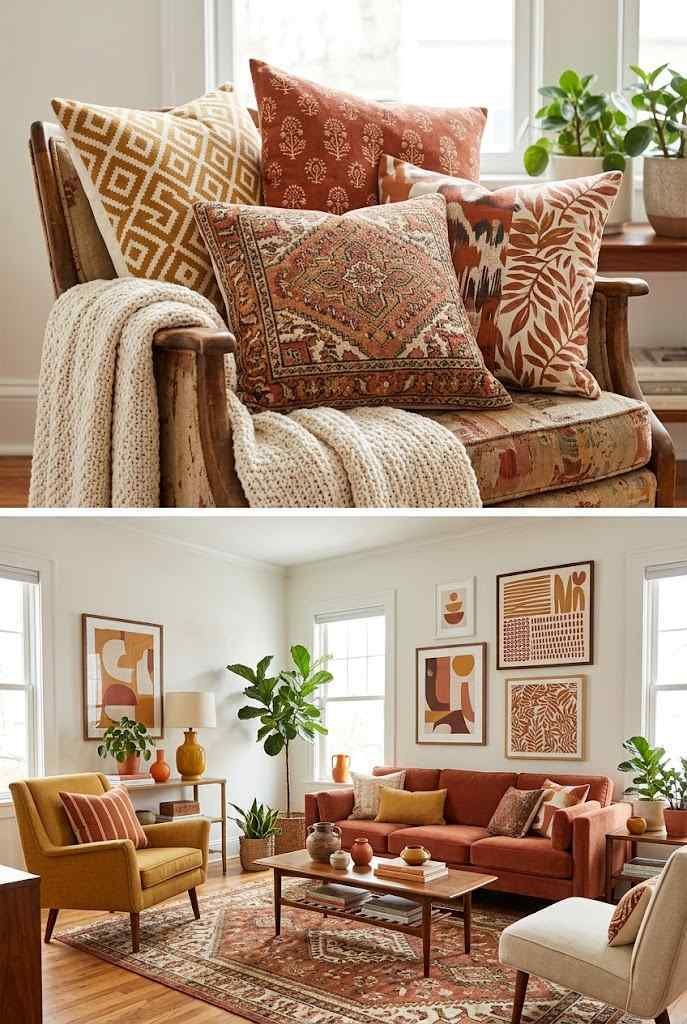
One approach pick a dominant neutral (white, gray, beige, black) and let it do the heavy lifting. Your walls, large furniture pieces, or flooring stay relatively consistent, which creates visual calm. Then your patterns and colors play across textiles, art, and smaller furniture. A neutral sofa suddenly becomes the perfect canvas for patterned throw pillows in completely different designs a geometric print, a traditional rug pattern, a botanical motif, even something abstract. They work because the sofa acts as the ground they’re standing on.
Another angle: go bold with a color story instead. Maybe you’re working with warm terracottas, creams, burnt oranges, and golden yellows. Everything you bring in respects that palette, even if the patterns and styles are totally different. A Moroccan pouf, a mid-century chair, an ornate mirror, and a modern abstract rug can all live together if they’re singing in the same color key.
The key limit your main colors to 3–4 and let patterns do the personality work. Too many competing colors will actually make an eclectic room feel chaotic instead of curated. Patterns, though? Layer them generously.
One tactical move that separates successful eclectic living rooms from overwhelmed ones is the 60-30-10 rule, borrowed from fashion design. Use your dominant color 60% of the time (walls, large furniture), a secondary color 30%, and an accent color just 10%. In an eclectic room, this works beautifully because you can have tons of style variation within those color constraints.
Imagine a living room with cream walls (60%), warm wood furniture and textiles in warm brown tones (30%), and then jewel-tone accents emerald, sapphire, burgundy sprinkled through pillows, art, and objects (10%). You could have a vintage chair, a modern lamp, bohemian textiles, and contemporary art, but the color story keeps it all singing together.
Pattern-mixing is also easier when you vary the scale of patterns. Pairing a small geometric print with a large botanical print with a medium-scale traditional pattern works better than three patterns at the same scale. They create rhythm instead of fighting for attention. Your eye can navigate between them.
Making It Feel Intentional (Not Just Lucky)
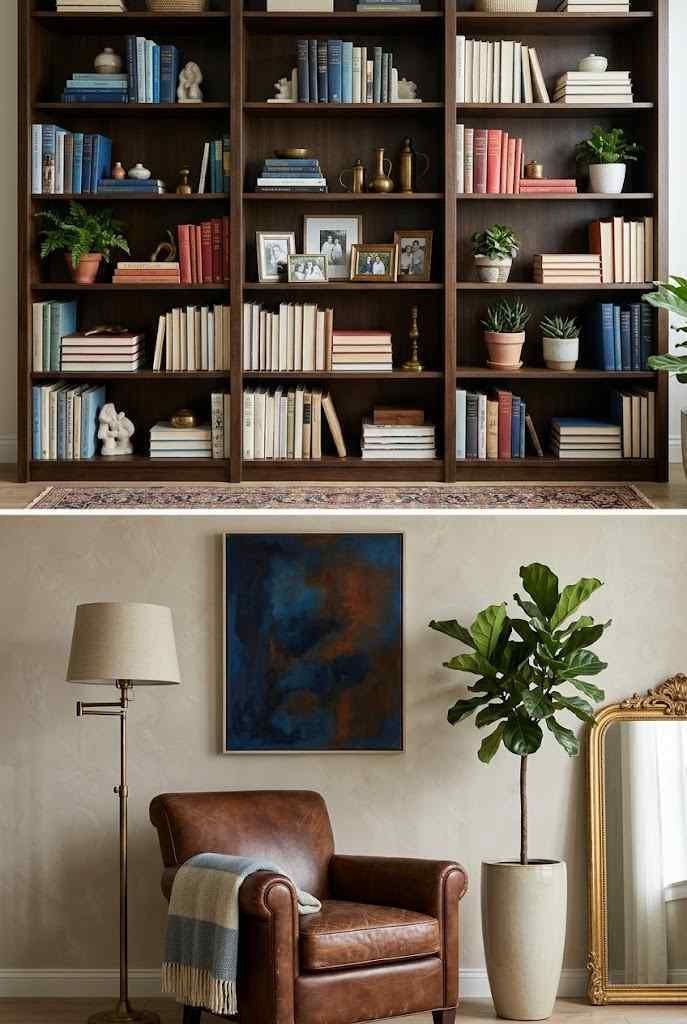
This is the confidence part. An eclectic living room only works if it looks like you meant to put it together that way. Here’s how to build that feeling.
Group items thoughtfully. Don’t scatter your books, plants, and art objects randomly around the room. Create mini-collections a shelf with books stacked horizontally, three small plants clustered together, a wall grouping of frames and art. Clustering makes choices feel deliberate.
Repetition is your friend here, too. If you’ve got brass accents in your lamp, let brass show up again in a mirror frame or a side table leg. Use a color twice in different places if your throw pillow is mustard yellow, maybe your artwork has mustard accents too. This repetition tells the story that it’s all part of a planned whole, not just things you already owned.
Quality over quantity matters more in eclectic design than anywhere else. One really stunning vintage chair will anchor a room better than five okay secondhand pieces. One excellent piece of original art will do more work than ten print posters, even if you love those posters. Each piece should feel like it earned its spot.
Here’s a detail most people miss spacing and breathing room matter as much as the objects themselves. An eclectic living room that feels intentional isn’t packed wall-to-wall. There are blank walls. There are shelves with space between objects, not every millimeter filled. This restraint signals that you chose each item deliberately you weren’t desperate to fill space.
Styling your eclectic room also means thinking about story progression. When someone walks in, where does their eye go first? Then where? Then where? Create a visual journey through the room that guides people to your favorite pieces or most interesting moments. A gallery wall above a sofa. A styled corner with a beautiful chair and plant. A bookshelf that looks thoughtfully arranged. These focal points tell people that yes, this was intentional.
Lighting is huge too. In an eclectic living room, different light sources a table lamp, a floor lamp, wall sconces, a ceiling fixture don’t all need to match, but they should feel like they’re part of the same design story. Maybe they’re all brass, or all matte black, or they span metals but they’re all warm-toned and vintage. Unified lighting creates cohesion even when furniture styles scatter.
The Permission You’ve Been Waiting For
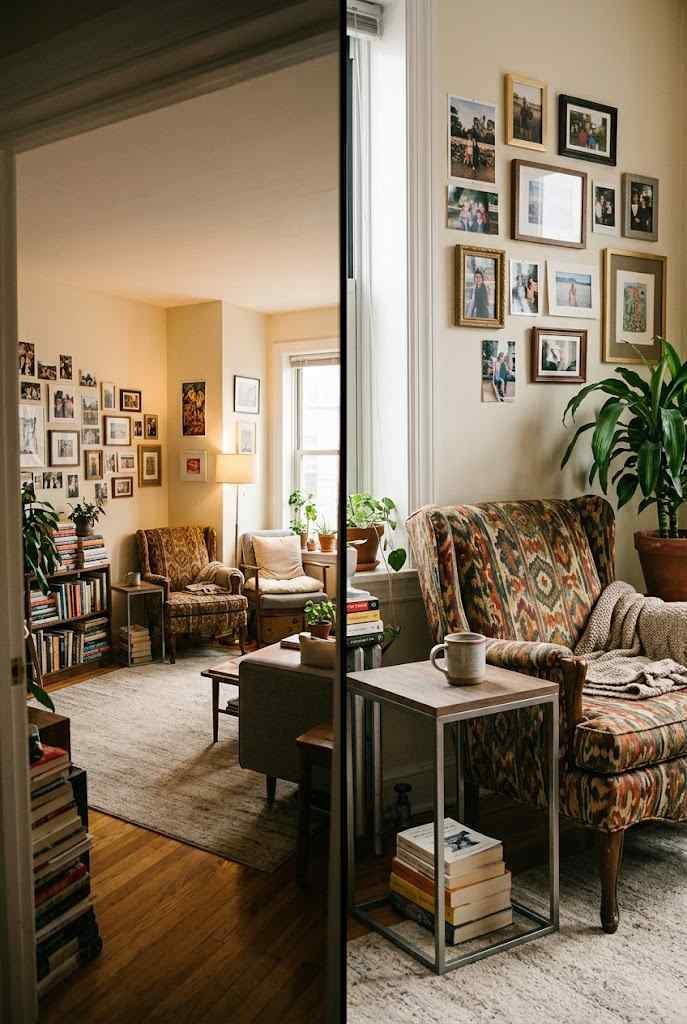
Here’s the thing nobody says directly enough: your living room doesn’t have to fit into any category. Not “minimalist” or “maximalist” or “bohemian” or “modern.” It can be all of it. It can be none of it. It can be whatever combination makes you feel at home.
Eclectic design is having the confidence to say “I like this, and I like that, and I’m putting them together because my taste is real, not because a designer told me they match.” That’s actually harder than following a style guide. It requires knowing yourself well enough to curate instead of just collect.
Stop waiting for permission to make your space feel like you. An eclectic living room is that permission in action.
If you’re still hesitating, consider this: the most expensive, exclusive interior design services cost thousands because designers specialize in one thing they help people make eclectic choices feel intentional. They don’t enforce matching sets. They curate. They mix eras. They break rules. You can do that yourself. You already know what you like. You just need to trust that liking different things doesn’t make your taste bad it makes your taste specific.
An eclectic living room is also the most sustainable design choice. You’re not following a trend that’ll feel dated in three years. You’re not replacing furniture because the aesthetic shifted. You’re building something that lives and grows with you over decades. That vintage chair you reupholster? It’s still yours in 10 years, just evolved. That inherited rug? Still relevant because you’ve chosen pieces that work with it.
FAQ’s
Can an eclectic living room work in a small space?
Absolutely. Use vertical space with wall-mounted shelving, choose a single bold anchor color, and let negative space prevent overcrowding.
How do I prevent my eclectic living room from looking cluttered or dated?
Stick to a cohesive color palette, repeat materials (wood, brass, natural fabrics), and invest in quality pieces you’ll love long-term. Update accessories seasonally, not furniture.
What’s the best way to start designing an eclectic living room if I’m starting from scratch?
Begin with one anchor piece (sofa, rug, or wall color) that reflects your style, then build around it. Add pieces one at a time instead of all at once.
Can eclectic living rooms work in modern homes with open floor plans?
Yes, but use your anchor piece to visually define the living room zone. Consistent flooring, a cohesive color story, and defined furniture groupings help eclectic style work in open layouts.
How much should I spend on furniture for an eclectic living room versus decorative pieces?
Invest heavily in foundational pieces (sofa, dining table, key chairs) and less on accessories. Mix high and low quality basics with budget-friendly objects
CONCLUSION
Start small if that feels safer. Add one intentionally eclectic element to your current living room a patterned throw pillow that doesn’t match anything, a piece of art in a style you love but haven’t “allowed” yourself, a lamp that breaks your existing color palette. Notice how it feels. Usually, you’ll realize the mismatch you feared actually makes the room more interesting, and that confidence will carry you forward.