
My husband hated every one of my kitchen cabinet color ideas until we tried this one
By Anna Grace | 3 June 2026
The paint sample was still wet when Dan walked into the kitchen. He looked at the cabinet door I’d leaned against the backsplash and said, “Absolutely not.” He didn’t even put his coffee down.
It was the fourth color I’d shown him in two weeks, and the fourth one he’d turned down in under five seconds.
I’d spent most of that winter collecting kitchen cabinet color ideas the way some people collect recipes they never cook. Navy. Charcoal. A moody black that looked incredible on my phone and, according to Dan, “like the inside of a hockey bag” in our actual kitchen. What I didn’t understand yet was that he wasn’t saying no to the colors at all.
The kitchen we bought, and the oak
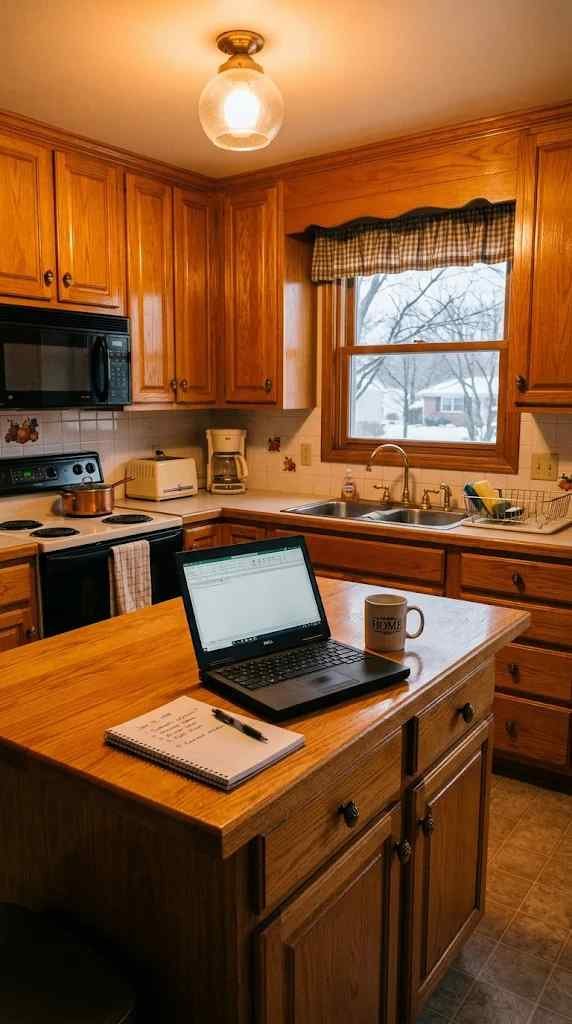
Our house is a 1994 two-story outside Columbus, Ohio. The kitchen came with the original honey oak cabinets: 31 doors and drawer fronts, all glossy and a little orange, with brass knobs shaped like tiny acorns. The only window sits over the sink and faces north, so the room never gets direct sun.
I work from home three days a week, and the island is my office. By two o’clock on a February afternoon, the oak turns the whole room the color of the inside of a pumpkin. I’d joke that I was working from a jack-o’-lantern. Dan never laughed.
He loved those cabinets. Every few weeks he’d knock on one like he was checking a melon at the grocery store. “Solid wood,” he’d say. “Do you know what solid wood cabinets cost now?”
I did know, actually. I’d looked it up. I wasn’t trying to replace them. I just wanted to paint them.
So I started a folder on my phone, and that’s when the trouble really started.
The first two weeks of rejections
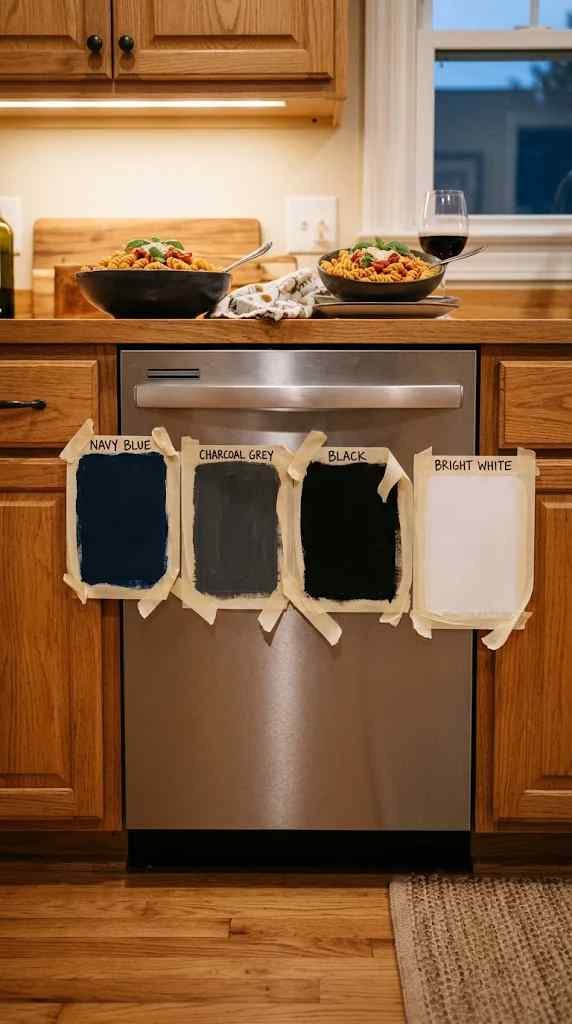
I opened with navy because it felt safe. Everyone online had a navy kitchen, and they all looked like they made sourdough on purpose. I painted a sample on a piece of poster board and taped it to the dishwasher.
“We’ll need the lights on at noon,” Dan said.
The charcoal reminded him of a dentist’s office. The black was the hockey bag. When I gave up on drama and suggested plain white, he said we’d be wiping fingerprints off them for the rest of our lives. I pointed out that we didn’t have kids yet. He said, “Exactly. Yet.”
What bothered me wasn’t the rejections. It was the pattern. Every no came fast, every no came with a different reason, and none of the reasons agreed with each other. A color was too dark, then the next one was too light, then the next one was “too trendy,” which is a word I’d never heard Dan use about anything.
My sister Jess came over for dinner during the second week and listened to the whole saga over pasta. When Dan went to take the trash out, she leaned across the table.
“He’s not rejecting the colors,” she said. “He’s rejecting something. You just haven’t found out what.”
The argument we actually had
It happened on a Tuesday, which felt right. Nothing good is ever decided on a Tuesday.
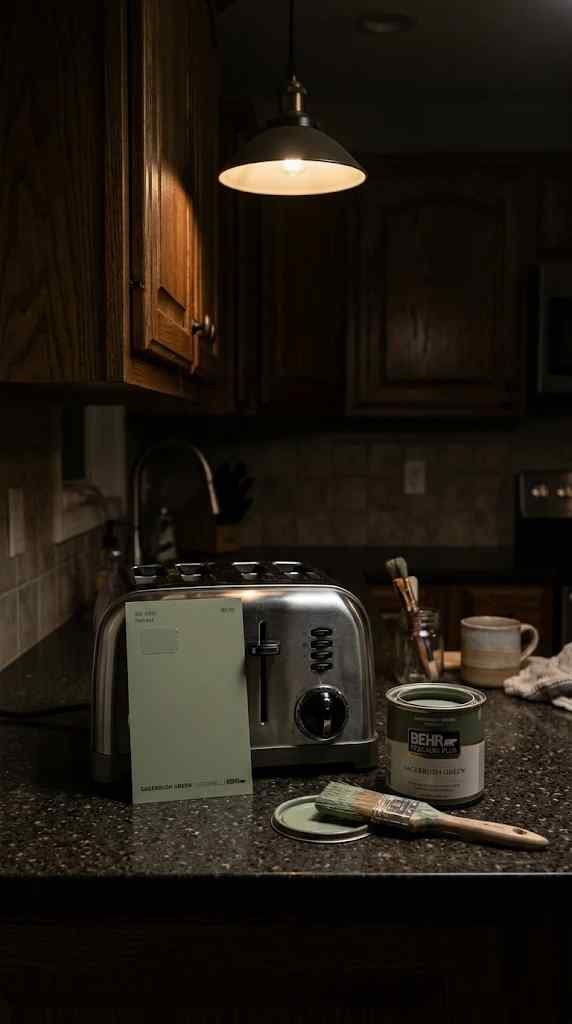
I’d brought home a sample of a muted green, and he barely looked at it before shaking his head. I set the brush down harder than I meant to. “Is there any color you’d say yes to?”
“Honestly?” He leaned against the counter. “I’d say yes to leaving them alone.”
So we had the real conversation, the one we’d been dancing around. I told him I spend seven hours a day in that room. It isn’t just a kitchen for me, it’s where I take calls, answer emails, and stare at the wall when I’m stuck. The orange made me tired, and I didn’t think that was a silly reason. A room you live in should not make you want to take a nap at 2 p.m.
He told me that painting oak can’t really be undone. You can strip it, but it’s miserable work, and the grain never looks quite the same. He said the house might be worth more with original wood than with a paint job that could look dated in five years. And he said, more quietly, that he liked that the kitchen looked like it had always looked.
Here’s the annoying part: he wasn’t wrong. Neither was I. We stood there with the green sample leaning on the toaster, two reasonable people with two reasonable positions and no way forward.
Then he said, “You don’t know what happened to my parents’ kitchen,” and I realized I didn’t.
What Dan finally told me

When Dan was fourteen, his mom painted their kitchen cabinets bright yellow over one weekend while his dad was away on a fishing trip. She didn’t clean them first, didn’t sand, and didn’t prime. She just rolled the latex paint right over the varnish because a TV show made it look easy.
It looked great for about three months. Then it started peeling near every handle, then along the bottom edges, then in long curly strips you could pull off with a fingernail. When his parents sold the house in 2008, the buyer’s agent walked in, pointed at the cabinets, and said they’d need to come down on price.
His dad spent a month of evenings in the garage stripping every door with chemical remover and a scraper. Dan helped. He said his parents fought the whole time, mostly not about the cabinets.
“I’m not scared of navy,” he told me. “I’m scared of the garage.”
That sentence rearranged everything. All those fast no’s weren’t about taste. Every sample I showed him was really a preview of a month of scraping and arguing, and he was saying no to that. I felt a little guilty for calling him stubborn to my sister, and a little relieved that the problem was something we could actually solve.
So I made him an offer. One door. We’d do it properly, start to finish, and if it peeled, I’d drop the whole idea.
The one-door experiment
We picked the small door above the refrigerator, the one nobody sees unless they’re looking for the good wine. Dan took it off the hinges that Saturday and carried it to the garage like it was evidence.
And then something funny happened. He took over. He watched videos about cabinet prep for two hours. He bought a degreaser, a sanding sponge, a tack cloth, and a bonding primer made for glossy surfaces. He read the can’s recoat times out loud to me like they were baseball stats. The man who’d spent two weeks saying no was now explaining scuff sanding to me at the dinner table.
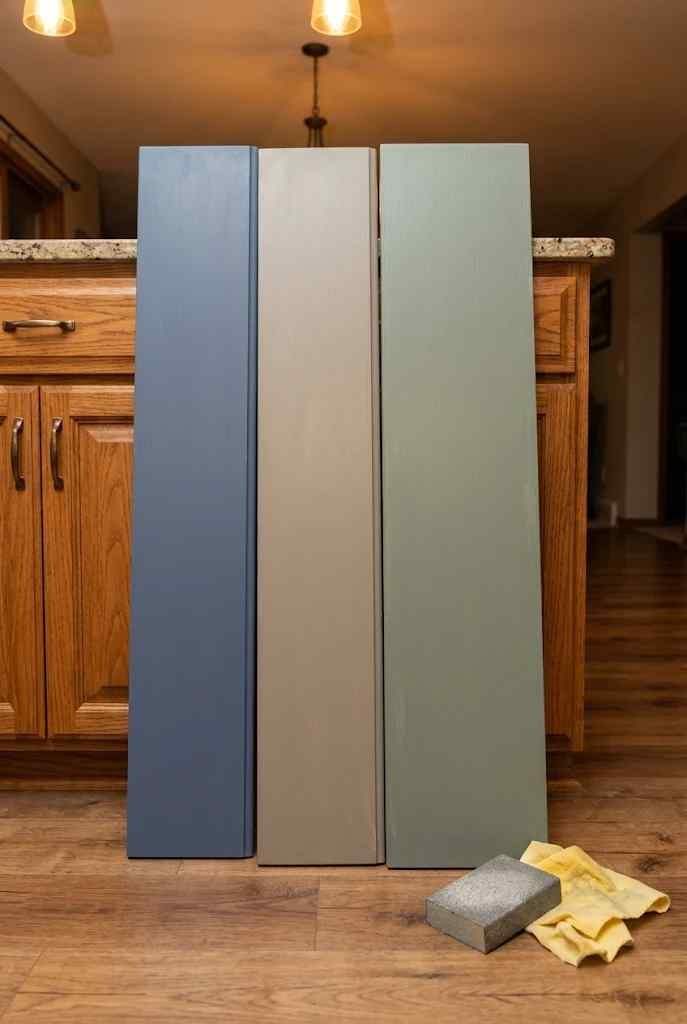
My job was the color. I narrowed my list to three and painted each on a large sample board: a soft navy, a warm greige, and Evergreen Fog SW 9130 from Sherwin-Williams. I’d almost left Evergreen Fog out. On the little paper chip, it looked like a gray that had given up.
For a week, those boards moved around our kitchen. I put them by the window in the morning, against the lower cabinets at lunch, and next to the stove under our warm bulbs at dinner. The navy went flat and heavy by evening. The greige disappeared into the oak floors. But Evergreen Fog kept changing. In the gray morning light it read as a soft, muted gray. At dinner it turned green, like sage after rain.
On Thursday night, Dan picked up that board on his own. He held it next to the cabinet base for a long time.
“That one changes,” he said. “I like that it changes.”
I tried very hard not to look smug. Then he set the board down and said, “But I have one condition.”
The compromise, and the white question
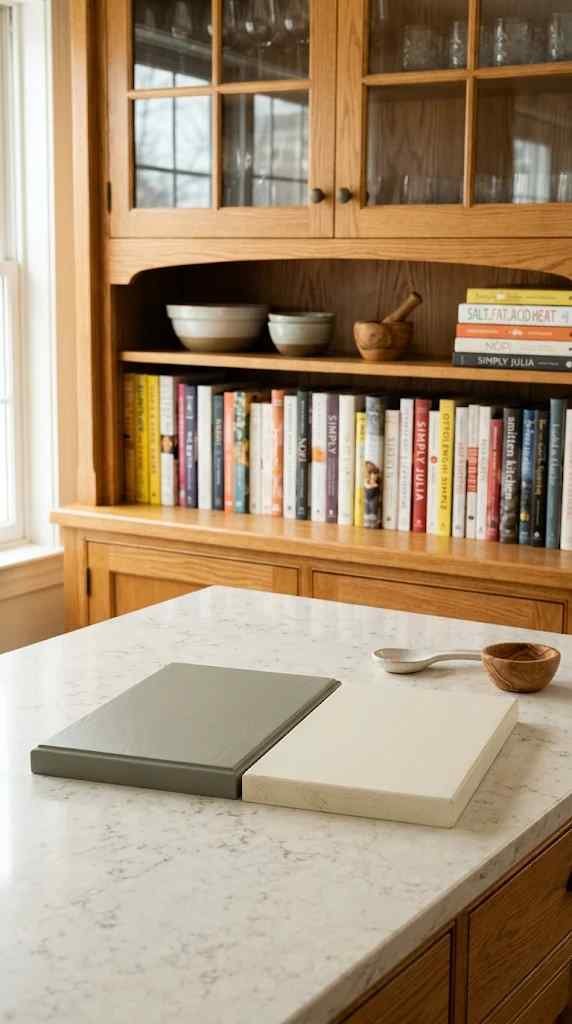
His condition was that the whole kitchen couldn’t go dark. Our room is narrow, about 11 feet across, and with a north window he worried that green on every cabinet would make it feel like a cave. He wanted the uppers light.
I didn’t love it at first. In my head, “light uppers” meant stark white, and stark white meant a hospital hallway with a coffee maker. I wanted the full green kitchen from my folder.
So we tested whites, too, and that’s how Alabaster SW 7008 came into the story. It’s a white, but a warm, creamy one, with just enough softness that it didn’t glare next to the oak floors or make the green look cold. We painted a board, and it looked calm next to the Evergreen Fog sample. Not boring. Calm.
We landed on Evergreen Fog for the lower cabinets and the island, and Alabaster on the uppers and the walls. Dan also asked to keep one thing oak. There’s a small built-in hutch at the end of the kitchen where we keep cookbooks, and he wanted that left as it was, just cleaned and refreshed with new finish.
“So the kitchen remembers what it was,” he said, and I let him have that one without a single joke.
The fridge door hung back up and stayed perfect for three weeks. We tested it with greasy fingers, a wet sponge, and a knuckle tap every time either of us walked past. No peeling.
So we planned three weekends for the rest. It took five.
Five weekends in the garage
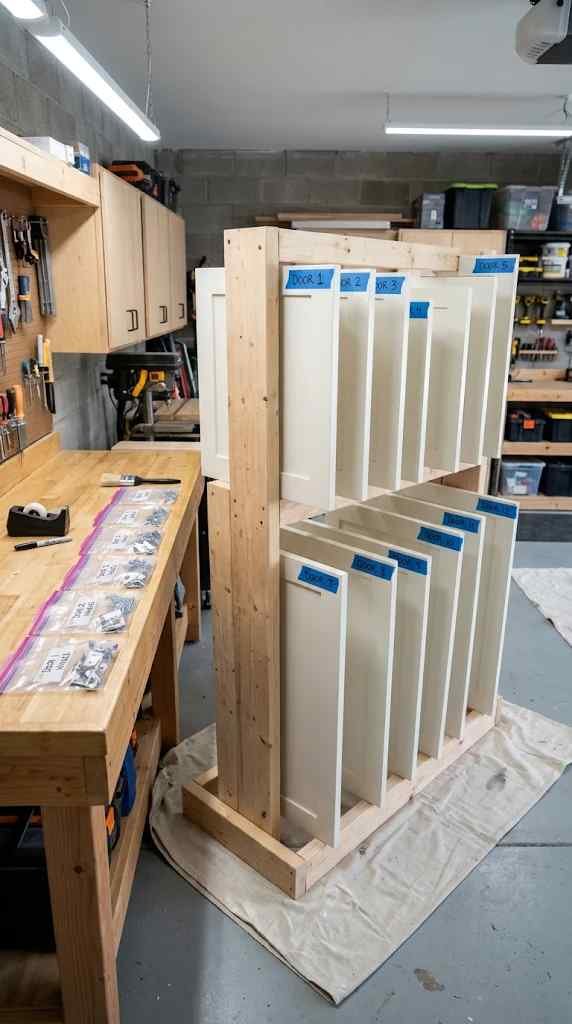
The garage looked nothing like Dan’s childhood memory, mostly because he planned it like a military operation. Every door got a number on painter’s tape matching a number inside its cabinet box. Hinges went into labeled sandwich bags. He built a drying rack out of scrap two-by-fours so doors could dry without touching anything.
The process was slow in a way I hadn’t pictured. Degrease, sand, wipe, prime, wait, light sand, paint, wait, paint again, wait. Then wait three more days before hanging anything, because paint can feel dry within hours long before it’s actually hard.
I was the one who broke the rules. On the second weekend I got impatient and stacked two drawer fronts that weren’t fully cured, and one of them came away with a scuff right in the center. Dan looked at it, looked at me, and said, “I’m not saying anything.” Which, as every married person knows, is saying something. Then he quietly sanded it and repainted it himself.
There were real costs. We spent about $600 on primer, paint, brushes, a small foam roller kit, and supplies. A professional painter had quoted us $5,800, so the savings were big, but so was the time. We skipped a lake weekend with friends. We ate a lot of takeout off paper plates because the kitchen was half disassembled.
And not everything came out the way I’d pictured. We skipped grain filler, so you can still see the oak grain through the paint if the light hits it from the side. I like the texture because it looks like real wood under there. Dan wishes we’d made it perfectly smooth. We still haven’t settled that one.
When the last door went back on, it was a Sunday night. I went to bed without really looking. The real test was the next afternoon.
What happened after
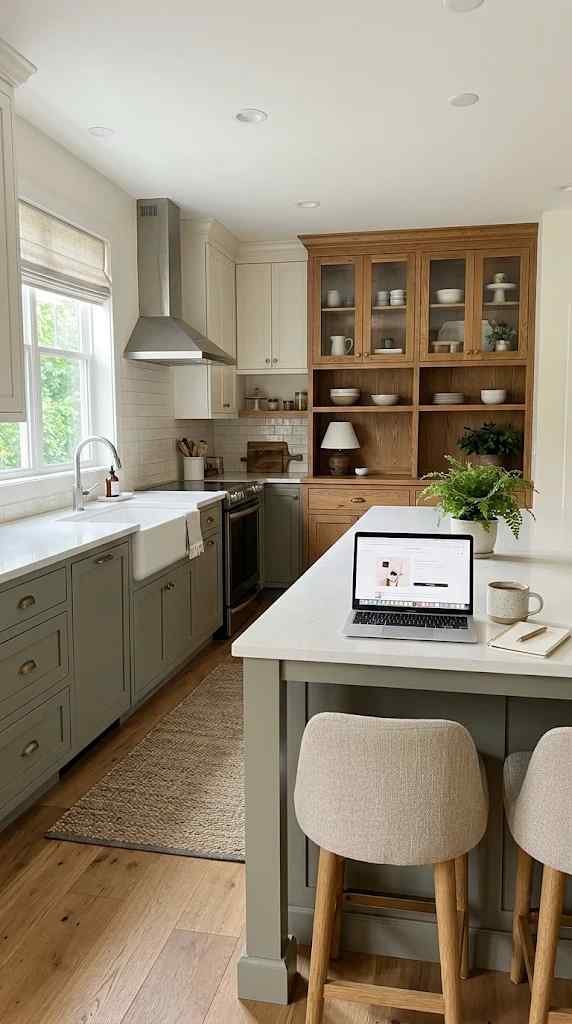
At two o’clock on Monday, I sat at the island with my laptop and waited for the pumpkin feeling. It didn’t come.
The Alabaster uppers bounced the window light around the room instead of soaking it up. The Evergreen Fog lowers looked grounded and soft, and they hid the scuffs from the barstools far better than white ever would have. The room felt bigger, though nothing in it had moved an inch.
Dan came home, ran his hand along a lower door, and knocked on it the same way he used to. “Still solid wood,” he said, and smiled like he’d won something.
A month later, his mom came to visit. She stood in the middle of the kitchen for a long moment, then opened a cabinet door and looked at the edge. “Did you prime?” she asked. Dan said yes. She nodded slowly and said, “We should have done it like this.” Dan and I looked at each other, and neither of us said anything, which was the right thing to say.
Four months in, there’s one small chip near the trash pull-out where the bin bumps the door. Dan touched it up in ten minutes. We are currently arguing about whether to swap the acorn knobs for brass or matte black pulls. Some disagreements are just hobbies now.
Practical home takeaways
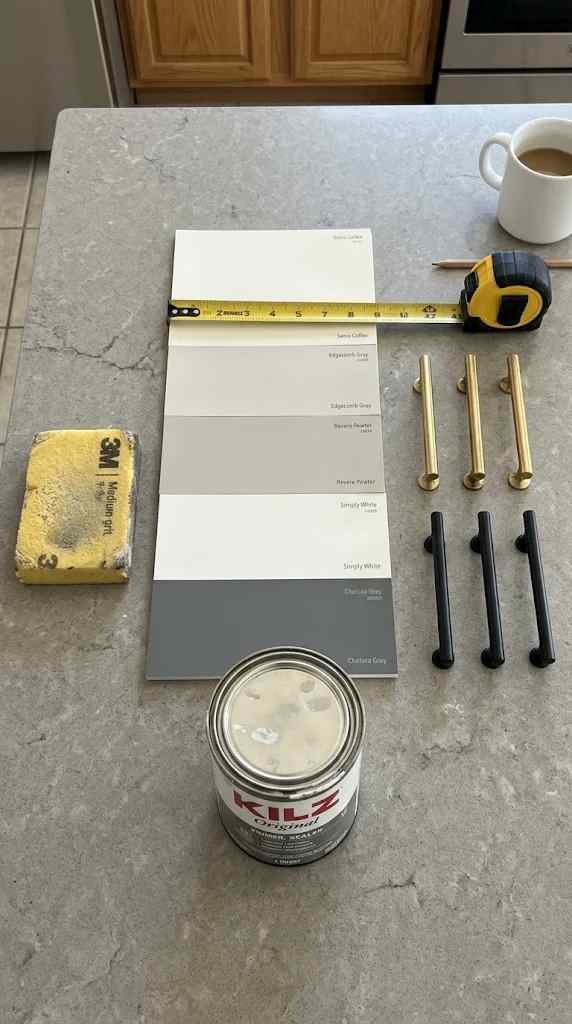
Test colors big and for a full day
- Paint samples on boards at least 12 by 12 inches. Small chips are hard to judge, and colors shift a lot at scale.
- Check them in morning, midday, and evening light, and under your actual bulbs. North-facing rooms tend to make colors look cooler and grayer.
- Hold samples against your floors, countertops, and anything you’re keeping, like we did with the oak hutch.
Use LRV to predict brightness
- Light Reflectance Value (LRV) tells you how much light a color bounces back, on a scale of 0 to 100.
- Alabaster SW 7008 has an LRV around 82, so it brightens dim rooms. Evergreen Fog SW 9130 is around 32, so it reads as a medium tone that adds depth without going very dark.
- Pairing a high-LRV upper with a mid-LRV lower is a simple way to add color to a small or north-facing kitchen without making it feel closed in.
Prep matters more than the color
- Degrease first. Kitchen cabinets hold cooking residue that stops paint from sticking.
- Scuff sand glossy finishes and use a bonding primer made for slick surfaces.
- Oak grain will show through paint unless you use grain filler. Decide early whether you want texture or a smooth finish.
- Paint dries in hours but can take several weeks to fully cure, depending on the product, humidity, and temperature. Handle doors gently and wait before stacking or rehanging.
Weigh DIY against hiring a pro
- DIY saves money but costs a lot of time. Plan on several weekends for an average kitchen.
- Pro pricing varies widely by region, kitchen size, and whether they spray the doors. Get at least two quotes.
Check clearances before changing the island
- A common guideline is about 42 inches of aisle for one cook and 48 inches for two. Tight layouts may need to work with less.
- For island seating, allow roughly 36 inches behind stools if no one walks past, and more if it’s a walkway.
- Kitchen runners usually look best when they leave a few inches of floor showing on each side.
Choose hardware last
- Paint changes how hardware looks. Brass warms up green, and black adds contrast against cream.
- Tape a few options to a finished door before buying a full set. Pulls around a third of the drawer width are a common starting point.
CONCLUSION
For two weeks I thought my husband had terrible taste. Actually, he had a memory of a garage, a peeling yellow kitchen, and his parents fighting under a bare bulb. Once I knew that, the question changed from “which color” to “how do we make this safe,” and that one we could answer together.
The kitchen is green now, and calm, and it still has its oak heart in the corner.