
livingroom office combo
By Anna Grace | 3 April 2026
The Living Room Office Combo Revolution That Actually Matches Your Home
Your living room wasn’t meant to hold a filing cabinet and a standing desk until suddenly, it kind of had to. The line between where you relax and where you work has officially blurred, and instead of fighting it, smart people are leaning into it. A living room office combo isn’t about cramming two jobs into one room it’s about designing a space that actually works for both without making you feel like you’re working in your couch cushions.
Here’s the thing most people treat their living room and home office like sworn enemies. But they don’t have to be. When you stop trying to keep them separate and start making them cooperate, you unlock a room that’s genuinely flexible, genuinely comfortable, and genuinely productive. Let me walk you through how to pull it off.
The Case for Combining These Spaces
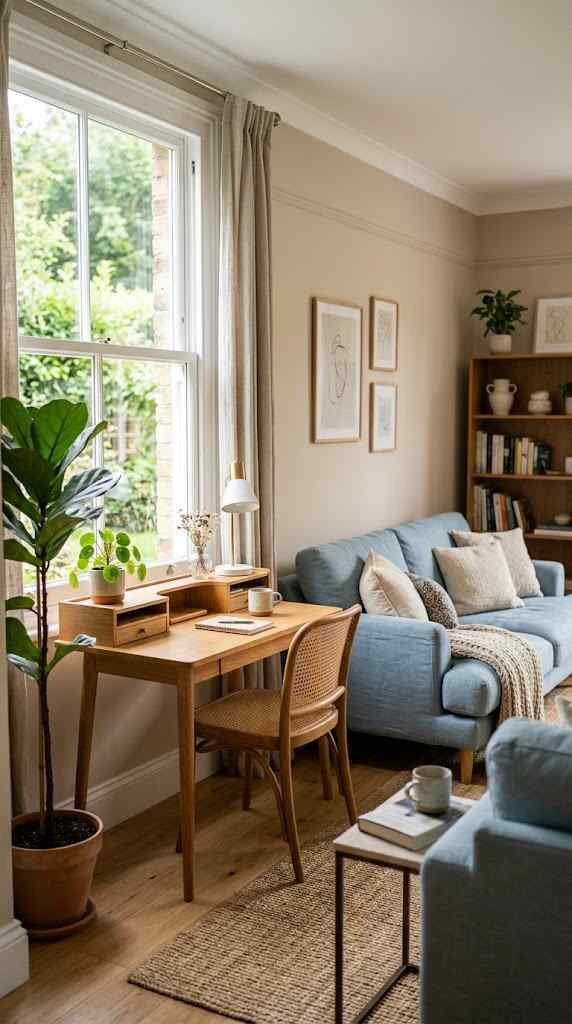
Single-purpose rooms are a luxury most of us can’t afford anymore. Whether you’re in a small apartment, a cozy house, or just tired of having an unused den, combining your living room with office space is practical and (this might surprise you) often leads to better work.
Why? Because living rooms naturally encourage you to move. You walk to the kitchen, you stretch on the couch, you stand to answer the door. A dedicated home office can feel isolating four walls, a desk, repeat. But a living room office combo gives you built-in movement and mental breaks without leaving your workspace. Your brain gets variety, your body gets less stiff, and your work actually improves.
Plus, let’s be honest nobody’s excited to furnish two separate rooms. Doing a living room office combination means investing in one thoughtfully designed space instead of spreading yourself thin. That money goes further. Your design choices are stronger. And the room actually feels intentional instead of like a compromise.
The psychological shift that happens when you stop compartmentalizing your home is real. Working exclusively in one designated room creates a mental prison you’re either “in work mode” locked behind a closed door, or you’re trying to relax while the workspace sits there judging you from across the house. A living room office combo flips that script. You’re integrated into your home’s natural flow, which means you’re not sacrificing your evening relaxation for a room that makes you feel guilty.
Studies on home office design consistently show that people who work in multi-use spaces actually report better work-life balance because there’s less psychological weight attached to being “in the office.” You’re just in your living room, which happens to have a functional desk. The anxiety of walking into a dedicated office space dissolves. Additionally, living room office combos force you to stay organized in a way a hidden office doesn’t require you can’t let papers pile up without it affecting your actual living experience, so you naturally maintain better habits.
Furniture That Earns Its Place
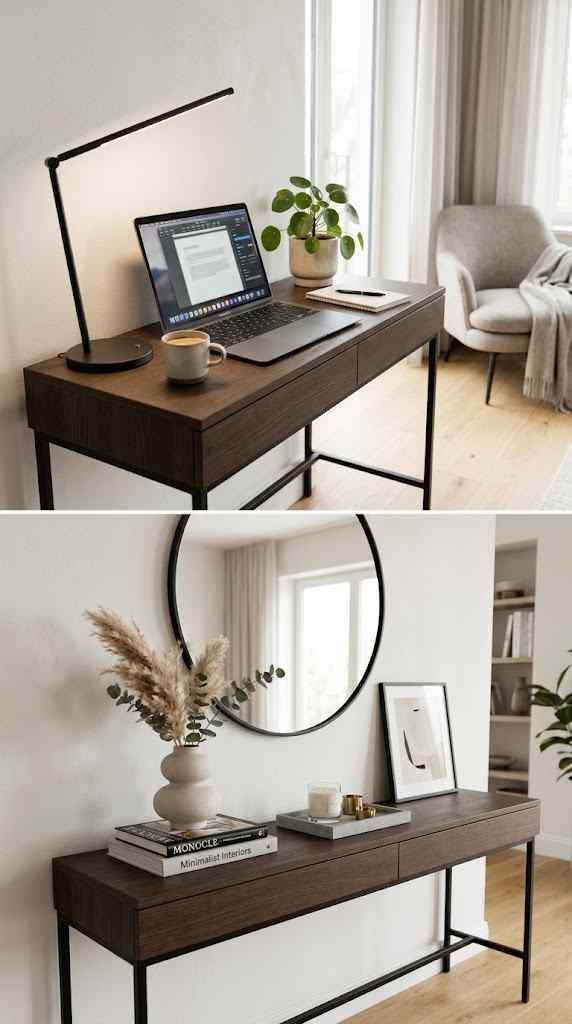
This is where most people get it wrong. They plop a desk in the corner and call it a day, creating an eyesore that screams “I work here, but I don’t want anyone to know.” Instead, your furniture should do multiple jobs without looking like it’s struggling.
A console table works as both a sleek desk surface and an elegant entryway accent when work is done. Wall-mounted shelving holds office supplies during the day and becomes a styling showcase at night. An upholstered ottoman with storage inside? Footrest, coffee table, and filing solution in one. Look for pieces with clean lines and finishes that match your living room palette nothing industrial or aggressively “office-like” unless that’s already your aesthetic.
Storage is non-negotiable. Floating shelves, a stylish credenza, or closed cabinets that tuck files out of sight make all the difference between “cozy workspace” and “cluttered mess.” The key is getting everything off your work surface when the day ends. If your laptop and papers stay out, your living room will start to feel like a second-rate office. If they disappear into beautiful storage, you’ve got a functional living room back.
The desk itself doesn’t need to be traditional. Some people use a desk-height console against a wall. Others opt for a narrow drop-leaf table that folds up when not in use. A few brave souls go for a standing desk that doubles as a bar or buffet. The point is this: whatever desk you choose should enhance the room’s design, not dominate it.
The furniture game-changer most people miss is vertical storage. While your desktop needs breathing room, your walls don’t. Floating shelves above your workspace hold everything from office supplies to decorative books that double as design elements. The trick is choosing shelving with the same finish as your living room furniture matte wood, metal accents, whatever matches your existing pieces. This continuity makes the workspace feel like it belongs there instead of looking like an afterthought. Another often-overlooked piece is a slim sideboard or buffet cabinet.
These were designed to hide dining room clutter, but they’re absolute magic for office supplies. Pens, notepads, cables, and files disappear behind closed doors during your downtime, and they’re beautiful enough that nobody suspects they’re holding your entire professional life. Wall-mounted desks are another option if floor space is tight they fold up completely and look like nothing when closed, giving you a fully reclaimed living room in seconds. Finally, consider a desk with a natural wood top and a base that matches your existing furniture legs or hardware. This small detail makes an enormous difference in how integrated your workspace feels rather than how obviously transplanted it is.
Lighting That Works for Both Jobs
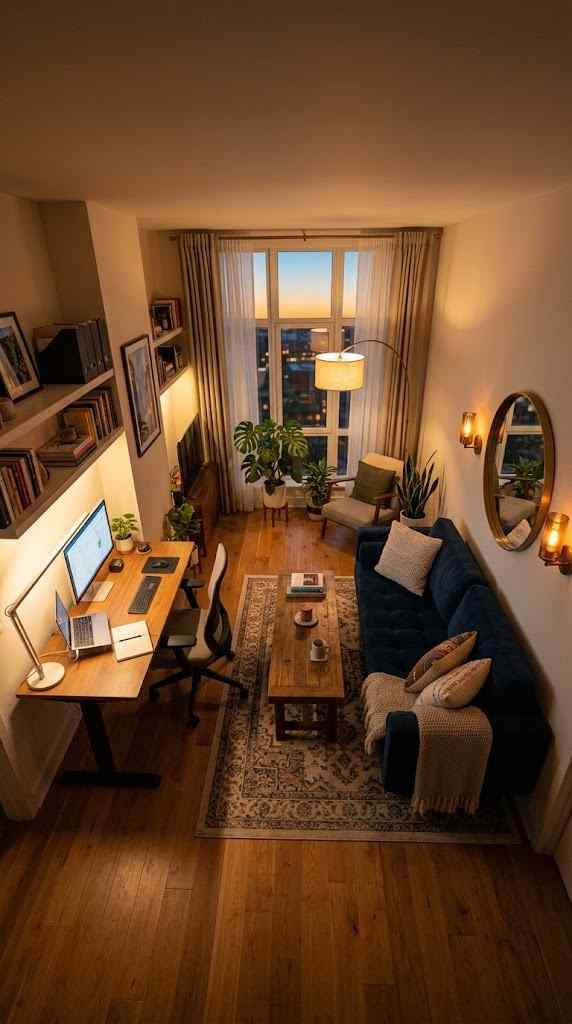
Bad lighting will tank both your productivity and your relaxation. You need a setup that handles work-mode focus and living-room coziness.
Overhead lighting is usually too harsh for either purpose, so skip the expectation that ceiling lights will carry the load. Instead, layer your lighting. A desk lamp with a warm, adjustable bulb keeps your work area lit without blasting the whole room. Wall sconces flanking a mirror or console add warmth and visual interest. A floor lamp in the corner gives you flexibility and creates ambient lighting for evening relaxation. Smart bulbs let you shift from cool, focused light when you’re working to warm, dimmed light when you’re winding down all without moving a thing.
Natural light is your secret weapon. Position your desk near a window if you can, but angle it so glare doesn’t hit your screen. Curtains or shades that filter light instead of blocking it entirely let you control your environment without sacrificing the openness of the room.
Here’s what people underestimate about lighting it’s the fastest way to mentally shift between work and relaxation mode. The moment you dim your desk lamp and brighten a side sconce, your brain registers “work mode off.” This is why smart bulbs are worth the investment they’re not a luxury, they’re a productivity and mental health tool.
The best combo includes a focused desk lamp with adjustable brightness so you can increase intensity during deep work and dial it back when you’re winding down. Pair that with dimmable overhead lights (if you have them) and wall sconces on a separate dimmer switch. Suddenly, you control the entire room’s mood without moving furniture. Color temperature matters too cool white light (4000K-5000K) keeps you alert during work hours, while warm white light (2700K) signals to your body that it’s time to chill.
Some people even use timed automations so their lights gradually shift warmer in the late afternoon, naturally signaling an end to the workday. A third option nobody talks about enough is layering in accent lighting through items like LED bookshelf strips or picture lights above artwork these add visual interest to the living room while providing subtle ambient light that makes the space feel intentional rather than “office pretending to be living room.”
Defining Zones Without Walls
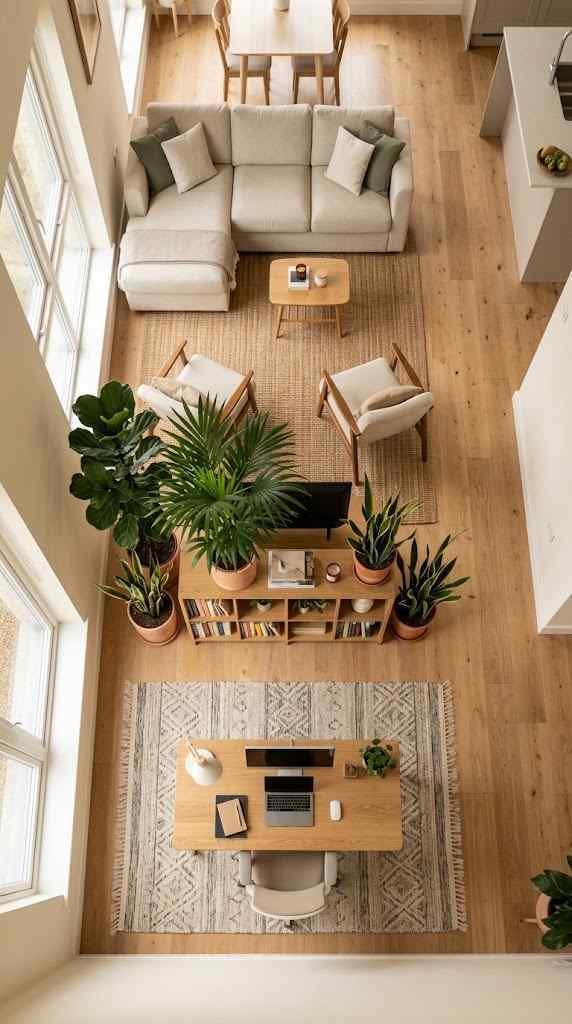
Here’s the mental trick: you can separate a living room office combo into distinct zones without throwing up a wall or creating an obviously divided space.
A large area rug is your best friend. Define the work zone with a smaller rug under and around your desk setup, then use a larger, living-room-appropriate rug for the rest of the space. This sounds simple, but your brain actually registers these as different areas, which helps you mentally transition between work mode and relaxation mode.
Furniture arrangement matters too. Angle your desk slightly away from the main seating area so it doesn’t visually anchor the room. If you can position it to face a wall or window instead of the couch, even better you’re less tempted to get distracted, and visitors don’t immediately see your workspace.
Plants, artwork, and décor can also create subtle boundaries. A tall bookshelf or standing plant can act as a gentle visual divider without screaming “keep out.” The idea is that someone entering your living room sees a living room first, with a tasteful workspace integrated into it not an office with some couch furniture awkwardly placed around it.
The psychology of zoning is more powerful than most people realize. Your brain needs clear visual signals that you’re moving between different mental states. Beyond rugs and furniture arrangement, color can be your subtle divider not necessarily different paint colors, but different fabric tones or accent colors that are slightly more muted in the work zone and slightly richer in the living zone. A low console table or credenza can also act as a subtle boundary without feeling like a wall; it’s substantial enough to create visual separation but not so imposing that it chops up the room.
Another strategy that works beautifully is positioning your desk to face away from the main living space entirely toward a window, a blank wall, or even a gallery wall of artwork. This positioning does two things: it keeps you from getting distracted by your own living room (the couch won’t tempt you), and it signals to visitors that you’re in a focused space even though they’re in the same room. Some people even use a tall, decorative room divider that’s more design-forward than utilitarian something that looks like it belongs in a living room, not a cubicle. The key is that all these strategies work together subtly, creating distinct zones through layering rather than a hard division.
Managing Distractions and Productivity
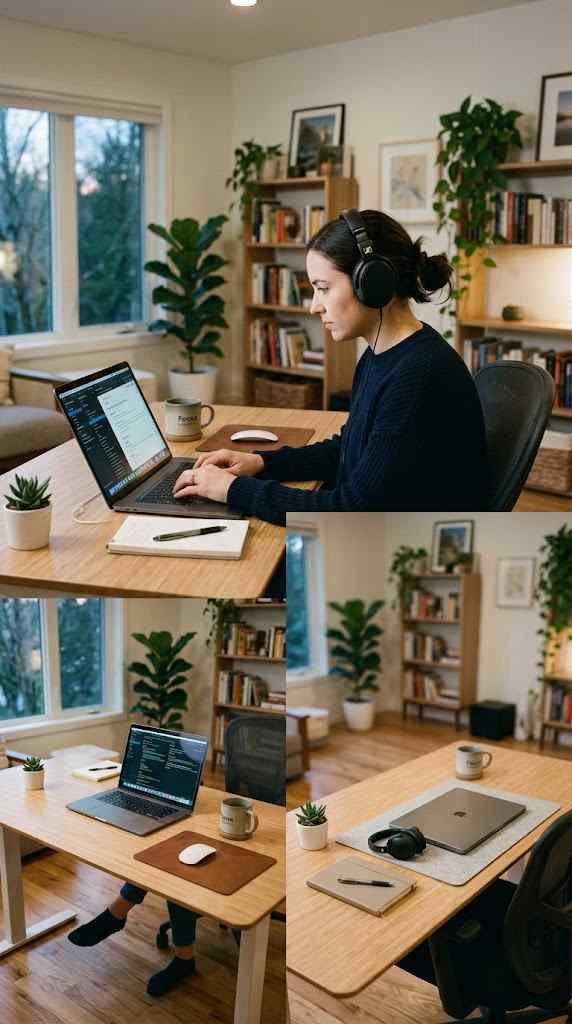
Working in your living room means your brain has to work harder to stay focused. You’re in the room where Netflix lives. Your comfortable couch is within arm’s reach. Self-discipline becomes your furniture.
Set clear “work hours” and stick to them. When 5 PM hits, shut down your computer, close your laptop, tuck files away. This psychological break is crucial your living room has to feel like a break from work or you’ll burn out. When your workspace is always visible, you never truly clock out.
Noise management matters. If your living room opens to a busy kitchen or household traffic, invest in a white noise machine or use noise-canceling headphones during deep-work time. Your living room office combo won’t save you if constant interruptions are pulling your focus.
Background noise from the TV or music can either help or hurt, depending on you. Some people focus better with ambient sound; others need silence. Test both and commit to what actually works for your concentration, not what sounds good in theory.
Discipline is only half the battle environmental design handles the other half. If your living room couch is directly in your line of sight while you work, you’re fighting an uphill battle every single day. Rearranging furniture so you face a wall, a window, or even a bookshelf keeps your peripheral vision distraction-free. Sound design is equally important but often overlooked. If you’re in a household with others, noise-canceling headphones aren’t optional they’re essential. Even if nobody’s being loud, the possibility of interruption creates mental load. Headphones signal to others that you’re focused, and they block ambient noise that your brain might otherwise register.
For some people, playing instrumental music or ambient soundscapes actually boosts focus, while others need absolute silence. The key is testing both without judging yourself what works for focus is deeply personal. One more productivity hack specific to living room offices establish a ritual for your transition time. Spend five minutes before work clearing your desk, opening windows for fresh air, and making a small cup of tea or coffee. This isn’t wasted time it’s your brain’s on-ramp to focus. Similarly, spend three minutes at the end of the day tidying and closing your laptop. These tiny rituals create invisible boundaries that your mind recognizes even in an open space.
The Real Win
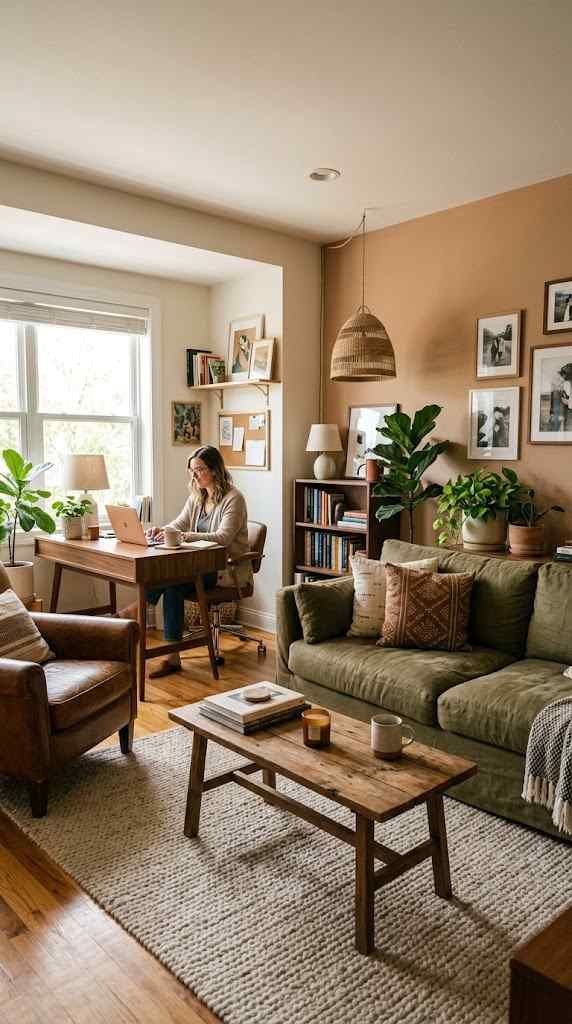
A living room office combo isn’t a compromise it’s efficient living. You get a functional workspace that doesn’t require closing yourself off from your home. You get a living room that doesn’t sit empty eight hours a day. And you get to stop pretending you have the space (or budget) for two separate rooms.
The secret is in the details: furniture that works for both purposes, lighting that shifts with your mood, zones that feel natural, and the discipline to actually close the laptop at the end of the day. Do those things right, and you’ll wonder why you ever thought one room had to do only one job. Your best home office was already sitting in your living room you just needed to redesign it.
The added bonus is resale value. Homes with thoughtfully designed multi-use spaces actually appeal to more buyers than homes with obvious dedicated offices, because they feel flexible and functional. Your living room office combo signals to future owners that the space is well-designed, not cramped or awkwardly divided. Beyond the practical benefits, there’s something genuinely satisfying about a space that works harder than it has to. Every piece of furniture earns its place.
Every design decision serves two purposes. You’re not just working from home; you’re working from a home you actually enjoy spending time in. That’s the real win not settling for functional, but designing for beautiful and functional. Start small if you need to. One piece of furniture, one lighting upgrade, one organizational system. The living room office combo doesn’t happen overnight, and it doesn’t need to. But once it clicks, you’ll stop thinking about it as a compromise and start thinking about it as the smartest design choice you made.
FAQ’s
Can you really focus in a living room office combo, or is it just distraction?
Focus depends on positioning, lighting, and discipline. Position your desk to face away from distractions, use noise-canceling headphones, and set clear work hours to mentally separate work from relaxation time.
What’s the best desk size for a living room office combo without overwhelming the space?
A console table or 48–60 inch desk works best. Avoid traditional large L-shaped desks. Choose a narrow profile that doesn’t dominate the room while providing enough workspace for laptops and documents.
Should you hide office supplies in a living room office combo, or can they stay visible?
Hide daily supplies in closed cabinets or credenzas, but display styled storage solutions like woven baskets or decorative boxes. This keeps the space intentional and clutter-free while maintaining functionality and aesthetic appeal.
How do you prevent a living room office combo from feeling like you’re always at work?
Close your laptop and tuck files away at the end of each day. Use dimmable lighting to shift from work mode to relaxation mode. Create a physical or visual boundary with rugs, furniture placement, or subtle dividers.
Is it worth investing in smart lighting for a living room office combo setup?
Absolutely. Smart bulbs let you shift from cool, focused work light to warm, relaxing ambient light without moving furniture, creating essential psychological breaks between work and home modes.
CONCLUSION
The future of home design isn’t about more rooms it’s about smarter rooms. As housing costs rise and lifestyles become less predictable, the ability to design a space that does multiple jobs beautifully becomes a genuine skill. You’re not settling for a living room that happens to have a desk; you’re intentionally creating a home office that doesn’t sacrifice comfort or aesthetics.