
Livingroom with tv
By Anna Grace | 21 feb 2026
Clever Ways to Blend The Living Room With TV that Doesn’t Need to Be Boring
Most people treat their living room TV setup like they’re designing a movie theater which, honestly, is the wrong starting point. Sure, the screen matters, but what actually makes a living room work is everything around it. You don’t need an interior design degree or an unlimited budget to pull this off. What you need is a realistic approach to how you actually spend time in that space.
I once visited a friend’s apartment where the entire room was arranged like a shrine to a 65-inch TV mounted on the wall. The couch faced it perfectly. The angle was flawless. But nobody sat there. They ended up eating dinner on the kitchen counter and watching shows on their phones because the setup felt sterile and uncomfortable. Your living room with a TV should feel like a room you want to be in, not one you’re forced into.
The real challenge isn’t the TV itself it’s creating a space that feels intentional, comfortable, and actually serves the people living there. Let’s talk about how to get there.
The mistake people make is treating a living room with a TV like it’s a dedicated purpose. You wouldn’t design your bedroom around a single piece of furniture, but somehow a TV gets a pass. The truth is, your living room serves multiple functions it’s where you decompress, entertain guests, work from home sometimes, and yes, occasionally watch something. A smart setup acknowledges all of that without sacrificing comfort for the sake of screen real estate.
Think about how your room actually gets used throughout the day. Maybe morning coffee happens on that couch with natural light and no TV. Afternoon might be a Zoom call where the TV’s off. Evening is where the TV finally gets attention. A living room that adapts to these rhythms, rather than forcing them into one fixed mode, feels infinitely more functional. The furniture arrangement, lighting options, and even what you put on the walls should support this flexibility, not fight against it.
Stop Letting the Screen Be Your Interior Designer
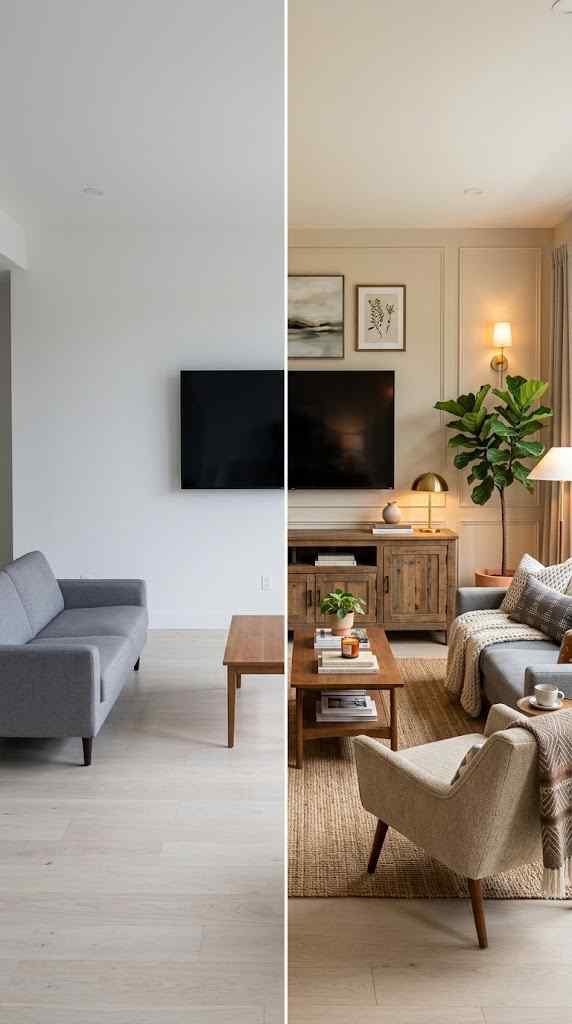
Here’s the thing a TV is a viewing device, not a room’s personality. Too many people start by asking, “Where should the TV go?” when they should be asking, “How do I want to feel in this space?” That shift in thinking changes everything.
The TV should integrate into your design, not dictate it. Think about what else happens in your living room conversations, reading, gaming, scrolling social media while half-watching something. A living room that works around a TV acknowledges all those activities, not just the last one.
This means considering sightlines from different parts of the room, not just dead center on the couch. Can someone sitting in a corner chair still see the screen comfortably? What if you’re standing in the kitchen entrance and want to glance at what’s on? These small decisions add up to a room that feels naturally arranged instead of aggressively optimized.
Your furniture should work with the TV, not orbit around it like it’s the sun. I’ve seen living rooms where people added an accent chair facing the wall instead of the screen because they wanted a reading nook. That’s smarter design than forcing every seat to have a perfect view of the TV.
When you default to “TV on the wall, couch facing it,” you’re not making a design choice you’re accepting default mode. Real design means considering what makes your space feel good to you. Maybe that’s a TV tucked into a bookcase instead of centered on a wall. Maybe it’s a setup where the screen lives on a rolling stand so you can angle it differently depending on the day. Maybe it’s positioned lower than typical because someone in your household is usually sitting or lying down, not standing.
The psychology of how a room feels actually shifts when the TV isn’t the gravitational center. Guests arrive and naturally drift toward conversation rather than defaulting to watching something. A room oriented around connection first and screens as optional eels more social and alive. You can always turn the TV on when you want, but the space doesn’t feel like it’s demanding that of you. That distinction matters more than people realize, especially if you spend several hours a day in that room.
Layout Matters More Than You’d Think
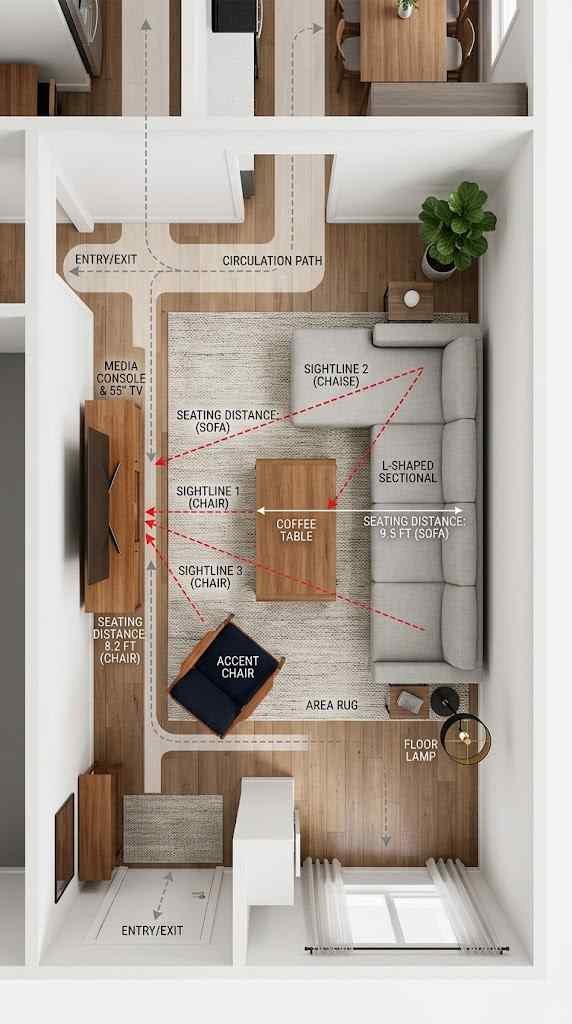
Figuring out where to actually put a TV in your living room comes down to a few practical questions:
Wall space Do you have a wall without windows that can handle a TV? This is usually your first constraint. A TV on a wall with windows behind it becomes hard to watch when sunlight hits. If you’re stuck with problematic lighting, consider a TV stand instead of wall mounting, which gives you flexibility to angle it differently.
Seating distance There’s actual math here, but keep it simple: you want to sit about 1.5 to 2.5 times the TV’s diagonal width away from the screen. A 55-inch TV works best if your couch is roughly 7 to 10 feet back. Too close and you’re straining your neck. Too far and you can’t see the detail. Most living rooms fall somewhere in this range naturally.
Multiple seating options If your space allows, arrange furniture so people can actually chat and watch without everyone sitting in a theater-style row. An L-shaped sectional, a primary couch plus an accent chair, or even a loveseat and separate seating creates a living room that doesn’t feel like a waiting room. IMO, this is where people mess up. They buy one giant sectional because “more seating,” but it locks everyone into TV-watching mode 24/7.
Doorways and traffic flow Nobody wants to squeeze past the couch to get to the kitchen. Consider how people actually move through the space, not just where they sit and stare.
Beyond the basic rules, think about how natural light plays into your TV placement. Morning sun creates glare on screens, so if your main seating gets bright until 10 AM, maybe your TV wall is actually the opposite side of the room, or you invest in good blackout blinds. Afternoon light from the west? A TV on that wall becomes unwatchable by 4 PM. Working with light instead of against it makes the space work better year-round, not just during optimal times.
Another angle most people skip what happens when you’re not watching? If the TV dominates the visual landscape even when it’s off (a black rectangle taking up half the wall), the room feels dominated by it. Some people solve this by mounting TVs on articulating arms that let them swing away when not in use. Others use a gallery wall format where the TV is one element in a larger frame of artwork and photos. These aren’t trendy solutions they’re practical answers to the reality that your TV will be off roughly 20 hours a day.
Design Elements That Actually Make This Work
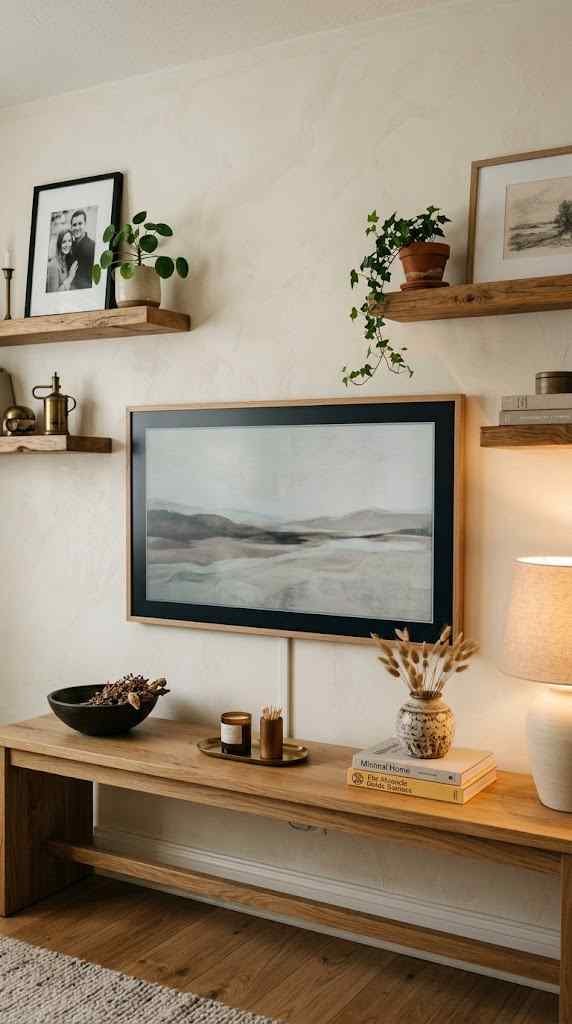
Once you’ve sorted the practical layout stuff, design is where a living room with a TV either feels curated or feels like an electronics showroom.
A simple strategy is not letting the TV frame dominate visually. If you’re wall-mounting, you have options: flank it with floating shelves, hang artwork above or beside it, add a console table below it with plants and personal items. This breaks up the black rectangle and makes the wall feel intentional rather than blank. You’re not hiding the TV you’re giving the space other things to look at besides when the screen is on.
Color and texture matter more than people think. A living room with a TV can feel cold if everything is white walls and black furniture focused on a dark screen. Warm wood tones, a patterned rug, cushions in colors you actually like, and lighting that doesn’t blow out your vision when the sun sets these details transform the space from “functional” to “actually nice.”
Lighting is genuinely critical. A room lit only by TV glow feels grim. You need overhead options, wall sconces, or lamps that can adjust based on whether you’re watching or just existing. Smart bulbs that dim automatically when you press play? They’re not a luxury they’re practically standard now.
Styling around a TV wall works best when you stop thinking of it as “TV wall” and start thinking of it as “a wall that happens to have a TV.” Use symmetry if that appeals to you matching shelves or artwork on either side. Or break symmetry intentionally with an off-center console and asymmetrical shelving that feels more organic. The key is that the styling doesn’t look like you panicked and added clutter to hide the screen.
Materials matter too. A TV mounted on a textured wall (shiplap, stone, warm wood paneling) feels warmer than one on flat drywall. A floating console in natural wood grounds the setup. Even the color of your wall influences how prominent the TV feels. A dark accent wall makes the black screen recede a light wall makes it pop. There’s no single “right” answer, but being intentional about these choices means your living room with a TV looks designed, not defaulted-to.
Technology That Doesn’t Take Over
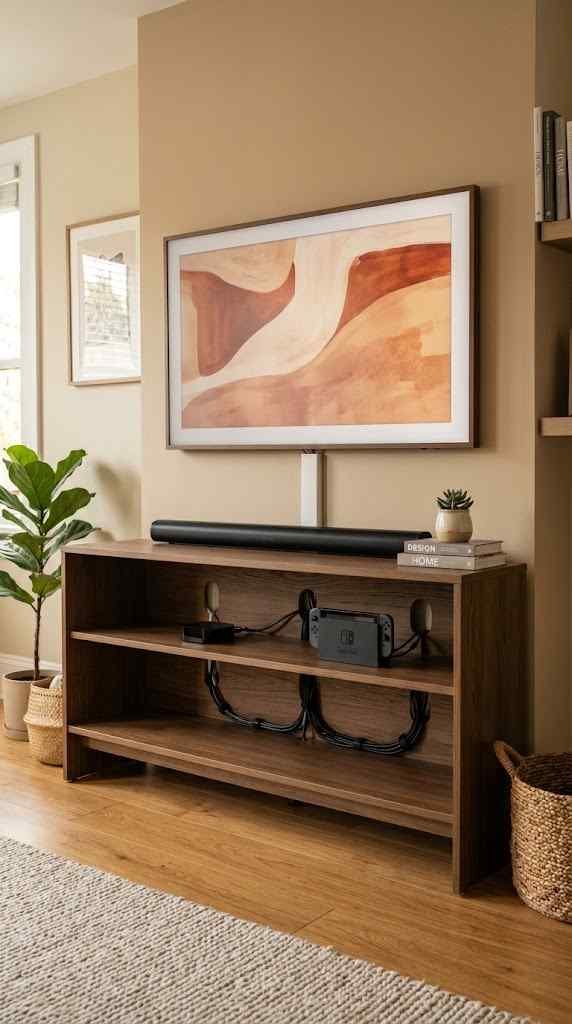
Here’s what I see happen constantly people buy a TV, mount it, run cables everywhere, and then complain about how messy it looks. The technology in a living room should work silently in the background.
Cable management is non-negotiable. Wall-mount your TV? Run your cables through the wall or use a raceway system that actually looks intentional, not like someone dumped wires and hoped no one noticed. A media console with a built-in cable management system keeps your soundbar, streaming devices, and gaming systems organized. Bonus: it also creates a horizontal line that balances a large TV on the wall.
Consider whether you actually need a visible sound system. Some people use a soundbar attached to the TV itself clean, simple, works fine for casual watching. Others invest in better audio with speakers that can sit on shelves or integrate into cabinetry. Neither is wrong. Just think about what matches your setup and how much you actually care about audio quality.
Wireless everything has made this easier. Airplay-compatible speakers, Bluetooth remotes, streaming via devices you already have instead of random boxes it all reduces clutter. Your living room with a TV doesn’t need to look like a Best Buy display.
The dirty truth about most living rooms is that the technology ecosystem is a mess behind the scenes. You’ve got HDMI cables running down the wall, power cables bundled messily, and devices scattered everywhere because nobody planned it. Preventing this chaos starts during the layout phase, not after the wires are already there. If you’re wall-mounting, have a professional run cables through the wall (or do it yourself if you’re comfortable) it costs way less than redoing it later.
Wireless alternatives have genuinely improved. A quality soundbar via Bluetooth paired with a streaming device means fewer visible boxes and cables. If you’re a gamer or film purist who wants real surround sound, sure, that requires more setup, but even then, a good installer can make it look clean. The point isn’t no technology it’s technology that serves you without announcing itself constantly. When you walk into the room, you should notice the comfort, lighting, and design first. The tech should work silently.
Making It a Living Room, Not a Media Cave
This is the part people skip, and it’s the reason so many living rooms feel lifeless you have to actually use the space for living.
A good living room with a TV has a reason to be sat in even when nothing’s playing. That means natural light during the day, a rug that ties the seating area together, a coffee table that actually holds a book or a drink without feeling like an obstacle, and maybe a side table for a lamp where you can read. These aren’t decoration. They’re what make a room feel like it’s meant for people.
Include some things that aren’t screen-related. A bookshelf, a bar cart, a gallery wall, plants, whatever matches how you actually live. When friends visit, they should be able to hang out and talk without assuming the TV is the entire point.
A living room that only exists for TV-watching is honestly depressing. You’ve essentially built a one-trick space that feels purposeless the moment you’re not watching something. Combat this by designing the room to be valuable outside of screen time. A comfortable chair facing a window becomes a meditation spot or reading nook. Shelving that holds books, not just storage bins, invites browsing. A coffee table that’s actually pretty enough to look at means you’re not staring at a blank surface between shows.
Layered lighting is crucial here. Overhead lights, wall sconces, a floor lamp or two multiple lighting zones mean you can adjust the ambiance based on your mood and activity. Watching a movie? Dim everything. Reading? Bring up the task lighting. Just relaxing? A middle ground with soft, warm indirect light creates atmosphere. This flexibility transforms a living room from “media center” to “personal retreat,” and the TV becomes something you choose to do rather than the only logical thing to do in that space.
FAQ’s
How far should my couch be from the TV in a living room?
Ideally, sit 1.5 to 2.5 times your TV’s diagonal width away roughly 7–10 feet for a 55-inch screen.
Can you put a TV on a wall with windows behind it?
Not ideal sunlight causes glare and makes watching difficult. Consider a media console instead for flexibility.
What’s the best color for a living room wall with a TV mounted on it?
Warm neutrals or soft accent colors work best dark walls recede the screen visually, light walls make it prominent.
Do I need a soundbar if I have a TV in my living room?
Not mandatory, but TV speakers alone usually sound thin. A soundbar noticeably improves dialogue clarity and overall quality.
How do I hide cables behind a wall-mounted TV in my living room?
Run them through the wall during mounting (professional installation recommended), or use a cable raceway system that conceals wires neatly.
CONCLUSION
Your living room with a TV should feel like the room you’d want to spend time in with or without the screen on. If you’ve done the layout right, considered the furniture thoughtfully, and designed the space intentionally, the TV just becomes one part of it instead of the whole point.
Start with how you want to feel in the room, not where the TV has to go. Build your layout around comfort and functionality. Let the design elements make the space feel like you, not like you’re sitting in an electronics store. When you flip the priorities around, everything else falls into place naturally and your living room becomes a space you actually enjoy, not just somewhere you go to watch things. 🙂