
Pink bedroom
By Anna Grace | 19 April 2026
Pink Bedroom Ideas That Actually Look Sophisticated (Not Like a Toy Store)
Pink gets a bad rap. Somewhere between childhood princess phases and early-2000s bubblegum overload, the color earned itself a reputation for being a little… much. But here’s the thing pink bedrooms done right are some of the most calming, visually interesting, and flat-out gorgeous spaces you’ll find on any interior design feed right now. The trick isn’t avoiding pink. The trick is knowing which pink, and how to pair it.
I’ll admit I was skeptical. When my sister painted her bedroom a dusty blush rose a couple of years ago, I braced myself for something out of a Lisa Frank notebook. Instead, I walked into a space that felt warm, grounded, and honestly a little luxurious. That was the moment I stopped underestimating this color.
Choosing the Right Shade of Pink (This Part Is Everything)
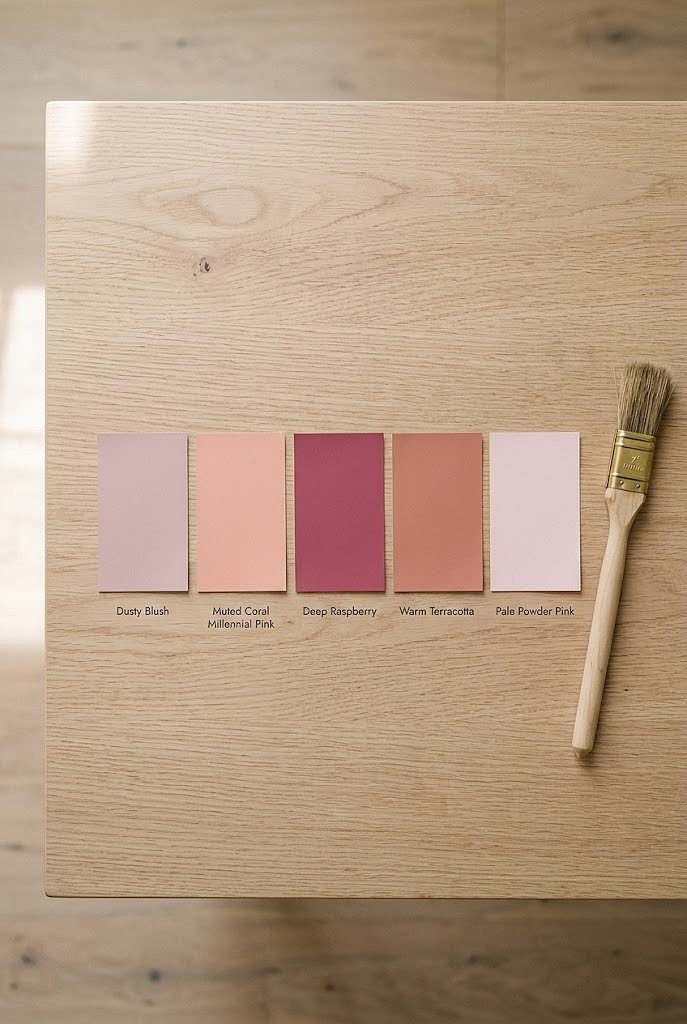
Not all pinks are created equal, and the shade you pick will make or break the entire room. Hot pink walls? That’s a commitment most people can’t live with at 7 a.m. But a muted, earthy blush or a deep terracotta-adjacent rose? Completely different energy.
Here’s a quick breakdown of the shades worth considering:
● Dusty blush / mauve-pink: soft, warm, pairs beautifully with neutral linen and wood tones. The most universally flattering choice.
● Millennial pink (muted coral-pink): still works, especially with white and brass accents, just avoid going overboard.
● Deep rose or raspberry: bold and moody, best used as an accent wall rather than all four walls.
● Warm terracotta-pink: earthy and sophisticated, feels more like a sunset than a valentine.
● Pale powder pink: light and airy, works best in rooms with good natural light or it can read a bit flat.
FYI paint always looks darker on the wall than on the sample chip, so if you’re going blush, test it in your actual room lighting before committing to a full gallon.
One thing most people skip entirely testing the paint at different times of day. A dusty blush that looks perfect at noon can turn borderline lavender by evening under warm artificial light, or muddy grey on an overcast morning. Before you commit, paint a large swatch directly on the wall (at least 12×12 inches) and check it at morning, midday, and night with your actual lamps on. It takes an extra day but saves you from repainting the whole room two weeks later.
Also worth considering: matte vs. eggshell finish matters more than most people realize. Matte pink absorbs light and reads as softer, more sophisticated. Eggshell has a slight sheen that can make the color feel more saturated and vibrant. For bedrooms, matte almost always wins it photographs better and feels quieter on the eyes.
Pink Bedroom Color Combinations That Work
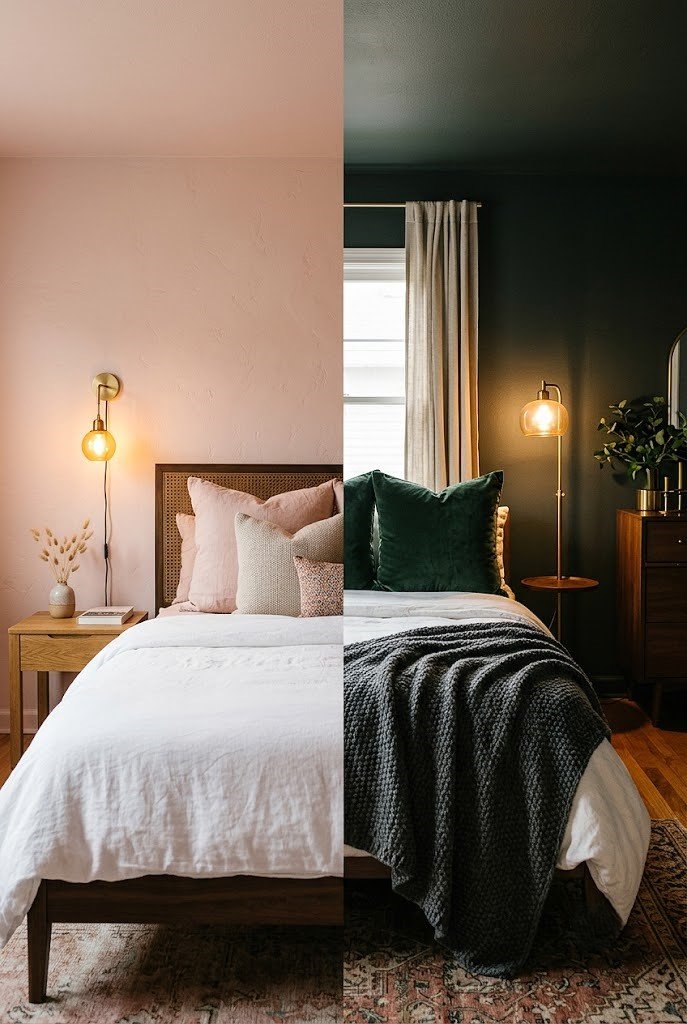
The color you pair with pink matters just as much as the pink itself. Get the combination right and the room feels intentional. Get it wrong and suddenly you’re living inside a candy wrapper.
Pink + White + Natural Wood
This is the classic combo and genuinely hard to mess up. Soft white bedding, a wooden bed frame with visible grain, and blush walls create a Scandinavian-meets-cozy aesthetic that photographs beautifully and feels even better in person. Add a woven rattan lamp or a jute rug and you’re basically living in a lifestyle magazine. 🙂
Pink + Dark Green
Unexpected, and honestly one of my personal favorites. Deep hunter or forest green paired with pink creates a rich, botanical feel think English garden meets boutique hotel. Use green in throw pillows, a velvet bench, or even a painted accent wall opposite the pink one. The contrast is stunning.
Pink + Gray or Charcoal
If you want pink without the sweetness, gray tones it down fast. Charcoal gray bedding against a blush wall reads as quietly modern and pulls the room out of any “girly” territory. This combination works especially well in smaller bedrooms because the contrast adds visual depth.
Pink + Gold or Brass
Hardware, mirror frames, light fixtures swap anything silver for gold or brushed brass and watch a pink room transform into something that feels genuinely luxe. It’s a small change with an outsized effect.
One combination that deserves more attention: pink and navy blue. It sounds like it shouldn’t work, but a muted blush wall against deep navy throw pillows or a navy upholstered bench creates a contrast that feels almost nautical-meets-feminine unexpectedly sharp. The key is keeping the pink soft and the navy deep. If either shade goes too bright, the combo tips into patriotic territory, which is… not the vibe. :/
Also experiment with texture as a “color.” A chunky cream boucle throw, a rough linen duvet, a smooth ceramic lamp these add visual layers that make a room feel rich without adding another actual hue. Some of the most interesting pink bedrooms use only two real colors and let texture do the rest of the work.
Furniture and Bedding Choices That Elevate a Pink Bedroom
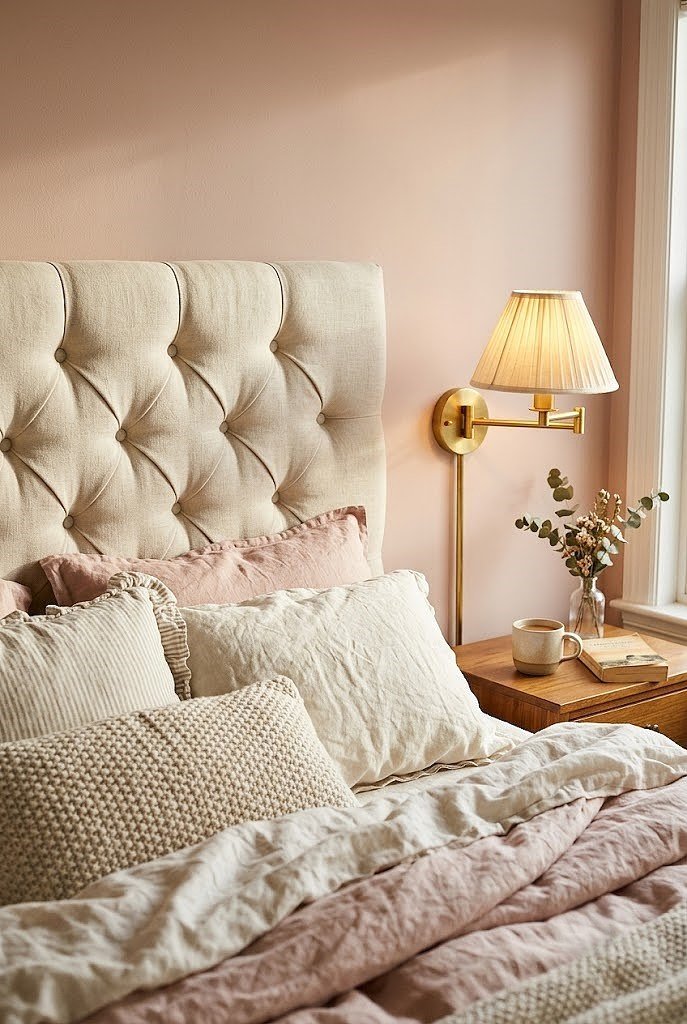
What’s in the room shapes how the pink reads. A pink bedroom filled with cheap particleboard furniture and scratchy polyester bedding will always look like a budget dorm. The same shade of pink with quality textiles and considered furniture? Completely different story.
Bedding is the single most important element in a pink bedroom. Go for natural fabrics linen, cotton sateen, or even a lightweight velvet duvet in complementary tones. Ivory, cream, or a warm white will soften the walls. Stark white can feel a bit clinical depending on the pink, so test it first.
For bed frames, wood and upholstered frames both work well. A tufted upholstered headboard in a complementary color (blush, cream, or even deep green) adds texture and warmth. Metal frames in black or brass also look sharp against pink walls they provide contrast without competing.
Avoid matching everything to the pink. Monochromatic pink rooms can work in editorial photoshoots but tend to feel overwhelming to actually sleep in every night. Bring in variety through wood tones, textured textiles, and plants.
Storage furniture is where people make the biggest mistakes in pink bedrooms. A big dark wardrobe in a blush room can feel heavy and mismatched unless it’s intentional think dark walnut or a painted sage green for something that reads as curated rather than accidental. If your storage pieces are the standard flat-pack white or beige, that actually works fine in a pink room; the neutrality lets the wall color lead.
Thread count and fabric weight matter more in a pink room than in neutral ones. Because the walls are already doing visual work, cheap-looking bedding stands out more. You don’t need to spend a fortune but a linen duvet cover in the $60–$100 range reads ten times better than a glossy polyester one at half the price. The texture catches light differently and gives the whole room a softer, more considered feel.
Lighting and Accessories: The Difference Between “Nice Room” and “Wow”
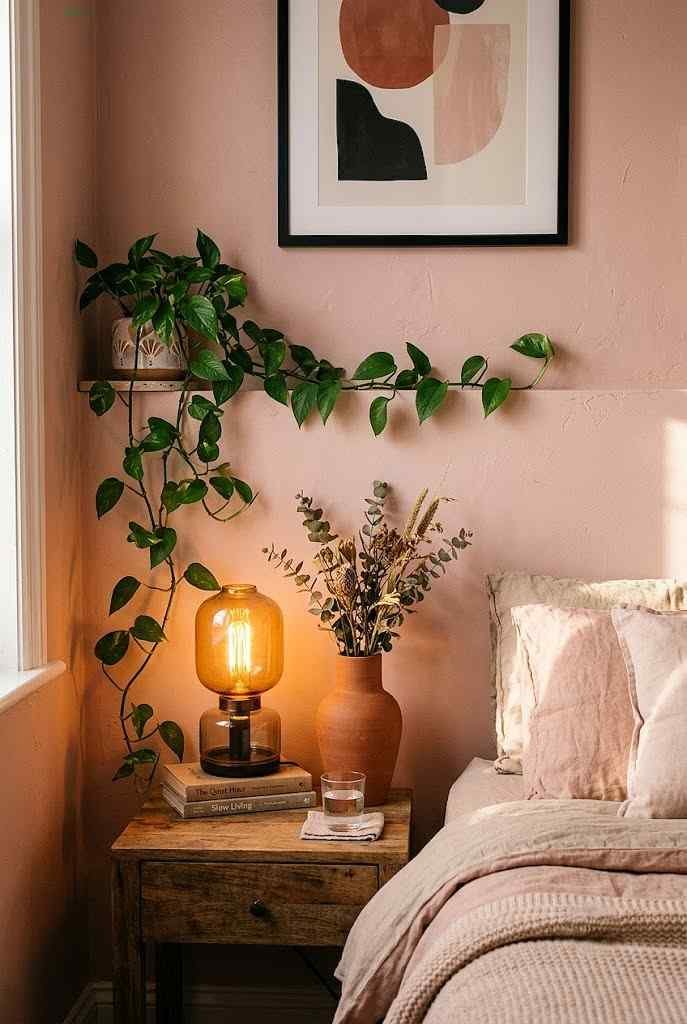
Here’s a question worth sitting with: how much of your bedroom’s personality comes from the stuff on the walls and shelves, versus the paint color itself? A lot, actually. Lighting and accessories do heavy lifting that most people don’t give them credit for.
Warm-toned bulbs are non-negotiable in a pink bedroom. Cool white light makes pink walls look washed out or vaguely clinical. Warm Edison bulbs or soft amber LEDs will make the same shade of pink glow in the best way. Aim for 2700K–3000K on any bulb you’re buying.
For accessories, think contrast and texture rather than matching. A ceramic vase in sage green or terracotta on a nightstand, a chunky knit throw in ivory, a statement mirror with a dark frame these elements keep the room from feeling one-dimensional.
Wall art in a pink bedroom is a genuine opportunity. Black and white photography pops beautifully against blush or rose walls. Abstract prints with earth tones (ochre, sienna, moss green) add richness without clashing. IMO, one larger piece beats three small scattered frames every single time.
Plants genuinely belong in pink bedrooms more than almost any other color scheme. The green is natural contrast, and trailing plants like pothos or a fiddle-leaf fig in the corner adds life and organic texture that no amount of throw pillows can replicate.
Layered lighting is the thing most bedroom makeovers get wrong. A single overhead fixture even a beautiful one flattens a room. Pink bedrooms especially benefit from three light sources at different heights: an overhead fixture for ambient light, a bedside lamp for task and mood lighting, and something low like a floor lamp or LED strip behind the bed or under a floating shelf. That third layer creates depth and makes the pink walls glow rather than just sit there.
For accessories, edit ruthlessly. A pink bedroom that’s also cluttered with random stuff just looks like a pink mess. IMO, three to five intentional objects on a surface always beats ten miscellaneous ones. A good rule if you can’t describe why something is in the room in one sentence, it probably shouldn’t be there. The restraint is what makes the color not the accessories the focal point.
Small Pink Bedroom? Here’s How to Make It Feel Bigger
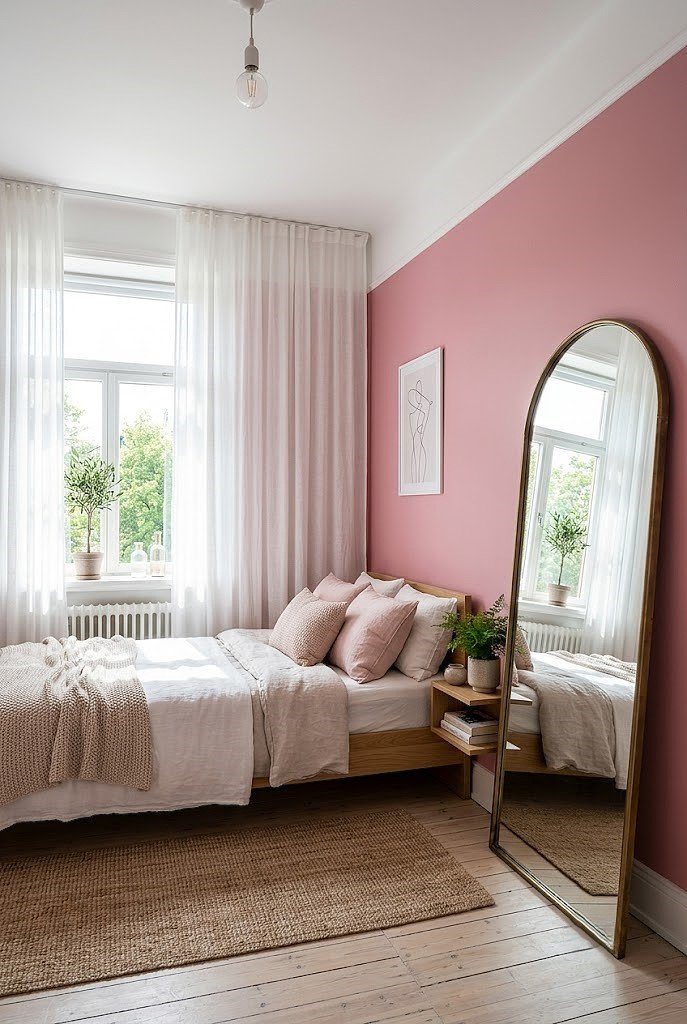
Pink walls in a small bedroom can either make it feel cozy and intentional, or cramped and overwhelming — the difference comes down to a few specific choices.
Keep the ceiling and trim light. If you’re painting the walls a medium or saturated pink, a white or off-white ceiling lifts the room visually and keeps it from closing in. Painting the ceiling the same color as the walls works in large, lofty rooms — in a small space, it can feel like the walls are folding in.
Use mirrors strategically. A large mirror opposite a window bounces light around the room and makes it feel significantly more spacious. Lean a floor mirror in the corner rather than hanging a small one — the scale matters.
Choose low-profile furniture. A platform bed or a bed with short, tapered legs gives the eye more wall and ceiling to see, which reads as more space. Bulky, high-backed headboards eat visual real estate in small rooms.
Curtains hung close to the ceiling and extending to the floor make windows — and the whole room — appear taller. Even in a pink bedroom, vertical height tricks your eye into perceiving a larger space.
One counterintuitive move that actually works in small pink bedrooms: don’t fight the coziness, lean into it. Rather than trying to make a small room feel like a bigger room, design it to feel like an intentionally intimate space — a room that’s warm and enveloping rather than cramped. Deep blush or rose on all four walls, warm lighting, and plush textiles can make a tiny bedroom feel like a boutique hotel suite. The psychology of color works in your favor here: warm pinks advance visually, making the room feel wrapped around you rather than closing in on you.
Also rethink your floor space. Floating nightstands (wall-mounted, no legs) visually open up the floor line and make the room feel less crowded. Pair that with under-bed storage to eliminate bulky dressers and suddenly a small pink bedroom feels both smarter and more spacious. A few centimeters of visible floor can change how a room reads entirely.
FAQ’s
Can a pink bedroom work for adults without looking childish?
Yes! choose dusty blush or deep rose over bright, saturated pinks.
What paint finish is best for pink bedroom walls?
Matte finish works best it reads softer and photographs more beautifully.
Does a pink bedroom need to have a lot of pink in it?
No! one blush wall or pink bedding creates impact without overwhelming the space.
What bedroom size suits pink walls best?
Pink works in any size small rooms feel cozy, large rooms feel warm and grounded.
Are pink bedrooms hard to redecorate later?
Not at all! pink pairs with so many colors, switching accents refreshes the whole room.
CONCLUSION
Pink is not a risky choice. Beige is a risky choice safe to the point of being forgettable, and not even easy to pull off well. Pink, done with intention, creates bedrooms that feel personal, warm, and genuinely beautiful to spend time in.
Pick a shade that suits your natural light. Pair it with textures and tones that offer contrast. Invest in decent bedding. Get the lighting right. The rest largely takes care of itself.
There’s a whole spectrum between “bare white walls” and “bubble gum explosion,” and the best pink bedrooms live somewhere in the confident middle the kind of room that people walk into and immediately want to know how you pulled it off.