
small kitchen storage ideas
By Anna Grace | 27 July 2026
Small Kitchen Storage Ideas Without Renovating
Small kitchens have a talent for making you feel like a magician who ran out of tricks. You open a cabinet, three lids fall out, and you wonder how a room this size holds so much stuff and so little order. My own kitchen in a rental apartment is roughly the size of a walk-in closet, and for the first year I lived there, I just accepted chaos as the price of admission. Then I got tired of losing my whisk in a drawer that fought back every time I opened it.
Here’s the good news: you don’t need a bigger kitchen. You need smarter storage. This guide walks through practical, budget-friendly small kitchen storage ideas that squeeze more function out of the square footage you already have, without knocking down a single wall.
Rethink Your Vertical Space
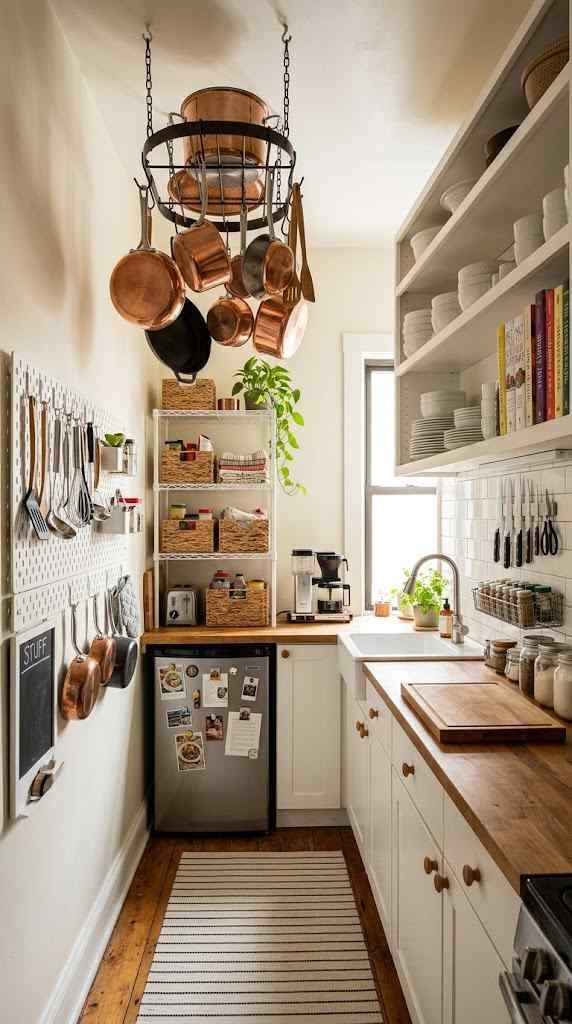
Most small kitchens waste the one dimension they actually have plenty of: height. Cabinets stop, walls keep going, and that gap above your upper cabinets often sits empty except for dust and maybe a stray pizza box you forgot about. Vertical storage is the single biggest untapped resource in a compact kitchen.
Start by looking up. Open shelving mounted above your counters can hold everyday dishes, glassware, or a curated row of cookbooks. Wall-mounted magnetic strips keep knives off the counter and off your precious drawer space. A pot rack hung from the ceiling or a wall bracket frees up an entire lower cabinet that used to be a clanging graveyard of mismatched lids.
Don’t forget the space above your refrigerator, either. That awkward gap is practically begging for a stackable basket system to hold items you use only occasionally, like the fondue set from your 2019 dinner party phase. Wire shelving units are cheap, easy to install, and instantly double your storage capacity in tight corners.
A few vertical wins worth trying:
● Install a pegboard on an empty wall for pots, utensils, and even spice jars in small clip-on containers
● Add a tension rod under a sink to hang spray bottles by their necks, opening up the floor of that cabinet
● Use stackable shelf risers inside cabinets so you’re not piling plates directly on top of bowls
There’s also the matter of corner cabinets, which somehow manage to be both huge and useless at the same time. You reach in, your arm disappears up to the shoulder, and you still can’t find the blender attachment you swear you own. A lazy Susan solves this instantly by turning dead corner space into a spinning carousel of jars, oils, and canned goods you can actually reach without contorting yourself. Rotating turntables work just as well inside a pantry, especially for spices or condiments that tend to hide behind taller bottles.
If you’re renting and can’t drill into walls, adhesive hooks and tension-mounted shelves become your best friends. They hold surprisingly heavy items, from mugs to small cast iron pans, without leaving a single mark behind when you move out. Even something as simple as a hanging fruit basket clears counter space that bananas and onions were quietly hogging.
Vertical solutions work best when they’re within arm’s reach of where you actually cook, so resist the urge to mount everything decoratively far from the stove. A gorgeous shelf full of copper pots means nothing if you have to walk across the kitchen every time you need one. Function first, aesthetics second, and somehow the kitchen still ends up looking pretty great.
Make Every Drawer Do More Than One Job
Drawers in small kitchens tend to become junk pits. You open one expecting to find a spatula and instead you find rubber bands, three dead batteries, and a takeout menu from a restaurant that closed years ago. Sound familiar? The fix isn’t buying a bigger kitchen; it’s organizing the one you’ve got with intention.
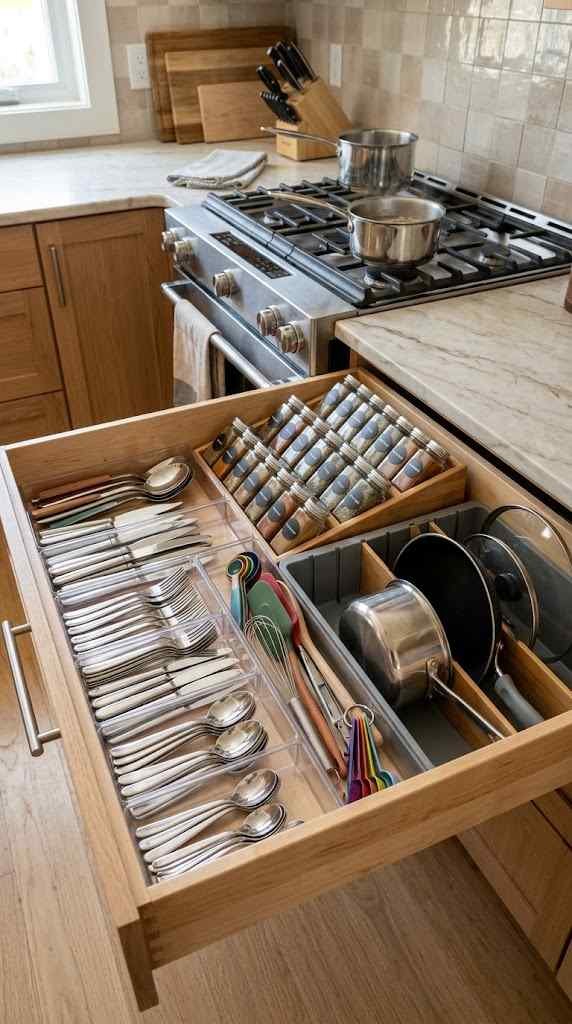
Drawer dividers are the unsung heroes here. A simple expandable divider turns a chaotic utensil drawer into something that actually resembles a system. Deep drawers benefit from tiered organizers that let you stack items in layers instead of one messy pile.
For pots and pans, consider converting a lower drawer into vertical storage with adjustable dividers. Instead of nesting pans and yanking out the bottom one while the top three crash to the floor, you slide each pan into its own slot. IMO this single change saves more morning stress than almost any other kitchen upgrade, mostly because it removes the 7 a.m. cookware avalanche from your routine.
Spice drawers deserve a mention too. Rather than a cabinet shelf where jars tip over every time you reach for the cinnamon, a shallow drawer near the stove with a slanted spice insert keeps everything visible and labeled. You glance down, you see paprika, you grab paprika. No archaeology required.
Junk drawers get a bad reputation, but every kitchen needs one small landing zone for the odds and ends that don’t have an obvious home. The trick is containing it. A shallow tray or small divided box keeps that drawer from spreading its chaos into neighboring drawers, which is exactly what happens when boundaries don’t exist. Give the mess a box, and suddenly it stops being a mess.
Nested measuring cups and collapsible measuring spoons are another underrated drawer saver, especially for anyone who bakes semi-often but not enough to justify a full baking cabinet. Silicone versions fold flat and slide into a slim drawer slot instead of rattling around loose. Command hooks stuck to the inside of a drawer can even hold small items like twist ties or scissors upright, keeping the drawer bottom clear.
One habit that costs nothing: do a sixty-second drawer reset once a week. Toss the wrapper you shoved in there, return the pen that migrated from the junk drawer to who-knows-where, and straighten dividers that have shifted. It sounds almost too simple to matter, but a drawer left unchecked for a month turns back into the chaos you just spent an afternoon fixing. Small maintenance beats big cleanups every time.
Use Cabinet Doors and Wall Gaps You’re Currently Ignoring
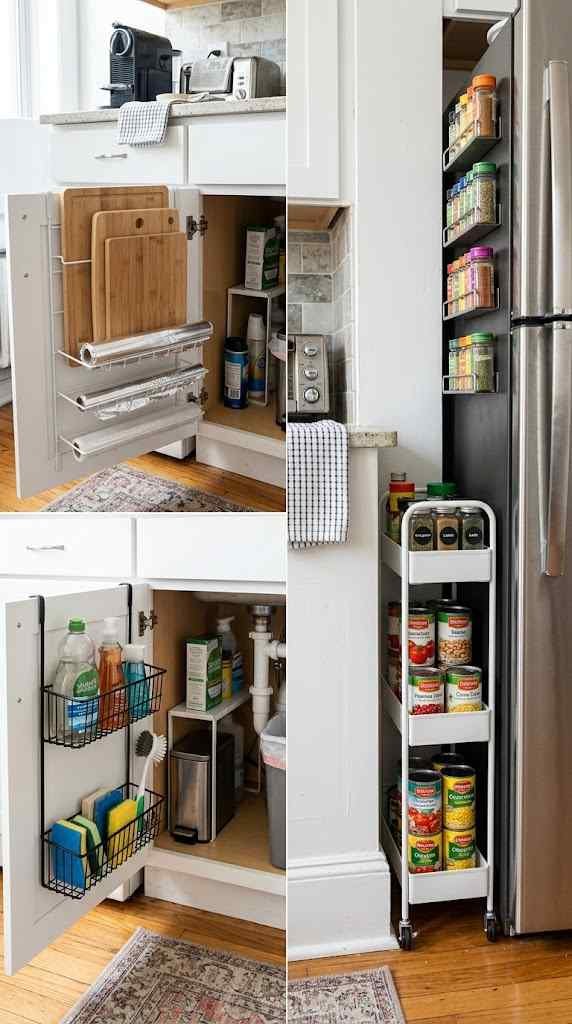
The inside of a cabinet door is basically free real estate that most people never touch. Over-the-door organizers, whether store-bought or a simple tension-mounted rack, can hold cutting boards, foil rolls, cleaning supplies, or lids that never seem to match their pots. It’s one of those small kitchen storage ideas that feels almost too easy, but it works because it uses space that was already there and already wasted.
Consider these overlooked spots:
● Inside the pantry door – a shallow shelving unit holds spice jars, snack packets, or small condiment bottles
● Under the sink door – a hanging caddy or slide-out bin keeps sponges and cleaners organized instead of tipping over
● Side of the refrigerator – a magnetic spice rack or paper towel holder uses vertical wall space nobody thinks about
●Gap between fridge and wall – a narrow rolling cart slides in and holds canned goods, cutting boards, or baking sheets
Speaking of narrow gaps, rolling carts might be the most underrated purchase for a small kitchen. Mine is about six inches wide, tucked between the fridge and the counter, and it holds more canned goods than I thought physically possible. It rolls out when I need it and disappears when I don’t. That’s the whole philosophy of small kitchen storage in one sentence: things should earn their spot, and they should get out of your way when you’re not using them.
Cabinet interiors deserve a second look too, not just the doors. Adjustable wire shelving inserted mid-cabinet effectively doubles the storage inside a single shelf by creating a second tier for smaller items like mugs or spice jars. Instead of stacking bowls three high and praying nothing shifts when you grab the bottom one, each size gets its own level.
The narrow strip of wall between a stove and a cabinet, often no wider than a few inches, can hold a slim vertical tray divider for cutting boards, baking sheets, and cookie trays that otherwise get wedged sideways behind pots. These flat items are notoriously awkward to store because they don’t stack neatly with anything else, so giving them a dedicated vertical slot solves a problem most people just live with.
Even the kickboard beneath your lower cabinets, that thin strip of wood at floor level, can become storage with a toe-kick drawer. It’s a renovation-level project, sure, but for anyone doing a kitchen refresh, it turns completely wasted space into a place for baking sheets or platters you only pull out twice a year. Not every idea here needs to be a five-minute fix; some are worth the extra effort.
Choose Multi-Purpose Furniture and Tools Instead of Single-Use Clutter
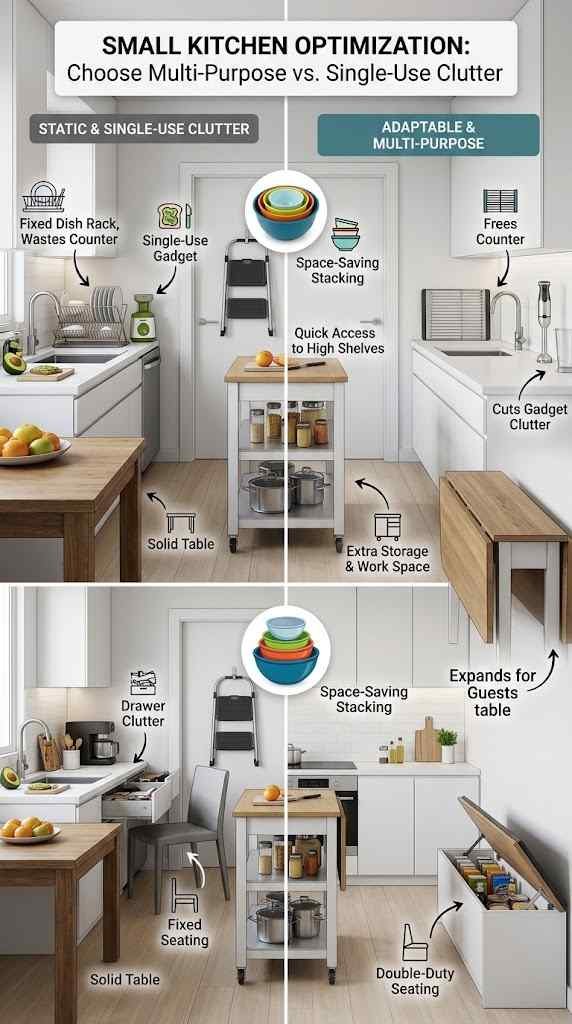
Every item in a small kitchen should justify its existence twice. A single-use gadget that only makes avocado toast is a luxury that space-strapped cooks often can’t afford, however tasty the toast may be. Instead, look for furniture and tools that pull double duty.
A kitchen island on wheels, for example, gives you extra counter space when you’re cooking and extra storage underneath for cutting boards, small appliances, or linens. Push it against a wall when you’re done, and you’ve reclaimed your floor. Stackable, nesting mixing bowls take up a fraction of the space that a full matched set would, and they still cover every recipe from soup to salad.
Consider bar carts, too, which sound fancy but function as mobile storage for anything from coffee gear to baking supplies. Expandable shelf inserts let you stack plates and bowls in cabinets that used to fit only one layer. Even your dish rack can multitask: a fold-flat model tucks away when you’re not drying dishes, giving your counter back its breathing room.
Here’s a quick comparison of common multi-purpose swaps worth considering:
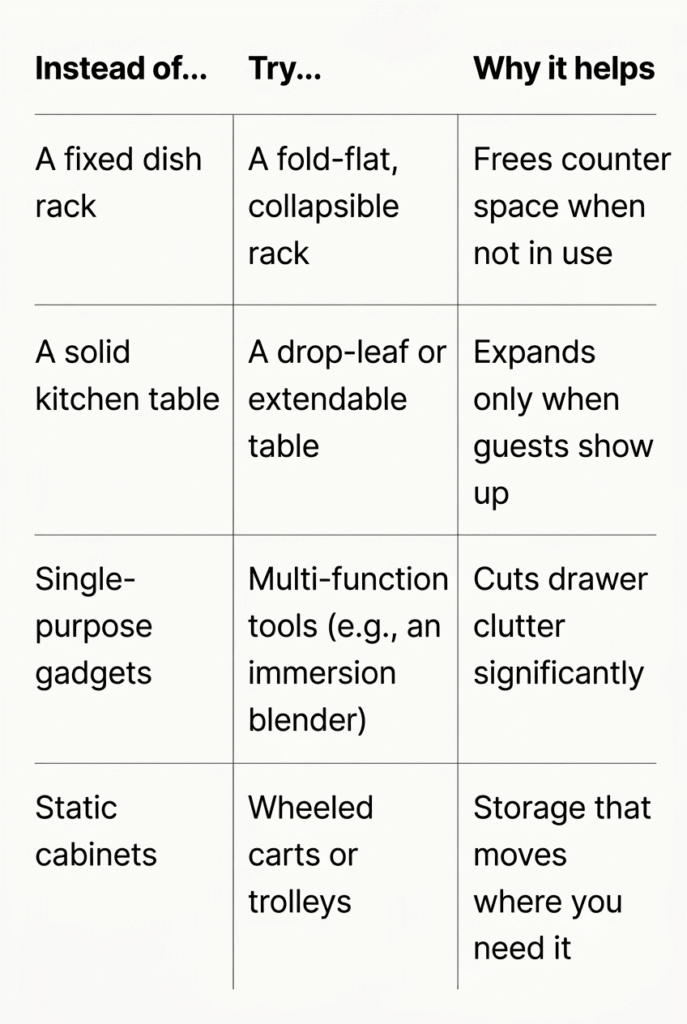
The theme running through all of this is simple: flexibility beats fixed furniture in a small kitchen. If a piece can adapt, roll, fold, or stack, it earns a permanent place. If it can’t, it’s probably taking up room that could be doing more.
Foldable step stools deserve a mention here too, mostly because small kitchens love to put your most-used items on the highest shelf for some reason. A slim stool that tucks behind the pantry door or hangs on a wall hook means you’re not dragging a chair across the kitchen every time you need the good baking dish. It’s a small purchase that solves an oddly common annoyance.
When shopping for new kitchen tools, ask whether an item can nest inside another. Mixing bowls that stack inside each other, measuring cups that clip together, and cutting boards that slide into a vertical slot all save more space collectively than any single organizer product claims to offer. This is less about buying new things and more about buying smarter versions of things you already need.
Even seating counts. A narrow bench with a lift-up seat can double as extra pantry storage in kitchens too small for a full pantry closet. It’s not a conventional kitchen item, but small kitchens reward unconventional thinking. Once you start looking at furniture through the lens of “what else can this hold,” you’ll notice opportunities in places you never considered before.
Get Ruthless About What Actually Stays
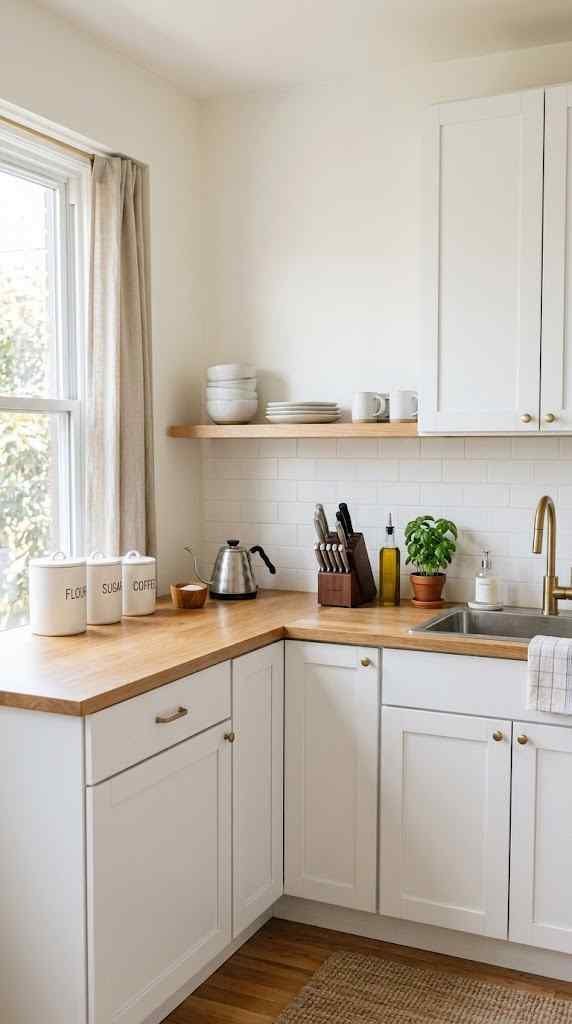
This part isn’t glamorous, but it might matter more than any storage container you buy. Small kitchens punish clutter in a way that bigger kitchens simply don’t. A cabinet that could comfortably hide three unused appliances in a spacious kitchen becomes an overflowing mess in a small one, and no amount of clever shelving fixes a drawer full of things you don’t actually use.
Take fifteen minutes and pull everything out of one cabinet. You’ll probably find a garlic press you’ve used twice, a novelty mug from a work gift exchange, and a mystery lid with no matching container anywhere in the house. Ask yourself honestly whether each item earns its spot. If it doesn’t, donate it, sell it, or let it go.
Once you’ve decluttered, group items by how often you use them. Daily tools go at eye level or in the most accessible drawer. Occasional-use items move to higher shelves or the back of cabinets. Seasonal gear, like a turkey roasting pan you touch once a year, can live somewhere less convenient entirely, maybe even outside the kitchen if storage is truly tight.
This step costs nothing but time, and it’s often the difference between a kitchen that feels organized and one that just looks organized for a week before sliding back into chaos.
FAQ’s
What is the cheapest way to add storage to a small kitchen?
Drawer dividers, tension rods, and over-the-door organizers cost little and instantly create more usable space.
How do I organize pots and pans in a small kitchen?
Use vertical dividers inside a deep drawer or hang pots on a wall-mounted rack to free cabinet space.
Where should I store items I rarely use in a small kitchen?
Place seasonal or occasional items on high shelves, above the fridge, or in the least accessible cabinet.
Can furniture help with small kitchen storage?
Yes, wheeled islands, drop-leaf tables, and bar carts add storage and counter space while staying flexible.
How often should I declutter a small kitchen?
Aim for every three to six months, since small kitchens fill up faster and show clutter more obviously.
CONCLUSION
A small kitchen doesn’t have to feel like a puzzle you lose every single day. With a bit of vertical thinking, smarter drawers, unused door and wall space, multi-purpose furniture, and a willingness to let go of stuff you don’t need, you can turn a cramped cooking space into one that actually functions well. None of these ideas require a contractor or a big budget; most of them cost less than a nice dinner out. Give your kitchen a weekend of attention, and you might be surprised how much bigger it feels without gaining a single square foot.