
victorian livingroom
By Anna Grace | 6 feb 2026
Victorian Living Room Ideas That Feel Rich
Victorian living rooms get a bad rap. Most people imagine dark, stuffy spaces packed with doilies, overstuffed chairs, and enough velvet to choke a decorating magazine. But here’s the thing the Victorians actually understood luxury, storytelling, and how to make a room feel rich without looking ridiculous. When you strip away the worst clichés and focus on the actual principles, a Victorian living room becomes genuinely magnetic.
The problem? We’ve let the 2024 version of Victorian design get buried under stereotypes. People think it has to be all heavy florals and ornate everything, when the truth is far more nuanced (and honestly, way more livable)
Stop Confusing Victorian with Just… Heavy
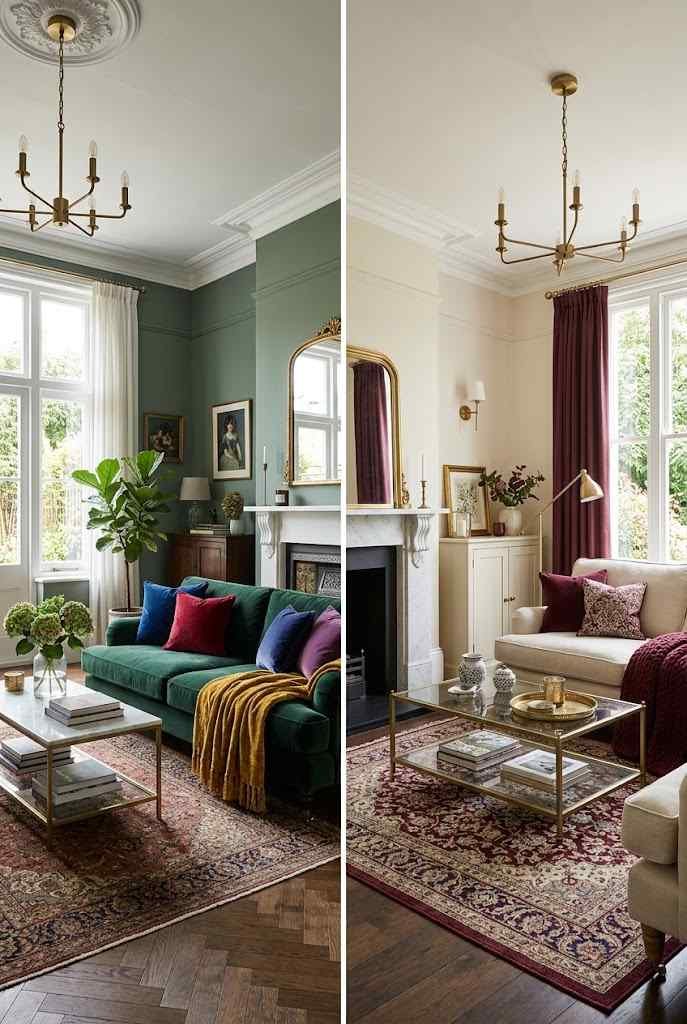
Victorian design spans from roughly 1837 to 1901 that’s 64 years of shifting aesthetics, and people usually pick the most dramatic bits. Early Victorian was actually cleaner. Late Victorian got wild with pattern and texture. The sweet spot for a modern home? Taking the bones of Victorian design symmetry, depth, quality materials and editing it ruthlessly.
You don’t need to fill every surface or match everything. Victorian homes back then had empty walls. They had plain ceilings. The difference was what they did choose to display mattered every piece earned its spot because it was either beautiful, functional, or told a story.
IMO, most people get this wrong because they’re thinking aesthetically instead of functionally. A gorgeous burnt orange accent wall looks fantastic in a photo, but will it feel welcoming at 9 PM when you’re mentally exhausted? That’s the real question.
So when you’re building your Victorian living room, think curator, not hoarder.
Here’s a fact that surprises most people: early Victorian parlors often had bare floors with just one statement rug, not wall-to-wall carpeting. The obsession with “more is more” actually crept in later, during the Aesthetic Movement, and somehow that’s the version everyone copies today. If you want your Victorian living room to feel authentic and livable, borrow from the earlier, calmer era instead.
Think about it this way would you rather host friends in a room that feels like a set piece, or one that feels like your actual life happens there? Pick pieces that reflect the Victorian obsession with craftsmanship, not their occasional tendency toward visual chaos. Your future self, trying to dust around forty knickknacks, will thank you.
Color Palettes That Actually Work
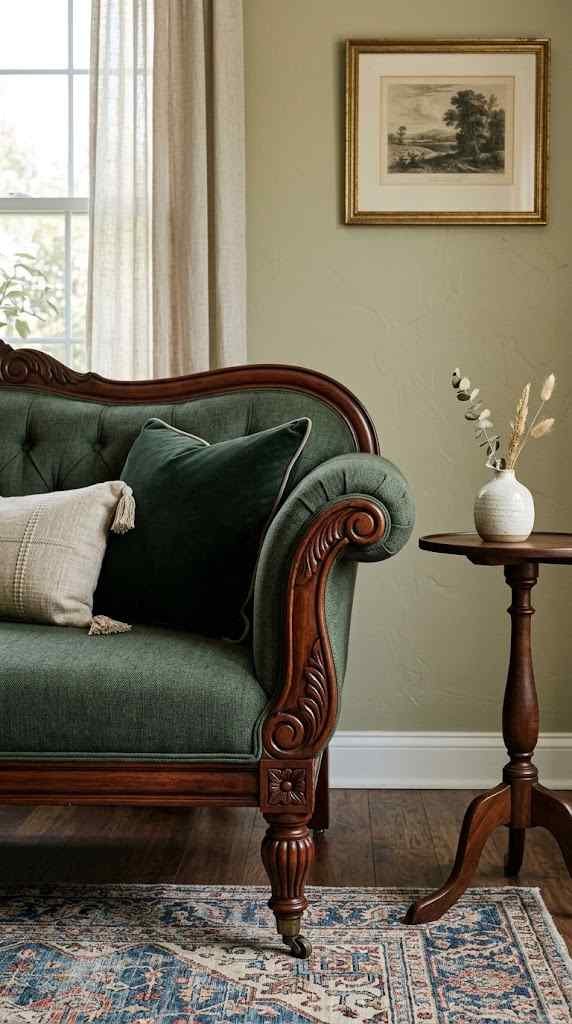
Forget the “dark Victorian manor” stereotype. Real Victorian interiors used bold jewel tones deep emerald, sapphire, burgundy but they balanced them. You’d see a rich wall color paired with cream woodwork or light-toned furniture.
Here’s what works for a modern space:
● Deep walls + light trim. A moody sage, navy, or even a soft plum on the walls with bright white crown molding and baseboards creates that Victorian drama without suffocating your room.
● Jewel-tone accents. Use that emerald or burgundy in textiles, artwork, or a statement chair instead of painting four walls.
● Neutrals as anchors. Cream, soft gray, or warm beige give the room breathing room while you layer in patterns and richer colors through accessories.
One thing people forget undertones matter more than the color name on the paint chip. A “sage green” with too much yellow can read cheap, while the same green with a gray undertone instantly looks expensive and period-appropriate. Test swatches on your actual wall before committing lighting changes everything, and Victorian rooms were designed around candlelight and gas lamps, not fluorescent bulbs.
If you’re nervous about committing to a bold wall color, start smaller. Paint just the lower third of the wall (a nod to Victorian wainscoting) or commit to one room instead of your whole house. FYI, a small test can save you an entire weekend of regret and repainting.
The key is restraint. Victorians had it in their proportions and balance we should too. IMO, a single feature wall beats a whole room that looks like you’re living inside a jewelry box.
Furniture That Feels Right (Not Suffocating)
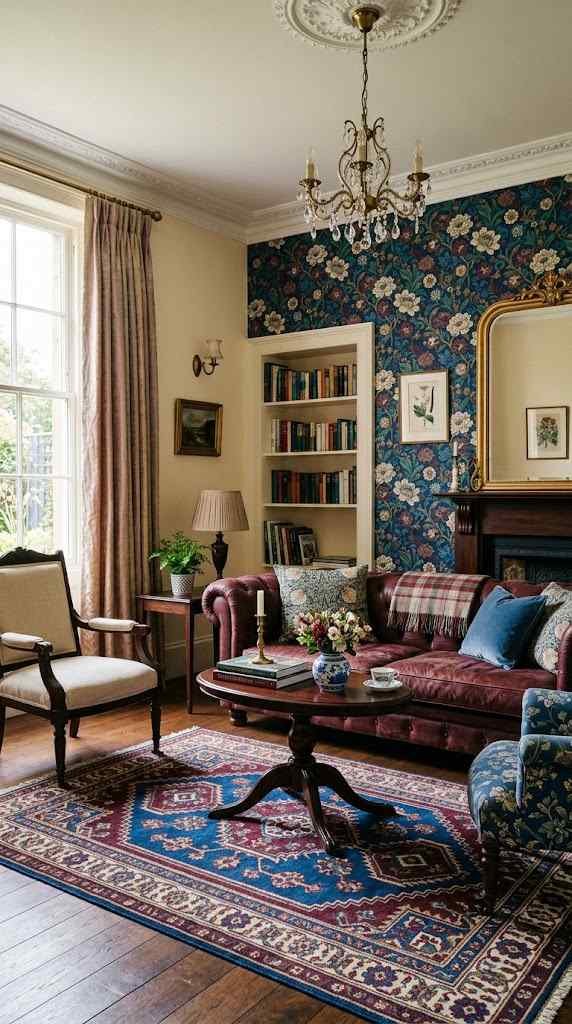
Victorian furniture is built to last. Solid wood frames, quality construction, those curved legs and tufted backs this isn’t IKEA stuff. But you can’t just crowd a room with a settee, two wingback chairs, a fainting couch, and a chaise lounge unless you’re actually opening a salon.
Instead, choose pieces that have that Victorian silhouette but keep the layout open:
● A statement sofa with rolled arms and wooden legs (without necessarily needing a full pattern covering)
● One or two complementary seating pieces (maybe a wingback chair or ottoman)
● A beautiful coffee table with turned legs or carved details
● Minimal accent tables quality over quantity
The Victorians understood negative space more than people think. They just filled their meaningful spaces with intention. You’re doing the same thing just with better sight lines and a less chaotic vibe.
Scale matters just as much as style here. A massive tufted sofa in a small apartment living room doesn’t read as “Victorian elegance” it reads as “I measured wrong.” Victorian homes had generous room sizes, so when you’re working with a smaller modern space, scale everything down proportionally a loveseat instead of a full sofa, a smaller accent chair instead of a wingback throne.
I made this exact mistake in my first apartment bought a gorgeous carved wood armchair that looked stunning in the store and completely swallowed my tiny living room. Measure twice, buy once. Your space should feel curated, not like furniture Tetris.
Patterns, Wallpaper, and Knowing When to Stop
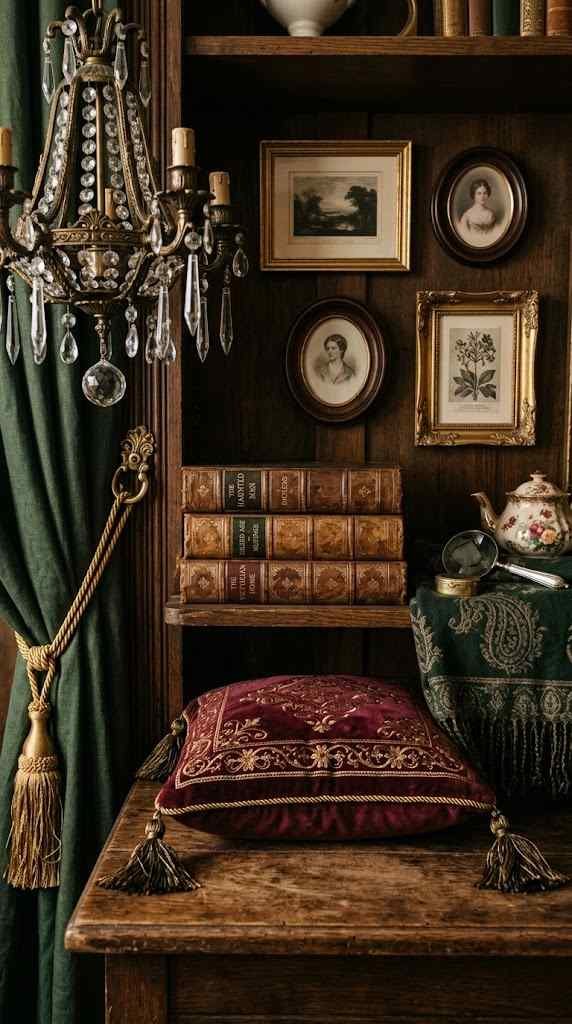
This is where Victorian design gets fun and where people usually panic. Victorians loved pattern floral wallpapers, striped fabrics, geometric carpets. But here’s what they also did: they used one bold pattern as the statement, then supported it with complementary but quieter patterns and solids.
So a floral wallpaper on one wall? Great. Then your sofa might be a solid jewel tone or a subtle stripe. Your curtains could pick up one color from the wallpaper but in a simpler weave. Your rug might have a geometric border without being wildly busy.
The formula: One splashy pattern, two to three supporting patterns in different scales, and solid breathing room.
And honestly? You can make this work without wallpaper at all. A painted feature wall, patterned curtains, and a beautiful patterned rug gets you 80% of the way there without the commitment. Not every room needs to be the whole Victorian fantasy sometimes the suggestion of it feels better.
Scale of pattern matters just as much as color coordination. Mixing a large floral with a large stripe usually creates visual chaos, but pairing a large floral with a small geometric or a subtle stripe lets both patterns breathe. Victorians actually followed this instinctively their pattern mixing had rhythm, not randomness.
Not sure where to start? Pull three colors max from your main pattern and repeat them throughout the room in smaller doses. This keeps everything cohesive without looking like you raided five different fabric stores with zero plan.
Details That Make People Stop and Notice
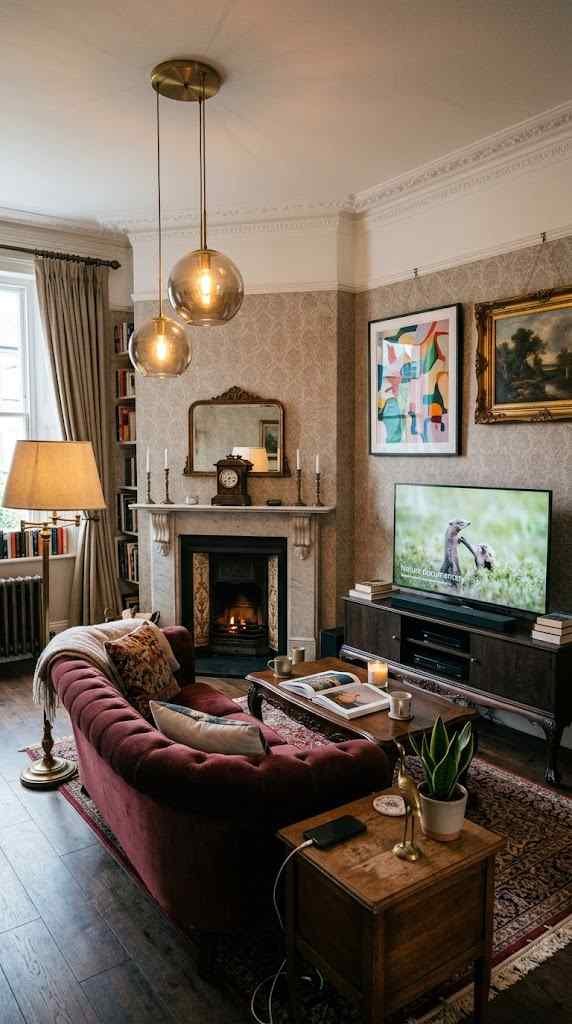
Victorian living rooms succeed because of the small stuff. This is where your room stops being “decorated” and starts being a space:
Curtains that hit the floor or ceiling. Not the weird halfway-down-the-wall situation. Go all in or keep them simple. Victorians used long, heavy drapes with tassels or elegant ties.
Proper artwork and frames. A gallery wall with mixed-frame sizes and actual art (not just motivational quotes) has that curated Victorian energy.
Lighting that layers. A chandelier or impressive ceiling fixture, plus table lamps with fabric shades, plus maybe sconces. Victorians lit rooms for mood, not just function.
Textiles with texture. Velvet pillows, a wool throw, linen curtains. Mix fabrics so it feels tactile and intentional.
Books, objects, and curiosities. Victorians displayed things that mattered to them travel souvenirs, leather-bound books, paintings they loved. Your space should feel like you live there.
These aren’t extra touches; they’re the difference between a room that looks dressed-up for a photo and a room you actually want to sit in. 🙂
Don’t underestimate what a single antique or vintage-inspired mirror does for a room. Victorians loved mirrors not just for vanity, but because they bounced candlelight around dim rooms and made spaces feel larger. A gilded or ornate-framed mirror above your mantel or sofa instantly adds that layered, collected feeling without much effort.
Scent matters too, oddly enough. A room that smells like beeswax candles or fresh flowers reinforces that old-world, cared-for atmosphere in a way visuals alone can’t. It’s a small detail, but it’s the kind of thing guests notice even if they can’t quite explain why your living room feels so inviting.
The Modern-Victorian Blend (Because You’re Not Actually Living in 1880)
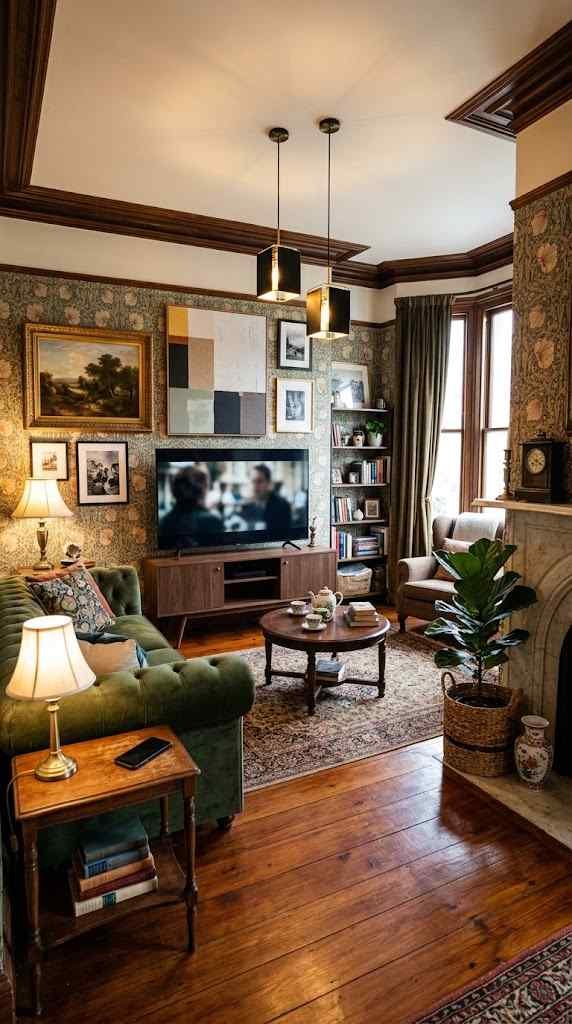
Let’s be real: you probably have a smartphone. You might want to stream Netflix. A pure Victorian aesthetic with zero modern elements reads as theme-park-y, not aspirational.
The blend works when you:
● Hide modern tech in or near pieces that have classic lines (a media console with Victorian-inspired legs, not a floating entertainment center)
● Use modern lighting fixtures that feel intentional rather than trying to make everything look antique
● Bring in contemporary art alongside traditional pieces
● Keep the feeling Victorian (layered, rich, intentional)
Think of it like respecting the aesthetic without worshipping it. A Victorian living room should feel like a really thoughtful person lives there someone who appreciates history and beauty but isn’t a museum docent.
FAQ’s
What colors are most authentic for a Victorian living room?
Deep jewel tones like emerald, burgundy, and sapphire paired with cream or white trim work best.
Can I create a Victorian living room on a budget?
Yes! focus on one statement piece, thrift vintage-style furniture, and use paint for maximum impact affordably.
What flooring works best in a Victorian-style living room?
Hardwood floors with a patterned area rug capture that classic, layered Victorian aesthetic beautifully.
How do I avoid making my Victorian living room feel outdated?
Blend antique-inspired furniture with modern lighting, art, and tech for a fresh, updated feel.
Is Victorian style suitable for small living rooms?
Absolutely! just scale down furniture size and simplify patterns to prevent the space from feeling cramped.
CONCLUSION
A Victorian living room that actually works is less about checking boxes (“Do I have enough velvet?”) and more about understanding what made Victorian design successful layering, proportion, intention, and pieces that matter. You can have a space that feels opulent, collected, and genuinely beautiful without it looking like you’re cosplaying as a 19th-century aristocrat.
Start with one statement element maybe a jewel-toned wall or a killer sofa. Add layers slowly. Choose quality over quantity. Let your personality show through. And remember, the Victorians would probably think we’re all insane for worrying so much about authenticity they just made stuff they liked.