
Mid-century modern livingroom
By Anna Grace | 8 feb 2026
How to Design a Mid-Century Modern Living Room to Get That Iconic Look
Your living room could either be a design accident or a deliberate masterpiece and here’s the thing mid-century modern makes the second option actually achievable. This design movement from the 1940s through 1960s has become the go-to aesthetic for people who want their space to feel sophisticated, warm, and intentional. The kicker? Most people butcher it.
I’ve walked into countless living rooms where someone bought the right couch, slapped on the wrong accessories, and ended up with something that screams “I Googled mid-century modern and bought what showed up.” That’s not the vibe we’re going for.
The beauty of mid-century modern is that it’s forgiving if you actually understand what you’re chasing. You don’t need a five-figure budget or a designer on speed dial. You need direction. You need to know why a chair works instead of just knowing it looks right. That’s the difference between a space that ages well and one that feels dated the moment a new Pinterest board goes viral. This style has outlasted trends for nearly a century because it’s built on actual design principles, not aesthetic whims. By the end of this, you’ll understand how to spot quality pieces, why certain combinations work, and how to avoid dropping cash on things that just look the part.
What Makes Mid-Century Modern Actually Mid-Century?
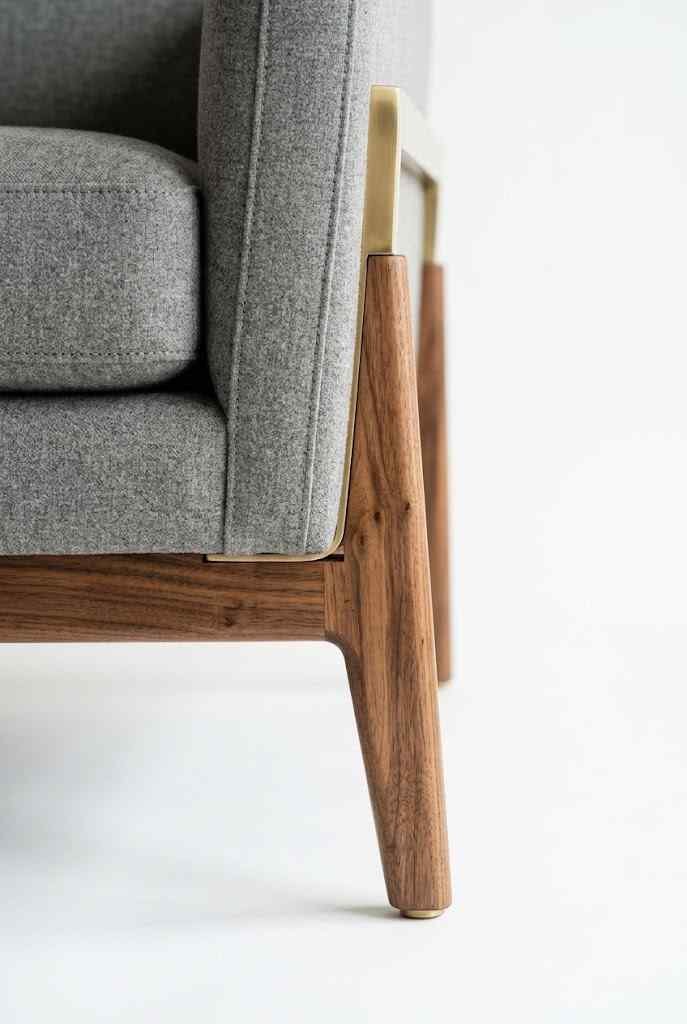
Here’s where most people get confused: mid-century modern isn’t just “old stuff that looks cool.” It’s a philosophy. The movement rejected ornate, fussy design in favor of clean lines, functionality, and the belief that a chair should be beautiful AND comfortable. Revolutionary, I know.
The heart of mid-century design is honesty. Materials weren’t hidden or layered under unnecessary details. Wood grain showed. Metal legs were visible. Upholstery fit like a glove instead of drowning the furniture in fabric. Everything had a job to do, and it did that job elegantly.
What separates authentic mid-century modern from knockoffs is restraint. Not every surface needs decoration. Not every corner needs a statement piece. Sometimes empty space is the statement.
What really separates mid-century from, say, “modern-ish” or “contemporary,” is the intention behind every choice. The 1940s-60s designers weren’t trying to be trendy they were solving real problems. Furniture needed to fit smaller post-war homes. Manufacturing techniques were improving. Veterans and young families wanted good design that didn’t cost a fortune. This necessity bred innovation. A chair leg wasn’t decorative it was load-bearing and beautiful because of that honesty, not in spite of it. You’ll notice this when you start looking at pieces there are no hidden hinges, no “design elements” that serve zero function, no visual tricks to make something seem bigger or fancier than it is. It’s almost puritanical in its restraint. That’s why buying a random vintage-looking chair and calling it mid-century modern never quite lands it’s missing this foundational philosophy of form serving function, not the other way around.
Building Your Foundation with Furniture
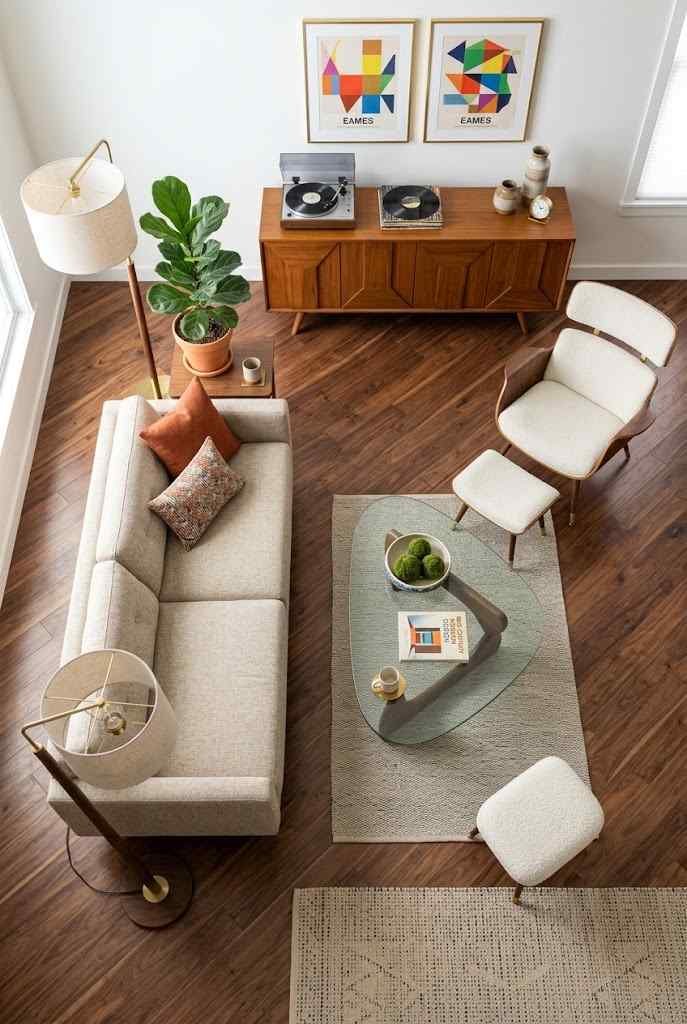
The furniture you choose will make or break your mid-century modern living room. This isn’t the time to compromise.
Your sofa should be the anchor. Look for one with tapered legs (those angled, typically wooden legs that lift the frame off the ground), a low profile, and minimal ornamentation. The best mid-century sofas feel like they’re floating slightly above the floor that visual lightness is everything. Pair it with accent chairs that echo the same design language: legs that show, upholstery that fits the frame snugly, and a silhouette that’s recognizable from across the room.
Coffee tables in this style usually sit low and feature exposed wood or metal construction. A glass top with wooden or metal frame works beautifully. Credenzas and sideboards are absolute MVPs if you can fit one they provide storage, display space, and that classic mid-century horizontal line that makes a room feel sophisticated.
The golden rule? Every piece should earn its place through both form and function. FYI, this is why mid-century modern pairs so well with minimalism they’re basically cousins asking each other not to clutter things up.
Beyond the headline pieces, there are smaller furniture moves that layer in authenticity. Nesting tables work beautifully in mid-century spaces because they’re practical and sculptural. A wooden side table with metal hairpin legs costs less than you’d think and reads unmistakably mid-century. If you’re working with a smaller space, a wall-mounted floating shelf with clean lines and minimal visible brackets gives you display space without eating floor real estate. Don’t sleep on ottomans either they’re essentially simplified furniture that ticks every box functional, sculptural, practical. The material of your furniture base matters as much as the silhouette.
Wood furniture that shows its natural grain (not painted over or veneered) costs more upfront but wins out long-term because it actually improves with age. Scratches and patina become character, not damage. Metal hardware should be authentic to the era brushed brass and warm copper were the metals of choice, not shiny chrome or cold stainless steel. If you’re hunting vintage, avoid anything with wobbly legs, water damage, or springs that have given up the fight. A reupholstered piece can be gorgeous, but structural issues are harder to hide than people think, and a wobbly chair will annoy you every single time you sit in it.
Color, Materials & Lighting: Where the Magic Happens
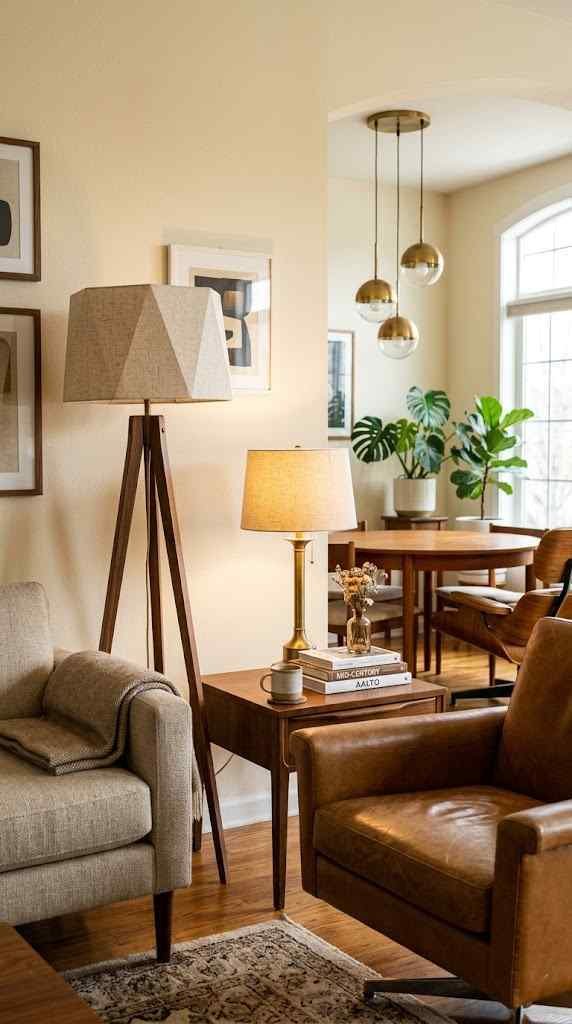
This is where people often stumble. They nail the furniture, then paint walls a shade of beige that sucks all the soul out of the room.
Mid-century modern living rooms thrive on warm, earthy neutrals with pops of strategic color. Think warm grays, creams, soft whites, and taupes as your base. Then introduce color through accent walls or accessories mustard yellow, burnt orange, teal, or olive green. The key is restraint you’re not wallpapering every surface in bold hues. One accent wall or a carefully placed color through textiles and decor is enough.
Materials matter just as much as color. Wood (especially walnut, teak, and oak) is non-negotiable for furniture. Pair it with metal in brass, copper, or black finishes. Leather seating is the gold standard, but quality upholstery works too. Natural fibers like linen and cotton in soft, saturated colors add texture without fussiness.
Lighting might be the most underrated element of mid-century modern design. The right lamp isn’t an afterthought it’s a piece of art that works overtime. Floor lamps with sculptural wooden tripod bases, pendant lights with geometric shades, and brass table lamps aren’t just functional; they define the entire mood of the room. A good mid-century modern living room uses light as both decoration and atmosphere.
When you’re choosing your accent color, think about your room’s natural light. North-facing rooms feel colder, so warmer accent tones (mustard, burnt orange, warm terracotta) work better. South-facing spaces can handle cooler accents (teal, sage, muted blues) without feeling heavy. Upholstery should be natural fiber where possible linen feels infinitely more luxurious than polyester, and it actually gets softer with use. Leather is the mid-century sweet spot for seating warm, durable, and it develops a beautiful patina over time. If leather isn’t in the budget, high-quality linen or a linen-cotton blend gives you that natural texture without the price tag. For lighting, placement is just as important as the fixture itself. A floor lamp should illuminate without glare, so place it beside your reading chair or sofa, not directly in front of where you’re sitting.
Pendant lights work best over dining areas or as a visual anchor in an entryway. Table lamps should be proportional to their surfaces a delicate brass lamp on a slim side table, not a bulky fixture that takes up half the tabletop. Consider layered lighting overhead fixtures for general brightness, task lighting for reading or detailed work, and accent lighting (like a sculptural floor lamp) that works as decor when turned off and mood-setting when turned on. This approach gives you flexibility without the harsh overhead-light-only feeling that kills the coziness factor.
Avoiding the Showroom Trap (Your Space Should Breathe)
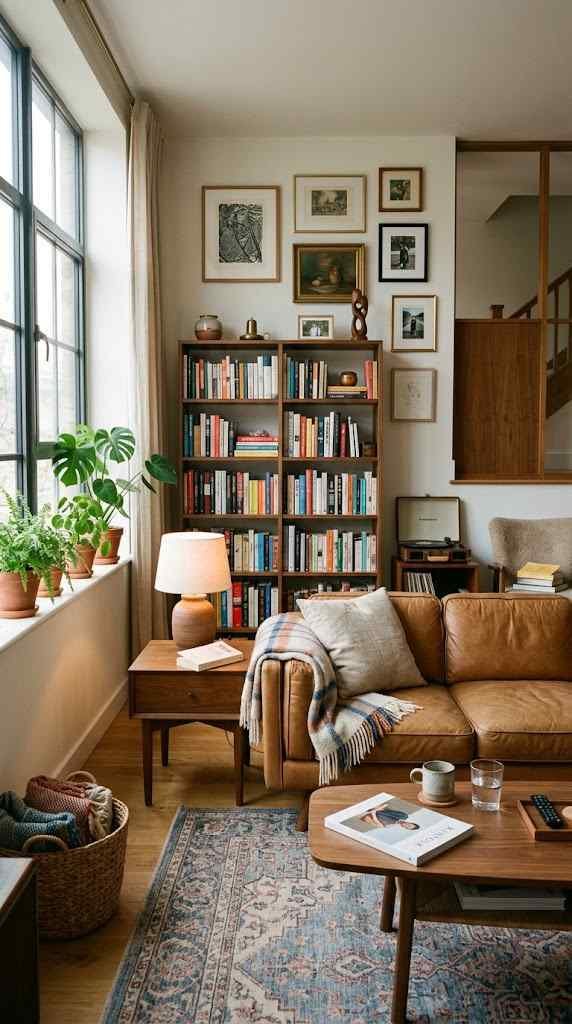
Here’s my hot take a living room that looks like it was professionally styled is a living room you can’t actually live in. The goal isn’t to recreate a catalog photo it’s to create a space that feels considered and intentional while still being yours.
This means white walls are fine. Eclectic art is fine. A bookshelf with your actual books (not just decorative objects) is not only fine, it’s better. The mistake isn’t including personal touches; it’s overwhelming the room with them.
Negative space matters more than you think. Leave some walls bare. Keep surfaces relatively clear. Let the good pieces breathe. You’re not running a furniture showroom; you’re creating a living room where people actually want to sit and stay awhile.
IMO, the best mid-century modern spaces have maybe 60% of the visual real estate “filled” and the rest calm, open, and quiet. This restraint is what separates “designed” from “over-designed.”
The showroom feeling happens when everything matches too perfectly or when pieces are arranged for visual symmetry rather than actual living. Real people don’t center every single object. Real people have a stack of books on the coffee table. Real people drape a blanket over the arm of the sofa because they get cold. Real people use their living room, and that use should show slightly.
The difference between “lived-in” and “messy” is intention a curated book collection on floating shelves reads differently than scattered magazines everywhere. A throw blanket casually placed says comfort three throw blankets layered says you haven’t cleaned in weeks. One large-scale artwork on a feature wall speaks design seven smaller prints scattered randomly speaks indecision. The magic is having enough stuff to make it feel like a home, but not so much that you can’t see the good bones of your mid-century pieces. Your credenza can hold your actual dinnerware, some family photos, and a few objects you genuinely love. Your bookshelves can have books (the actual content of which you read or reference), plants, and maybe one sculptural object that makes you happy. Nothing in your mid-century modern living room should be there exclusively because it looks good. That’s the real secret to pulling this off without it feeling like you’re performing design for an audience.
FAQ’s
Can I mix mid-century modern with other design styles in my living room?
Yes. Pair it with minimalism (both value restraint), industrial touches (expose metal and function), or Scandinavian elements (natural materials). Avoid maximalism and ornate styles.
What’s the most important element to get right when designing a mid-century modern living room?
Furniture silhouette. Tapered legs, clean lines, and proportional scale define the aesthetic more than color or accessories do.
How do I find authentic mid-century modern pieces without spending a fortune?
Hunt estate sales, local vintage shops, and Facebook Marketplace. Check structural integrity first. Reupholstering costs money but extends piece lifespan significantly.
What lighting mistakes do people make most often in mid-century modern living rooms?
Over-relying on overhead fixtures, choosing fixtures too small for spaces, and placing lamps where they create glare instead of ambiance.
Is it better to go all-in on mid-century modern or blend it with contemporary pieces?
All-in creates cohesion and impact. Blending works if contemporary pieces share mid-century’s design philosophy clean lines, honest materials, functional beauty.
CONCLUSION
A mid-century modern living room works because it’s built on principles, not trends. Clean lines, functional beauty, honest materials, and intentional restraint these aren’t going out of style because they’re rooted in logic.
Start with one or two statement pieces that genuinely excite you. Build around them methodically. Choose your color palette and stick to it. Let empty space be your ally. Then, most importantly, live in the room and let it evolve with you.
Your mid-century modern living room doesn’t need to look like anyone else’s. It just needs to look like someone actually thinks here, reads here, and gathers here. That’s the real magic of the style form follows function, and function is about actually living your life in a space designed with care.
Start this process by identifying one piece you absolutely love a sofa, a lamp, a credenza, whatever speaks to you. Everything else will follow from that anchor piece. Its color, materials, and design language will guide your remaining choices. Next, walk through your space at different times of day and notice the light. Morning light versus evening light will show you different moods and help you decide on accent colors and material finishes. Invest in at least one or two quality pieces rather than filling the room with cheaper approximations.
A single authentic mid-century chair will teach you more about the style than five IKEA knockoffs. Don’t rush to finish the room in one shopping trip let it evolve. The best mid-century modern spaces grow over time as their owners add pieces they actually want rather than pieces they thought they should have. Your mid-century modern living room is fundamentally about creating a framework for your actual life, not building a museum exhibit. Make it warm. Make it functional. Make it yours.